EverBen · Bulk PE temporary rainwear · OEM program
PE Disposable Raincoat and Emergency Poncho Program for Bulk Buyers
Specify disposable cape ponchos and sleeved raincoats around the real issue task, then lock film identity, opening behavior, packing and destination allocation before bulk release.
Built for event operators, tourism venues, preparedness-kit assemblers, promotional distributors and wholesale buyers — not retail single-unit shopping.
Carton allocation planned before the weather trigger
B2B decision system · temporary-use PE rainwear
Build a PE Disposable Rainwear Program Buyers Can Compare and Operators Can Issue
This page treats PE rainwear as a controlled temporary-use program, not a retail impulse item. It connects the garment, film, opening sequence, individual pack, carton map and release evidence to the buyer's operating job.
Start with the product-and-pack task.
Use the decision sections below to define what must be true before sample approval and what must be checked again before shipment.
Evidence boundary
No fixed MOQ, thickness, waterproof duration, certification, capacity or delivery promise is presented as universal. Exact values follow the buyer's specification and current evidence.
Define the Temporary Rainwear Job Before Asking for a PE Poncho Price
A purchasing brief should describe the real operating job before it names film thickness or asks for the cheapest unit. A tourism venue, stadium, emergency-kit assembler and promotional distributor may all buy PE rainwear, yet their issue speed, wearer range, exposure, pack and reorder risks are different.
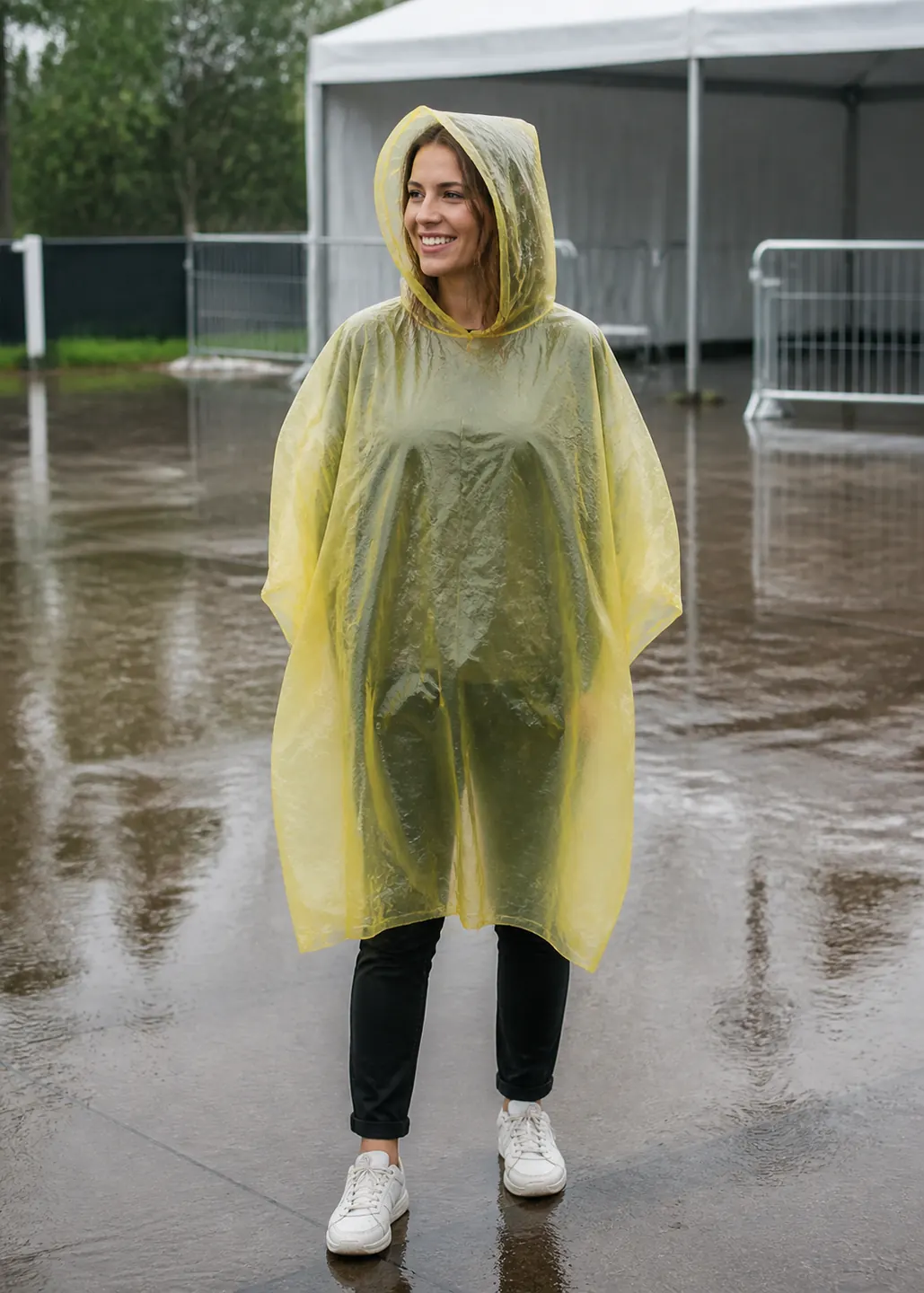
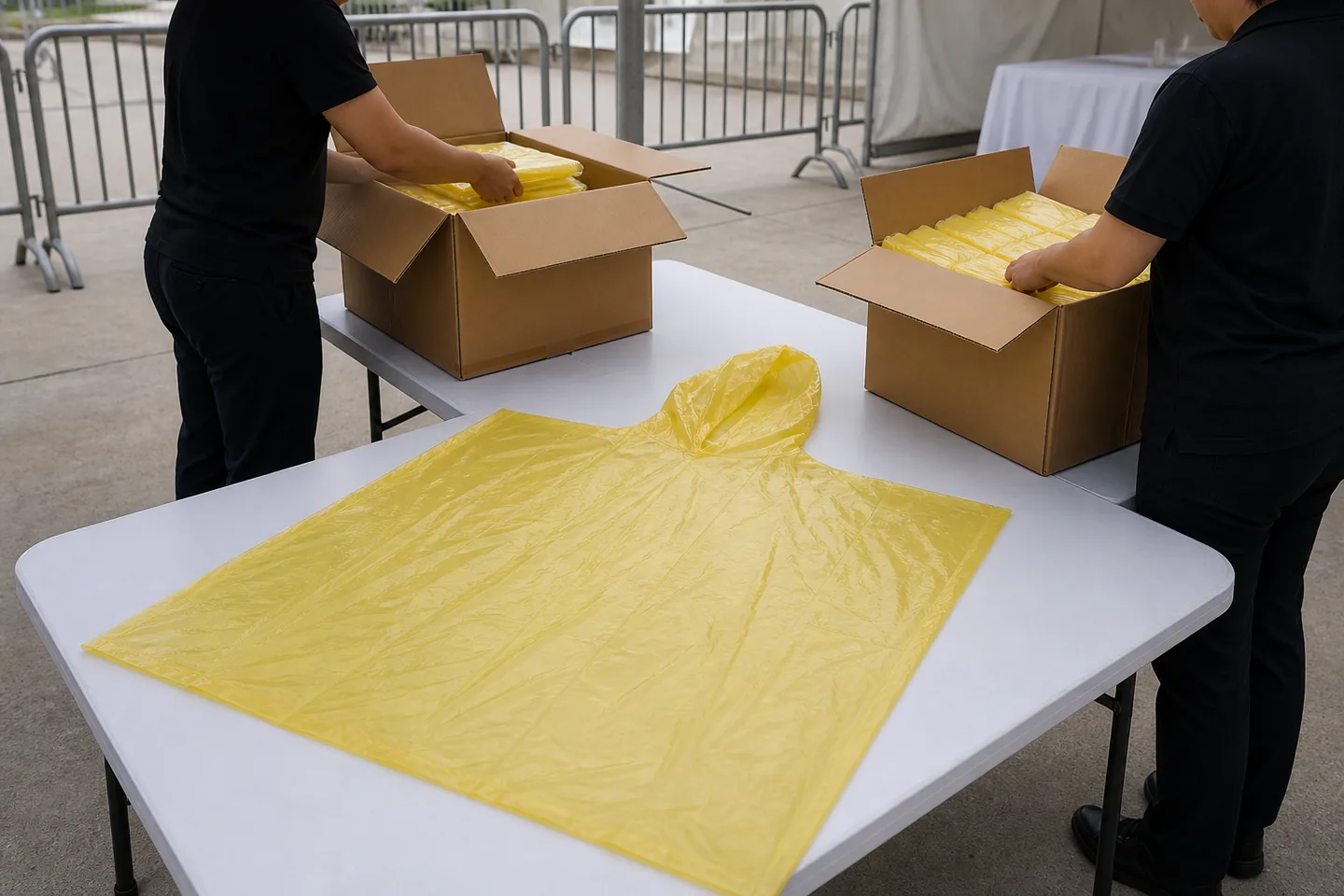
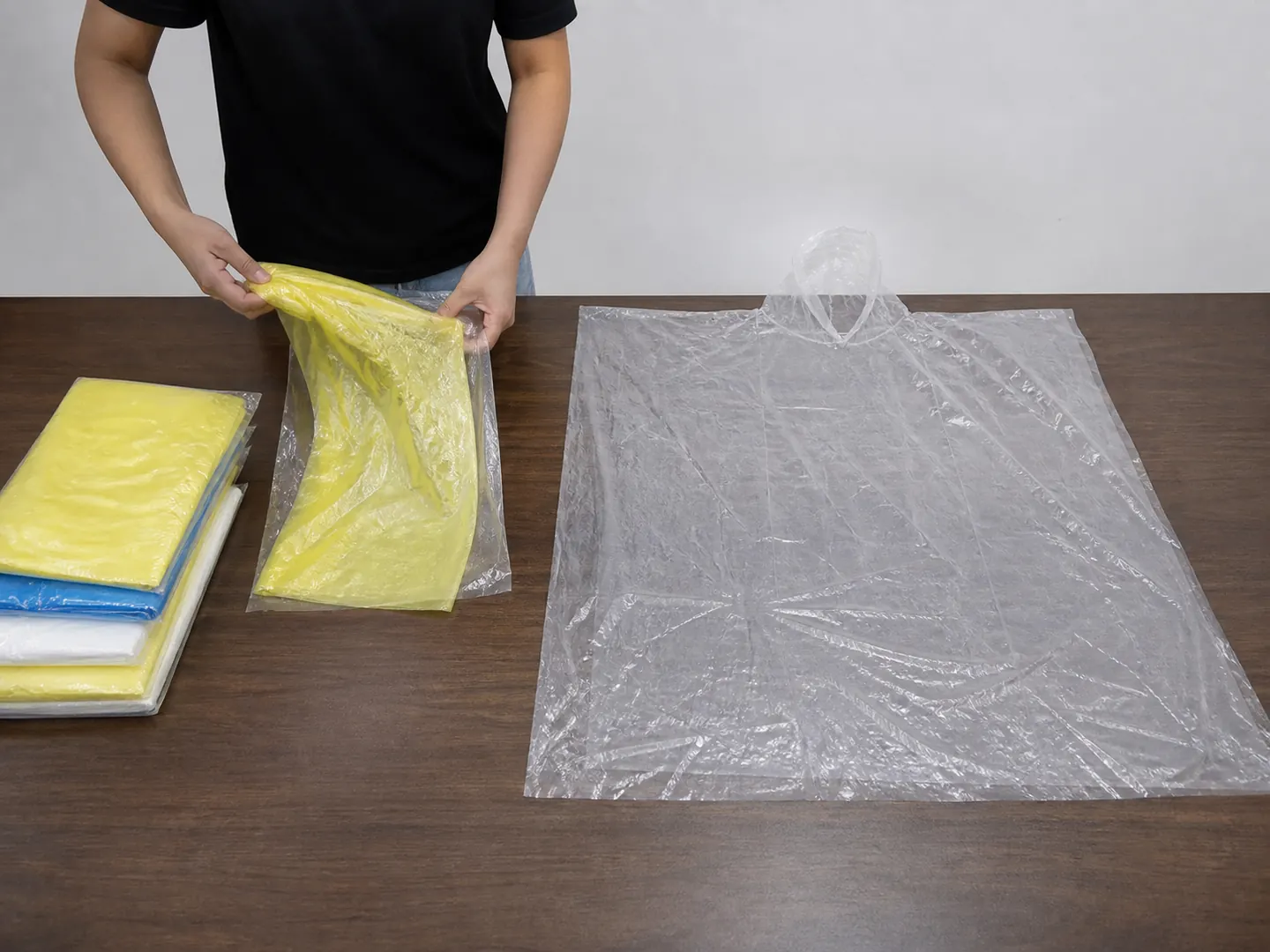
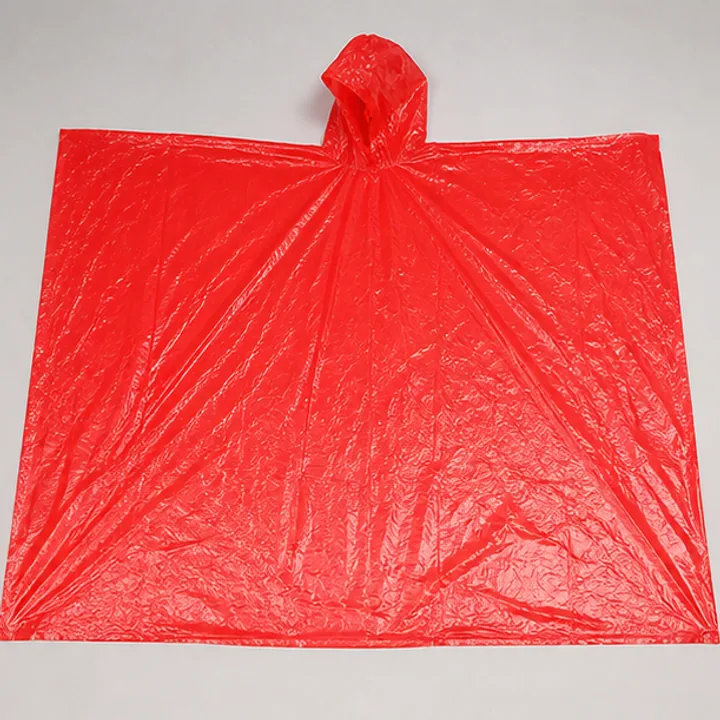
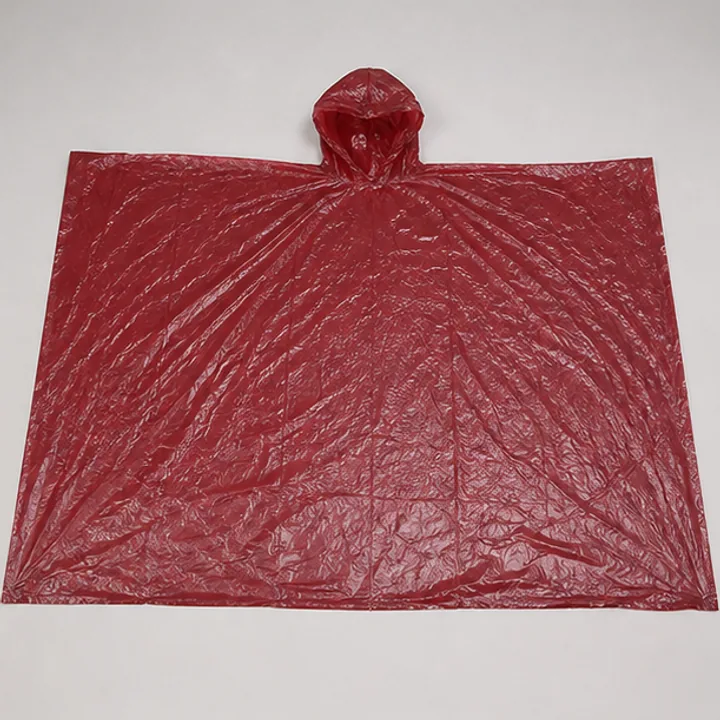
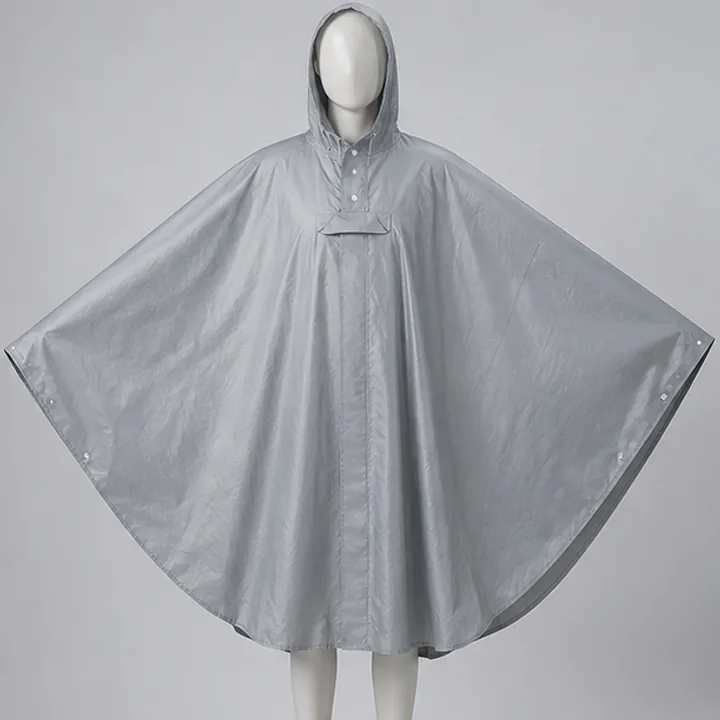
A temporary-use cape and its carton allocation should be reviewed together before venue distribution begins.
Separate venue handout, emergency-kit, promotion and wholesale routes
Issue route
A venue handout needs rapid opening, broad fit and cartons that can be split among entrances. An emergency kit may prioritize compact storage, clear instructions and periodic stock review. A promotional program adds artwork and proof control. A wholesaler may need color assortments, barcodes and repeatable replenishment. These routes should not share one vague specification simply because every item is described as disposable rainwear.
Write who stores the units, who opens them, how they are distributed and what happens to unopened stock. That statement determines which sample trials, pack fields and carton records deserve the buyer’s attention.
Describe duration, rain direction, movement and sheltered breaks
Exposure boundary
PE disposable ponchos are commonly selected for short, unexpected rain exposure. The brief should state whether users stand in a queue, walk between venues, sit in open seating or carry bags. Add realistic exposure periods and access to shelter. Thin temporary rainwear should not be positioned as reusable storm workwear without evidence for that different job.
The exposure boundary is a design input, not a universal waterproof promise. It tells the sample team which openings and movements to challenge and helps the buyer decide when a different rainwear family should be compared.
Name the person who controls issue, reserve stock and release decisions
Program owner
A bulk purchase can fail even when the garment is acceptable if nobody owns distribution. Identify who estimates attendance, holds the weather reserve, splits cartons, trains issue-point staff and records unopened balance. The product, individual pack and master carton should support that operating plan rather than create an extra sorting task on event day.
Assigning ownership also improves the RFQ. The supplier can quote the requested unit pack and carton map while the buyer retains control of forecast, reserve and destination allocation.
Buyer comparison · Product architecture
Choose the Temporary Rainwear Object before Quotation
PE temporary-rainwear decision matrix
Coverage object
Use-duration boundary
Joining and opening focus
Buyer inputs
Evidence gate
Emergency poncho
Short issue event defined by the buyer
Head opening, hood join, side openness and packed orientation
Audience, clothing layers, issue point and reserve plan
Complete packed-opening and donning observation
Sleeved raincoat
Temporary task with arm coverage and front-access needs
Sleeve roots, cuffs, front overlap and closures
Wearer range, movement, access and garment dimensions
Finished-garment movement and opening review
Rain cape
Broad temporary coverage with a defined movement route
Neck/hood transition, side depth and optional fasteners
Coverage, carrying task and exposure boundary
Representative wearer and coverage trial
Apron
Front-coverage task separate from full rainwear
Neck/waist ties, front dimensions and edge integrity
Task, contact area, wearer range and disposal route
Complete article fit and attachment inspection
Decision 02 · Product architecture
Choose a Cape Poncho or Sleeved Disposable Raincoat from the Donning Task
Cape ponchos and sleeved raincoats create different coverage, movement, pack volume and inspection points. The correct route follows the buyer’s distribution and wearer task, not a generic catalogue photograph.
A sleeved raincoat adds arm control and front access, but it also adds more joints, closure patches and size decisions than a simple cape.
Use a broad cape when rapid issue and simple size management lead
Cape route
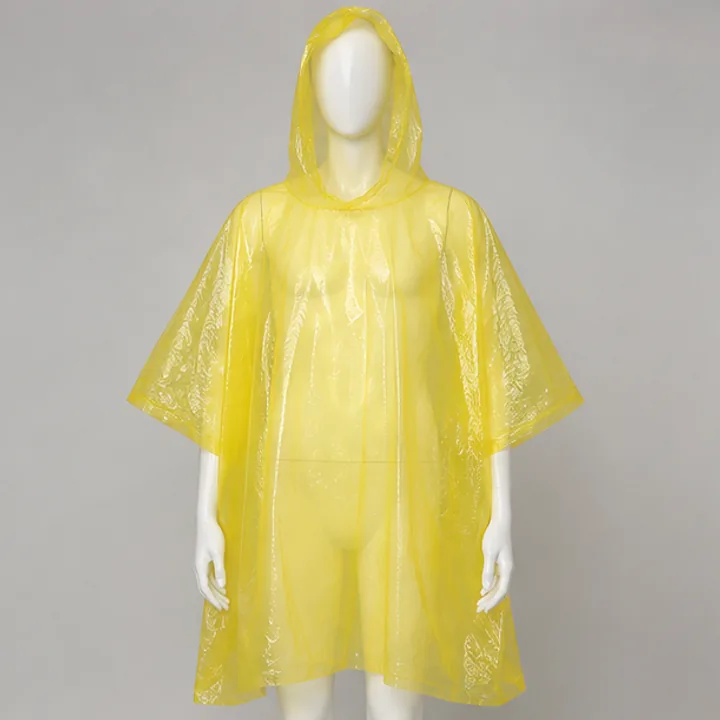
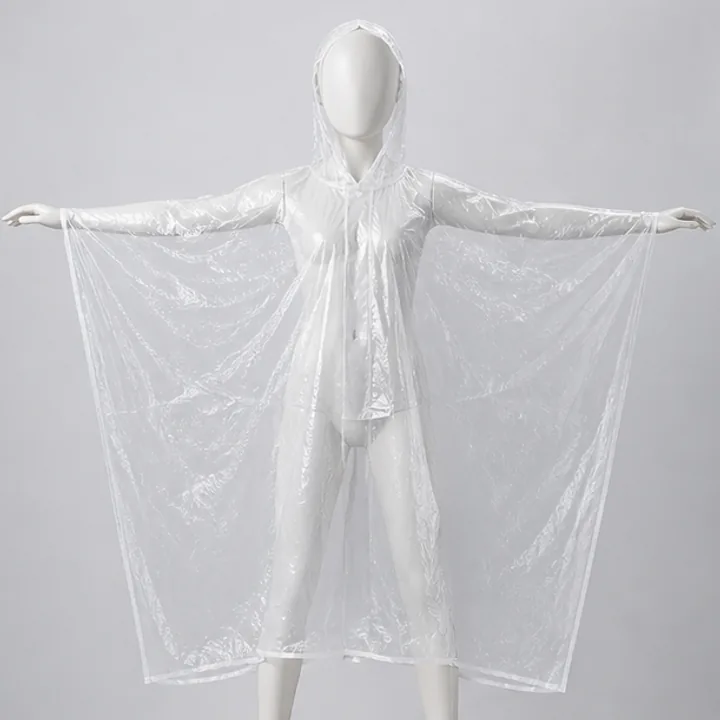
A cape can cover upper-body layers and may be quick to place over normal clothing. Define overall width and length, hood connection, head opening, side openness and any side fastener. Review whether users can reach tickets, phones or handrails without pulling the film or exposing the torso through an oversized side opening.
Broad fit does not mean universal fit. The approved sample should include short and tall wearers, common clothing layers and the actual movements expected at the issue location.
Use sleeves and a front opening when controlled arm movement matters
Sleeved route
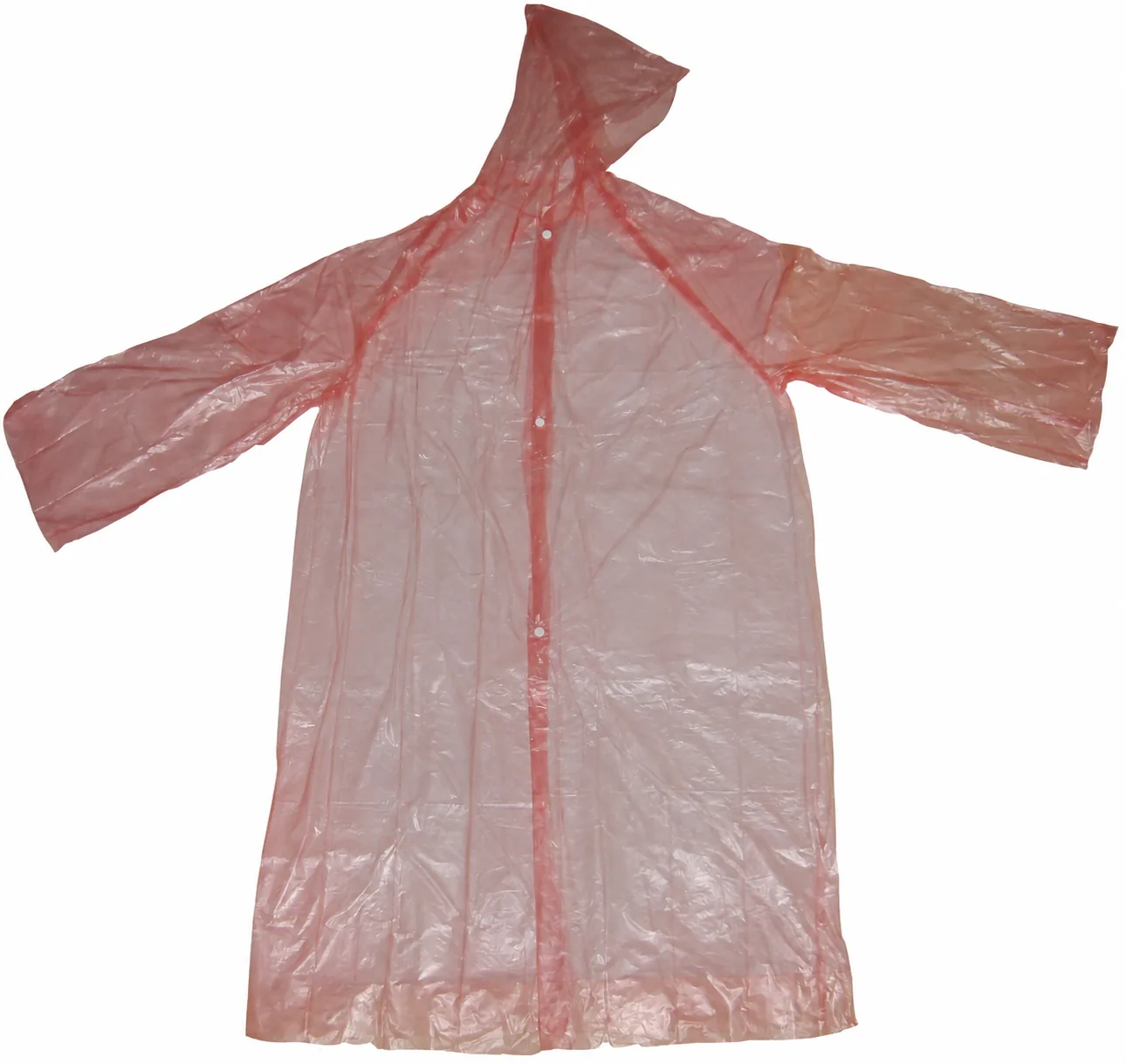
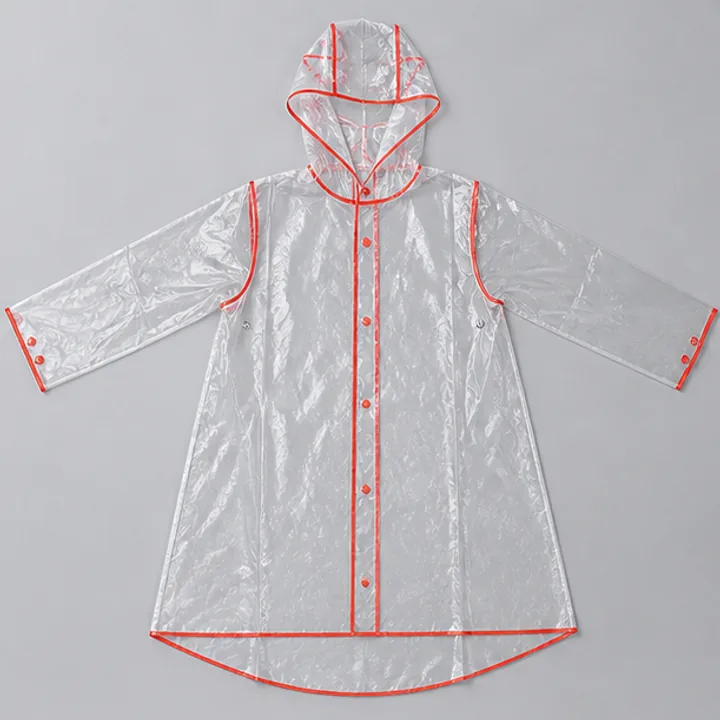
A sleeved disposable raincoat can give more predictable arm coverage and easier front access. It also introduces sleeve-root joints, cuff openings, a front overlap and closure reinforcement. Specify whether the garment is pullover, open-front or snap-front and identify every closure location on a dated drawing or approved sample.
Do not describe a sleeved coat as automatically stronger. Film, joint construction, geometry and user handling still determine whether the finished product is suitable for the project.
Approve both product shape and packed opening sequence
Architecture comparison
Compare coverage while worn and the steps needed to find the hood, front and arm openings after the product has been folded. A design that looks clear when laid flat can confuse users when thin film clings together. The pack fold should therefore be reviewed with the garment architecture rather than after the sample has already been approved.
Record the selected route and why. That decision protects later quotations from quietly switching between a cheap cape, a sleeved pullover and a snap-front coat.
Decision 03 · PE film identity
Write the PE Film Specification So Every Supplier Quotes the Same Object
PE is a material family, not a finished-product specification. The quote should identify the film or controlled supplier code, nominal dimension, tolerance, color, surface and the specimen that each value describes.
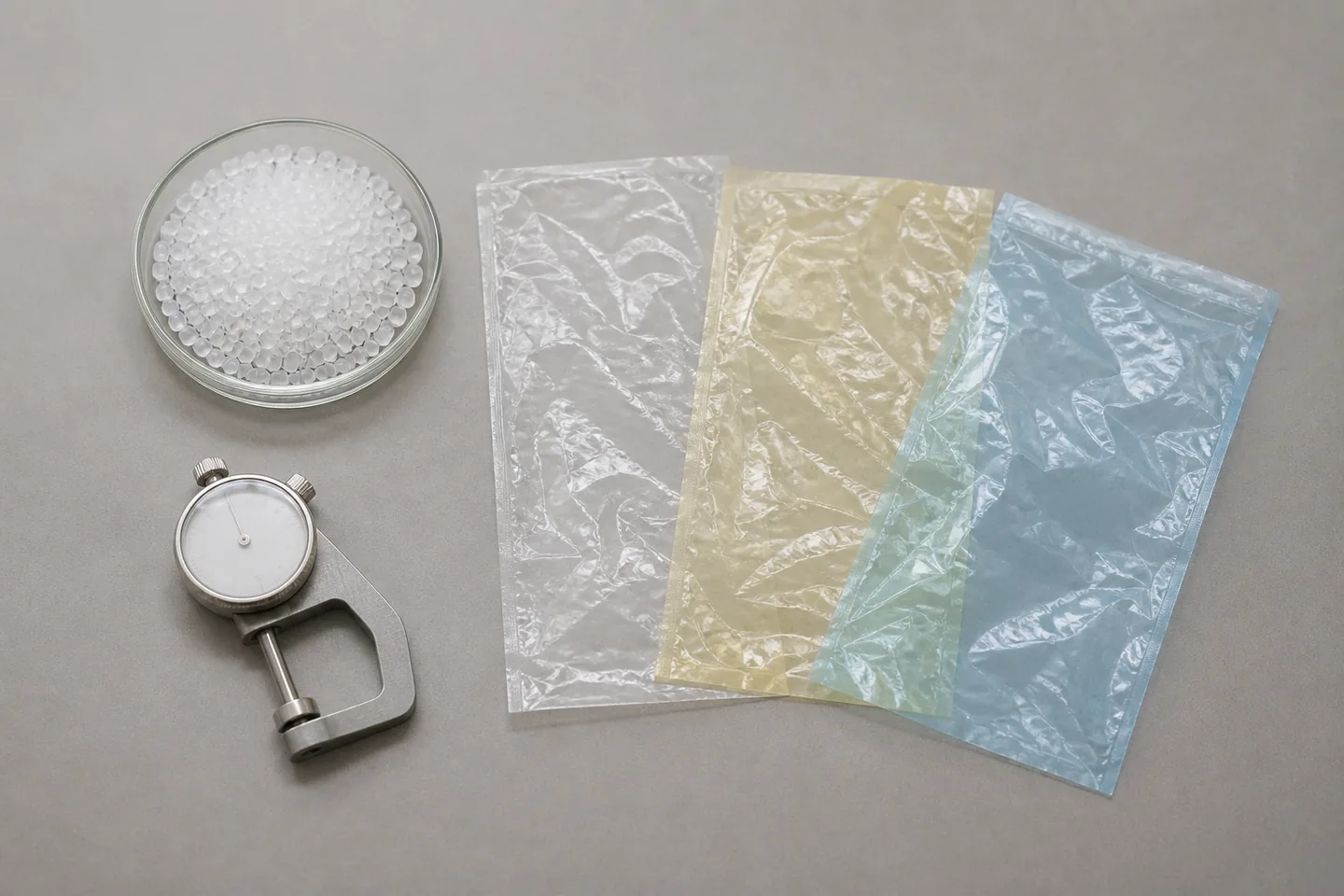
Film pellets, translucent color specimens and the thickness gauge organize material identity, shade and dimension checks for sample approval.
Separate loose-film dimensions from garment and packed-unit mass
Film versus finished unit
A thickness value describes film only when the specimen and method are stated. Finished garment weight includes pattern area, hood, closures and reinforcement. Packed-unit mass adds the individual bag or insert. Comparing these numbers as if they were interchangeable can produce a lower quote that is actually a different product.
For every numeric field, name the object, unit, nominal target, tolerance and sample locations. Keep the approved film reference connected to the finished product and pack revision.
Approve clear, translucent and solid colors against a known backing
Color and translucency
Thin PE color changes with film dimension, surface, clothing underneath and lighting. Define whether the buyer wants clear, translucent or opaque appearance and what visual variation matters. Use a physical reference under agreed viewing conditions instead of relying only on a screen color or Pantone number.
If visibility of clothing, modesty or brand color matters, record that requirement separately. Do not imply that a digital color proof guarantees the appearance of thin finished film.
Connect the sample to source, code, revision and substitution rule
Material change control
The controlled project file should contain enough identity to detect a source, formulation, colorant or process change. A visually similar film can open, fold, weld or print differently. State whether a proposed substitute requires a new film comparison, construction coupon, packed-opening trial or complete sample.
Confidential formulation details need not appear on the public page. Purchasing still needs a traceable material code and written change rule for repeat orders.
Decision 04 · Hood and opening geometry
Challenge the Hood, Neck, Side and Cuff Openings Where Temporary Rainwear Usually Fails
The center of a PE panel may be continuous while the wearer still experiences problems at an opening. The sample review should trace rain and user force through the hood, neck, sides, cuffs and front access points.
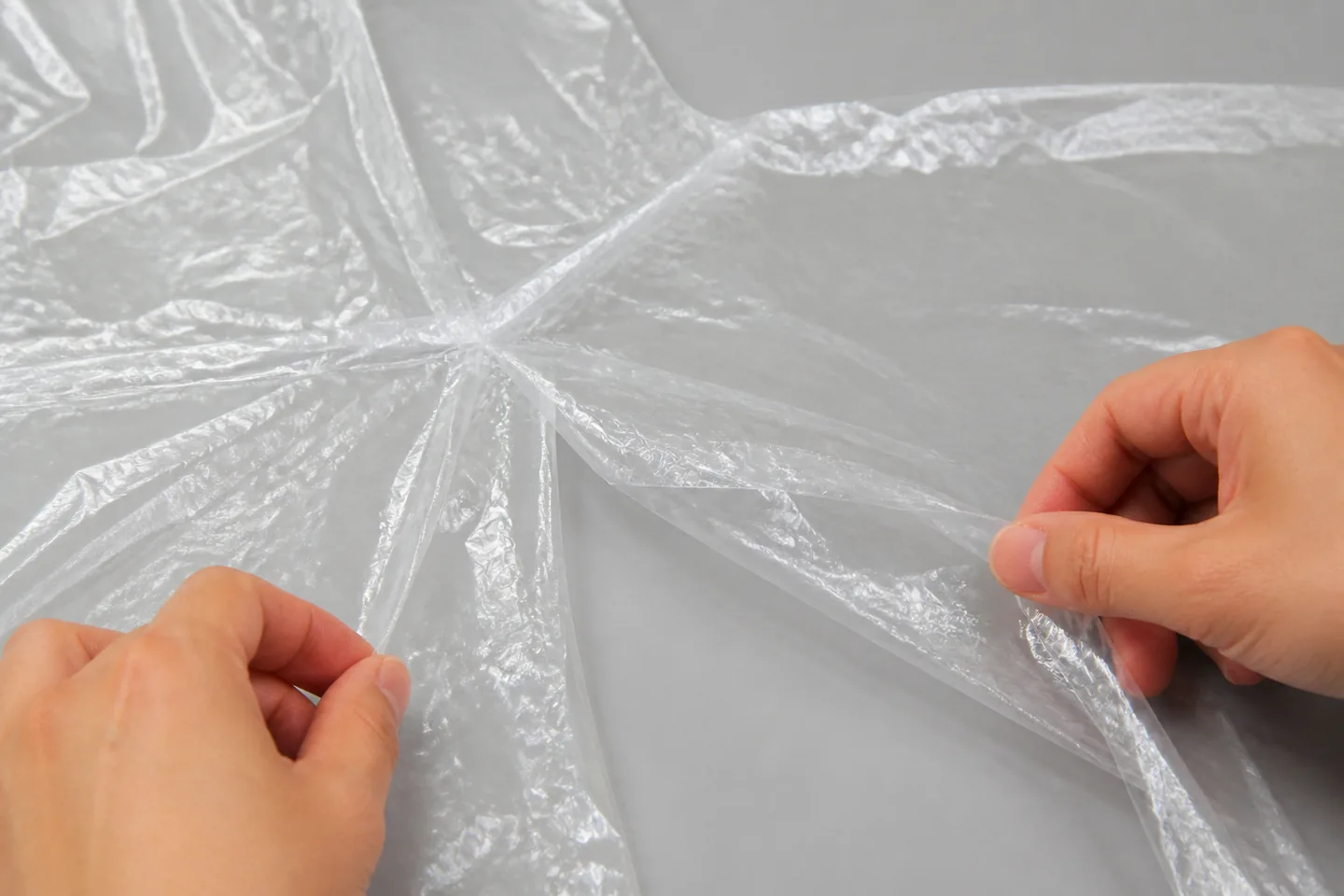
The opened PE construction shows layer separation, access geometry and welded-edge continuity for buyer inspection.
Balance face access, head movement and runoff without unsupported claims
Hood and neck
Define hood attachment, crown volume, face opening and neck transition. Check ordinary caps, hair and head turning if they belong to the target group. A very open face can expose the neckline; a tight opening can be difficult to find or position when the film is wet or clinging.
Any cord, elastic or small part creates a different product route and may trigger market-specific review. Do not add those components by assumption.
Control exposure and hand access at the architecture’s main opening
Cape sides or sleeve cuffs
For a cape, record open-side depth and any side snap. For a sleeved coat, define cuff opening and sleeve length. Observe reaching, carrying a bag and using a phone or ticket. The acceptance note should explain which movement and exposure the approved opening is intended to support.
A static flat measurement cannot show how the opening changes when the wearer moves. Include a simple movement trial with normal clothing layers.
Freeze the pullover, open-front or snap-front route
Front access and overlap
If a front opening is used, identify overlap direction, width, closure spacing, reinforcement and termination. Thin film can concentrate force around a snap patch even when the snap itself functions. A pullover route removes that closure but may make rapid orientation and donning harder.
Approve the complete interface on the finished sample. A straight joint or loose component does not prove the geometry around a hood root or closure end.
Decision 05 · Packed opening trial
Test the Individual Pack by Opening and Donning It Under Real Issue Conditions
A loose sample that has rested on a table cannot prove that a compressed unit will open quickly. Thin PE layers can cling, fold orientation can hide the hood and rushed users may pull at the wrong edge.
The useful test begins with the final fold and individual pack, then records how a user finds and opens the product.
Make the first visible opening and garment direction easy to recognize
Pack orientation
Define how the product is folded, which edge faces the bag opening and how the user finds the hood or front. If instructions are needed, approve their language and placement with the pack artwork. Avoid creating a tiny pack that saves cube but requires forceful unfolding or causes repeated orientation mistakes.
The approved fold pattern should carry a revision. A packing change after sample approval can alter both opening behavior and print contact.
Observe the process without turning one trial into a universal claim
Timed issue rehearsal
Select representative users and ask them to take one unit from the final pack, open it, identify orientation and put it on. Record where they hesitate, pull hard, damage an edge or require assistance. The goal is to find problems, not to publish an unsupported speed guarantee.
Repeat after a realistic packed-storage challenge when that risk matters. The trial conditions and sample identity belong in the project record.
Separate pack, fold, film and garment causes
Failure classification
An opening failure can come from the bag seal, excessive compression, film blocking, an unclear fold, a narrow head opening or a weak edge. Record the observed cause before changing the product. Otherwise a larger bag may hide a garment problem or a heavier film may be purchased when the fold sequence was the real issue.
Use the classification to assign corrective action, then name the affected checks that must run again before approval.
Decision 06 · Branding and proof control
Place Artwork Where Thin PE Film, Body Movement and Folding Will Not Defeat It
Custom printing can turn an emergency item into a branded handout, but thin film flexes, shows the garment underneath and may remain in contact with itself inside the pack. Artwork approval should cover the real film, print route, garment zone and fold.
Decide whether branding belongs on the garment, pack or insert
Print objective
A high-traffic event may value visible garment branding, while an emergency kit may need clearer unit identification on the pouch. A retail route may use an insert or label. Choose the communication job first, then compare the available print surface, cost, proof method and risk of distortion or transfer.
Do not copy old customer artwork from local photographs. Every new program must use buyer-authorized files and a documented approval.
Connect vector file, color, size, position and revision
Artwork proof
The controlled proof should identify the buyer file, color references, printed dimensions, position from garment edges and approved revision. A screen mockup can establish layout, but it does not prove ink appearance on translucent film or the effect of wrinkles and clothing underneath.
Approve a physical print trial on the intended film and color when the artwork decision is important. Keep the accepted sample with the production artwork record.
Check print zones after the final pack has been compressed and opened
Fold and contact review
Map fold lines across the artwork and observe contact between printed and unprinted surfaces after realistic packing. Look for transfer, blocking, cracking, distortion or loss of legibility according to the project’s agreed observation. Adjust location, fold or process only after identifying the interaction.
One packed sample supports a bounded decision; it does not create a permanent colorfastness or storage guarantee.
Decision 07 · Unit and carton pack
Design the Individual Pack, Inner Group and Master Carton as One Distribution System
Packaging is not only a freight calculation. It controls opening, sorting, storage, venue allocation and the evidence available when cartons arrive.
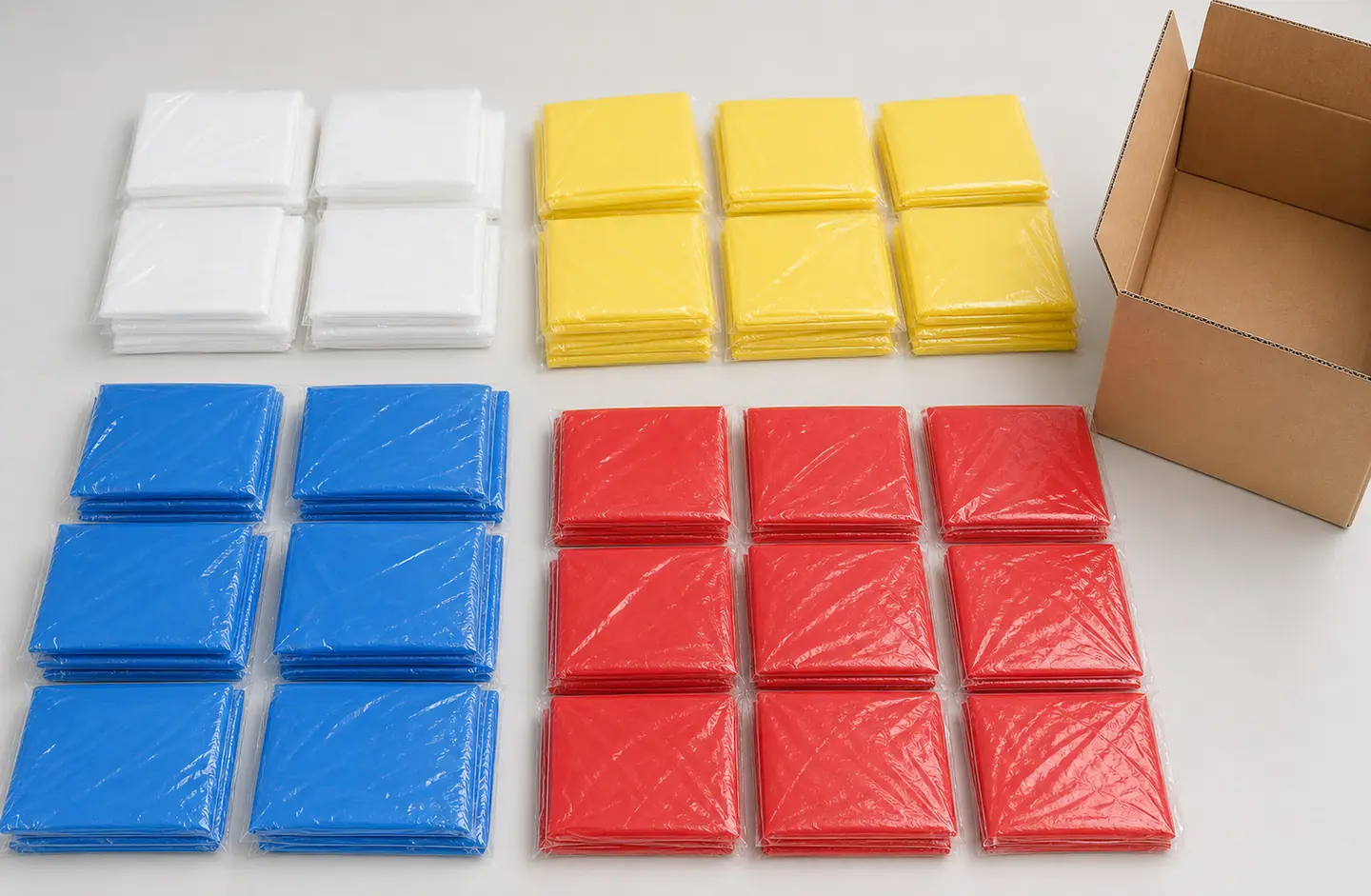
Color grouping and a plain master carton illustrate pack architecture only; final unit count and carton dimensions must be quoted for the approved SKU.
Freeze bag material, seal, fold, insert and identification fields
Individual unit
Specify bag or pouch type, dimensions, opening, seal, artwork, instructions, barcode or lot fields as required. The bag must protect and identify the unit without making it unnecessarily hard to open. When no custom print is needed, a controlled plain pack can reduce artwork and transfer risks.
Test the completed unit, not an empty bag. Product thickness, fold and trapped air influence the actual pack.
Use inner groups only when they improve counting or allocation
Inner grouping
An inner bag or small carton may help distributors and venues count units, separate colors or feed issue points. It also adds material, labor and cube. Define the operational reason, contained quantity, label and opening route instead of copying a historical packing format.
If the buyer does not need inner groups, compare a simpler controlled master-carton arrangement.
Control count, assortment, pressure, marks and destination split
Master carton
State units per carton, any color assortment, carton dimensions, gross-weight limit, shipping marks, lot identity and destination code. Review whether compression or heat can make folded film harder to separate. A carton map should tell receiving teams where each group goes without opening every box.
Final carton data follows the approved product and pack. Never publish an old carton quantity as a universal default.
Decision 08 · Quality evidence
Release Bulk PE Rainwear with Lot Identity, Risk-Based Checks and Retained Samples
A usable control plan follows the failure modes created by the approved product. It checks identity, dimensions, construction, pack and count without pretending every unit has been laboratory tested.
Verify the material lot against the controlled reference
Incoming film
Check supplier code, color, surface, nominal dimension and agreed appearance fields on a defined sample. Record the lot connection to production. If source or formulation changes, apply the written change rule before the material is released to cutting or conversion.
A supplier certificate and an incoming comparison answer different questions. Keep both within their stated scope.
Focus on edges, welded zones, openings and closure patches
In-process construction
Inspect first output and risk locations during production. For capes, review hood attachment, side geometry and open edges. For sleeved raincoats, add sleeve roots, cuffs, front overlap and snap reinforcement. Record defect examples and corrective action instead of relying on a generic workmanship sentence.
The sampling plan should reflect product risk and buyer agreement. Do not claim that checking one location proves every unit.
Confirm garment, fold, bag, assortment and carton marks together
Final pack and count
Final inspection should connect the approved garment to the approved pack revision. Check count, color mix, individual opening, printed or label content, carton marks and destination split. Retain a shipment sample and relevant records so complaints or repeat orders can be investigated against the released lot.
Close nonconformities before shipment release and record any accepted deviation in writing.
Decision 09 · Demand and destination allocation
Convert Attendance, Reserve and Issue Points into a Carton Allocation Plan
Event and preparedness buyers often focus on total quantity, yet operational failure happens at individual gates, vehicles, hotels or kit lines. The purchase plan should connect demand assumptions to destinations and reserve ownership.
Record the population, weather trigger and issue policy
Demand basis
Start with expected users, attendance uncertainty, staff allocation and whether every person receives a poncho or units are issued only after a weather trigger. Separate confirmed program demand from a management reserve. Do not present one reserve percentage as correct for every event.
Document who may release the reserve and when. That control prevents early over-issue at one location from emptying stock intended for another.
Assign cartons or inner groups before shipment or receiving
Destination map
List venue gates, warehouses, vehicles, branches or kit assembly lines and the quantity intended for each. Decide whether the supplier packs by destination, the importer reallocates after receiving or the venue sorts locally. The selected route affects labels, carton count and handling time.
Use simple destination codes approved by the buyer; avoid customer-sensitive information in public photographs or reusable templates.
Record received, issued, damaged and unopened balance
Reconciliation
A short reconciliation identifies forecasting error, opening damage, distribution bottlenecks and reusable unopened stock. It also improves the next RFQ. Keep damaged or opened items separate from unopened inventory and follow the buyer’s hygiene, disposal and local waste requirements.
Do not make universal recyclability claims. Local collection, contamination and material acceptance differ by destination.
Decision 10 · Storage and delivery
Plan Storage, Transit and Receiving around Thin Film and a Weather Deadline
Compact PE rainwear can reduce unit volume, but temperature, pressure, sharp contact and deadline risk still need control. The logistics brief should connect the product pack to the actual route and receiving schedule.
Protect packed units from heat, pressure, moisture and sharp objects
Storage conditions
Define warehouse duration, stacking, seasonal temperature and separation from hardware or contaminants. Review whether prolonged compression makes the garment hard to unfold or creates visible transfer. Storage guidance should match the approved film, print and pack rather than repeat a generic plastic statement.
Where long storage is expected, schedule periodic opening checks on retained stock instead of assuming indefinite readiness.
Work backward from receiving, distribution and event dates
Delivery milestone
The required date is not only the event start. Buyers may need customs clearance, receiving inspection, branch distribution and staff rehearsal beforehand. Write each milestone, destination and responsible party. Production and transit dates become commitments only after specification, artwork and packing are approved.
Do not publish a fixed lead time that ignores quantity, season, print, pack and route.
Inspect count, carton condition, identity and sample opening on arrival
Receiving gate
Receiving teams should compare carton marks and counts to the allocation plan, inspect damage, identify the production lot and open representative units. Record exceptions while evidence is available. Waiting until the weather trigger may leave no time to replace mislabeled or difficult-to-open stock.
The receiving record closes the supplier handoff and starts the buyer’s storage responsibility.
Decision 11 · Claims and market boundaries
Keep Waterproof, Sustainability and Safety Claims inside Verifiable Evidence
Temporary PE rainwear pages often overstate waterproof duration, environmental benefits or certifications. A responsible program separates basic product description from claims that require an exact construction, destination and current evidence.
Describe the intended temporary task without promising unlimited exposure
Rain protection wording
A continuous PE film can be selected for temporary rain coverage, while the finished product still contains a face opening, sides, cuffs or front access. Public and packaging language should reflect the approved architecture and test scope. Avoid implying that disposable rainwear replaces specialized workwear or PPE.
If a buyer needs a named performance claim, agree the specimen, method, laboratory and acceptance before production.
Avoid biodegradable, recyclable or eco-friendly claims without a complete route
Environmental wording
Material identity alone does not prove that a finished printed and packed product will be collected or recycled in a destination. Biodegradable or compostable claims require exact material and current supporting evidence. Keep PE and claimed degradable alternatives as separate controlled programs.
The buying guide can encourage demand planning and reduced over-ordering without making unsupported end-of-life promises.
Match documents to product, facility, market and validity period
Certification scope
A factory audit, material declaration and finished-product test answer different questions. Request current documents that identify the relevant facility, SKU or material, test method, market and date. Do not transfer a certificate from another color, formulation, product or supplier into the present program.
If evidence is pending, mark the requirement open and do not publish the claim as fact.
Decision 12 · Comparable RFQ
Send a PE Disposable Rainwear RFQ That Produces Comparable Quotes and a Controlled Sample
The final request should connect commercial quantities to the same product, pack, evidence and destination assumptions. A short but controlled RFQ saves more time than a long chain of disconnected questions.
State use, architecture, film, dimensions, color and openings
Product block
Name cape or sleeved route, target wearer, garment dimensions, hood and opening construction, film identity or approved reference, nominal dimension/tolerance, color and any closure. Add the sample tasks that matter, such as packed opening, donning and movement.
If any field remains open, identify it as a decision request instead of allowing each supplier to assume a different answer.
Attach authorized artwork and describe every packaging level
Brand and pack block
Provide the buyer-controlled artwork file, colors, size, position and proof requirement. State individual pack, instructions, labels, inner grouping, master-carton assortment, marks and destination codes. Include opening and fold approval in the sample route.
Use only buyer-authorized artwork for the new program. Keep historical customer designs outside the new approval file and never treat them as reusable buyer artwork.
Add quantity, destination, milestones, Incoterm and release records
Commercial and evidence block
State total and destination quantities, reserve assumption, sample requirement, compliance list, receiving deadline, shipping destination and requested Incoterm. Ask the supplier to list exclusions, quotation validity and change triggers. Define which sample, inspection and shipment records accompany the order.
A complete RFQ allows purchasing to compare like with like and allows production to follow the approved revision.
Buyer FAQ
Frequently Asked Questions about Bulk PE Disposable Rainwear
What is the difference between a PE disposable poncho and a sleeved disposable raincoat?
A cape poncho uses a broad, open-sided body that can simplify issue and fit. A sleeved raincoat provides separate arm coverage and often a front opening, but it adds sleeve joints, cuffs, closures and more sizing decisions. Choose from the wearer and distribution task, then approve the packed sample.
Which PE film thickness should a bulk buyer specify?
There is no responsible universal value. State the physical film specimen, unit, nominal target, tolerance and measurement method, then evaluate the finished garment and packed-opening task. Thickness must not be confused with finished garment weight or packed-unit weight.
Can EverBen print a logo on the poncho or individual pack?
Customization can be reviewed for the garment, pouch, label or insert. Use buyer-authorized artwork and approve color, size, position and print behavior on the intended film and fold. Feasibility, MOQ and price are confirmed after the complete specification is reviewed.
How should buyers test a disposable poncho sample?
Start with the final individual pack. Ask representative users to open, orient and don the product over normal clothing, then check hood, side or cuff openings, reach, film damage and repacking assumptions. Record the sample identity, conditions, observations and disposition.
What information is needed for an accurate bulk quotation?
Send use case, architecture, wearer range, film requirement or reference, dimensions, color, openings, artwork, individual pack, carton plan, quantity, destinations, required evidence, Incoterm and receiving date. Open decisions should be clearly identified.
What is the MOQ and delivery time?
MOQ and timing depend on the approved film, color, construction, print, packing, quantity, season and shipping route. EverBen confirms them after technical review rather than publishing a fixed promise that may not match the order.
Can PE disposable rainwear be called recyclable or biodegradable?
Do not use either claim without exact material and destination evidence. Collection, contamination and local acceptance affect recycling. Biodegradable or compostable programs require separate material identity and current supporting documents.
How is bulk quality controlled before shipment?
A project control plan can connect incoming film identity, first output, risk-based construction checks, final garment and packed-opening checks, carton count, assortment, marks and retained samples. The sampling scope and acceptance criteria must be agreed for the order.
Compare Adjacent Rainwear Routes before Freezing the PE Specification
These links are decision alternatives, not automatic substitutes. Open the route that matches the buyer's color, pack, service-life or movement question, then keep its evidence separate from the approved PE disposable program.