

PRODUCT LANDING · DECLARED FINISHED SYSTEM
EVA and PEVA Shower Curtain Manufacturer for Controlled Wholesale Programs
Turn an EVA or PEVA label into a buyer-owned finished-curtain specification before comparing samples, claims or price.
Scope: This page and its quotation route cover EVA and PEVA shower curtains. A shower cap is a separate purchase object; its intended use, material, size, structure, quantity and regulatory intent require an independent feasibility review.
For homeware importers, hospitality replacement programs and private-label buyers, repeatability depends on the declared film, complete hanging geometry, finish, hardware interface, pack condition and evidence file being approved together. A quotation should expose every supplier assumption and keep proposed alternatives visibly separate from the buyer's released baseline.
RFQ checkpoint 01
Define the finished article and commercial channel
A liner, decorative curtain, coordinated set and hospitality replacement unit can use similar film while creating different acceptance work.


01
Liner or presentation curtain
State whether the item hangs on the wet side as a liner, serves as the visible outer curtain, or ships as part of a set. This choice controls face appearance, lower-edge behavior, pack story and which surface the buyer will judge.
02
Retail or project unit
Describe the sale unit separately from the master carton. Retail may require artwork, barcode placement, inserts and shelf presentation; a hospitality replacement item may prioritize coded bulk packs, fast identification and stable repeat dimensions.
03
Installation context
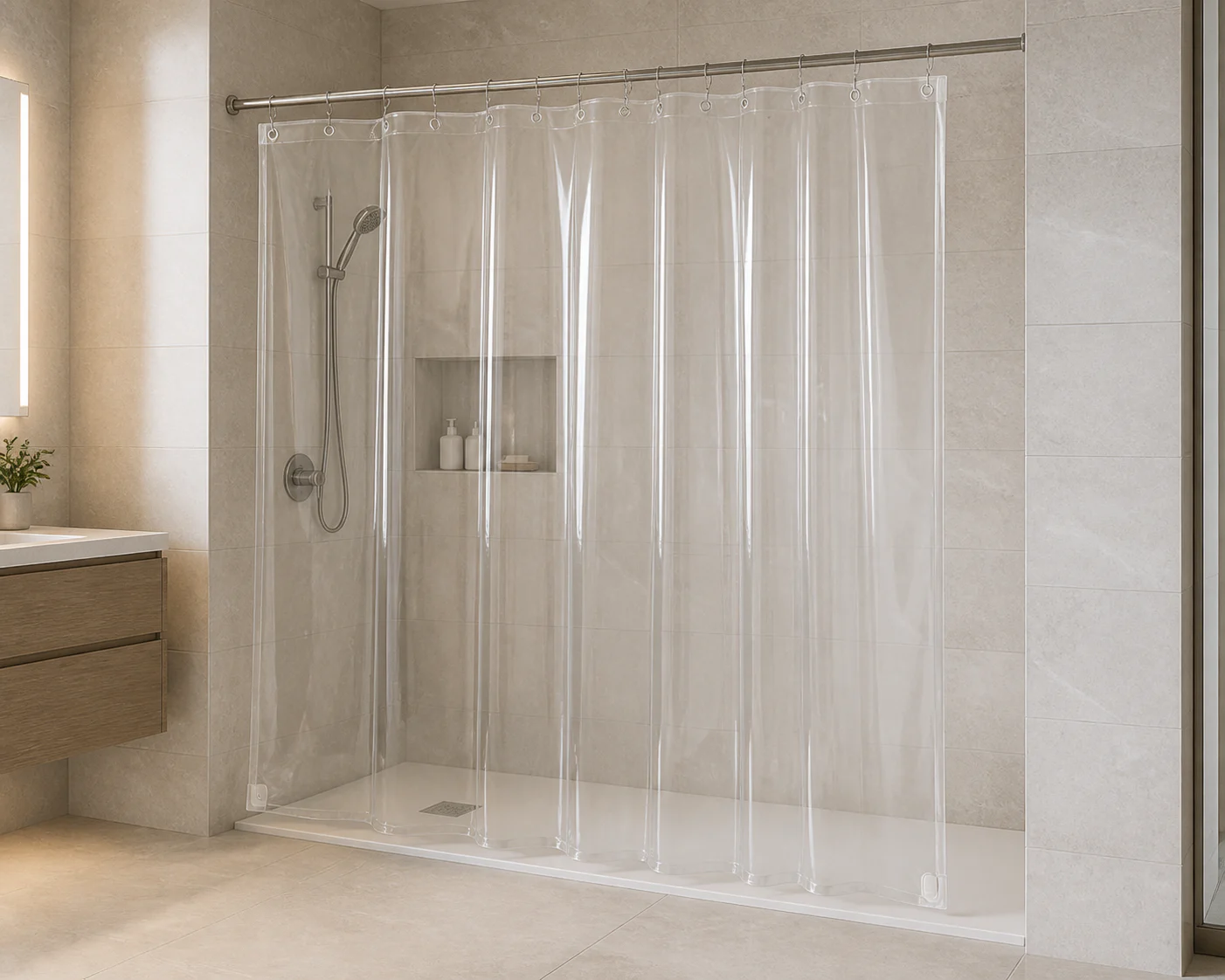
Record rod span, intended finished drop, tub or tray relationship and the proposed hooks or rings. The acceptance object is a complete hanging system, so a flat film swatch cannot close installation geometry.
04
Destination and intended wording
List the market and every material, care or performance phrase planned for the product page, label and package. Assign ownership for the evidence behind each phrase instead of borrowing generic language from another SKU.
RFQ checkpoint 02
Replace EVA and PEVA shorthand with a declared material route
Commercial labels are used inconsistently. The released file should identify what the supplier declares for the exact represented film and finished curtain.
| Entity | Attribute | Status | Acceptance record |
|---|---|---|---|
| Declared film | Supplier wording, source, color, gauge or mass method | Required / offered / open | Coded swatch plus applicable declaration |
| Finished curtain | Width, drop, edges and lower-edge construction | Buyer drawing and accepted tolerance | Measured complete sample |
| Top interface | Header, top-only openings, spacing, eyelets and hooks | Hardware specific | Drawing and full hang trial |
| Appearance | Opacity, color, emboss, print revision and face | Channel specific | Physical reference and complete curtain |
| Pack | Fold, unit pack, labels, count and carton | Destination specific | Sealed unit and released carton file |
01
Declaration source
Ask who issues the material declaration and which film code, color, thickness and production source it represents. Attach that record to a coded swatch and complete sample; do not let a declaration for another variant travel silently with the order.
02
EVA/PEVA terminology
Record the supplier's actual terminology without presenting one label as universally superior. If buyer packaging needs a particular composition phrase, state it as a claim to be supported, reviewed and approved for the destination.
03
Additives and recycled content
Treat colorants, functional additives and recycled-content statements as separate requested fields. Require SKU-specific support where they matter. Silence in a quotation is an open item, not proof that a substance or content route is absent.
04
Change-control trigger
Define which changes require advance notice: resin or film source, formulation, color, gauge, print, reinforcement, eyelet, lower-edge component or packaging. Reopen only the approval gates affected by the declared change.
RFQ checkpoint 03
Normalize thickness, mass and hand-feel comparisons
Gauge, millimeters and GSM can describe different measurements. A fair comparison states the controlling unit, method and sample condition.
01
Controlling unit
Choose the dimension or mass unit that governs the purchase specification and require suppliers to quote it consistently. Keep any converted value clearly secondary because density, emboss and construction can make simple conversions misleading.
02
Measurement locations
Name where readings are taken, whether emboss peaks or reinforcement are excluded, how many positions are checked and what condition is used. Similar catalog numbers can otherwise describe noticeably different film.
03
Full-size hand-feel review
Use a full hanging sample to evaluate drape, opening force, fold recovery and surface feel. Record observations, reviewer and sample code. A small swatch can screen material options but cannot represent the converted curtain.
04
Trade-off record
More mass or thickness is not automatically the right answer. Document the buyer priority among drape, pack volume, handling, header load, cost and presentation, then require any supplier alternative to show its impact on those priorities.
RFQ checkpoint 04
Approve transparency, color, emboss and surface condition
Clear, frosted, translucent, solid and embossed finishes change privacy and presentation. Words alone cannot serve as production references.
01
Opacity reference
Approve a physical reference under a named background and lighting condition. Record the viewing direction and acceptable boundary so one supplier's frosted film is not compared with another supplier's translucent white by adjective alone.
02
Color boundary
Use a physical swatch or agreed color reference and identify whether the target applies before or after emboss and printing. Translucent films can shift with background, light and thickness, so screen images are supporting notes only.
03
Emboss orientation
Define the pattern, scale, face orientation and appearance after folding. Review both sides of the complete curtain and identify any no-texture zone needed for sealing, printing or top reinforcement.
04
Surface defect language
Create visual reference examples for unintended marks, gels, specks, scratches, blocking or edge irregularity. Assign severity by location and effect instead of using one vague cosmetic standard for the whole product.
RFQ checkpoint 05
Dimension the curtain and top interface as one drawing
Finished width, drop, reinforced header, opening layout and hook compatibility must align before a sample is approved.
01
Finished datum points
Define the left, right, upper and lower measurement boundaries and whether headers or edge seams are included. Record the condition in which the complete curtain is laid out so incoming inspection can reproduce the result.
02
Header construction
Describe the reinforcement material or folded-film route, width, joining method and visible face. Approve the complete header appearance without turning a process name into an unsupported strength guarantee.
03
Opening count and spacing
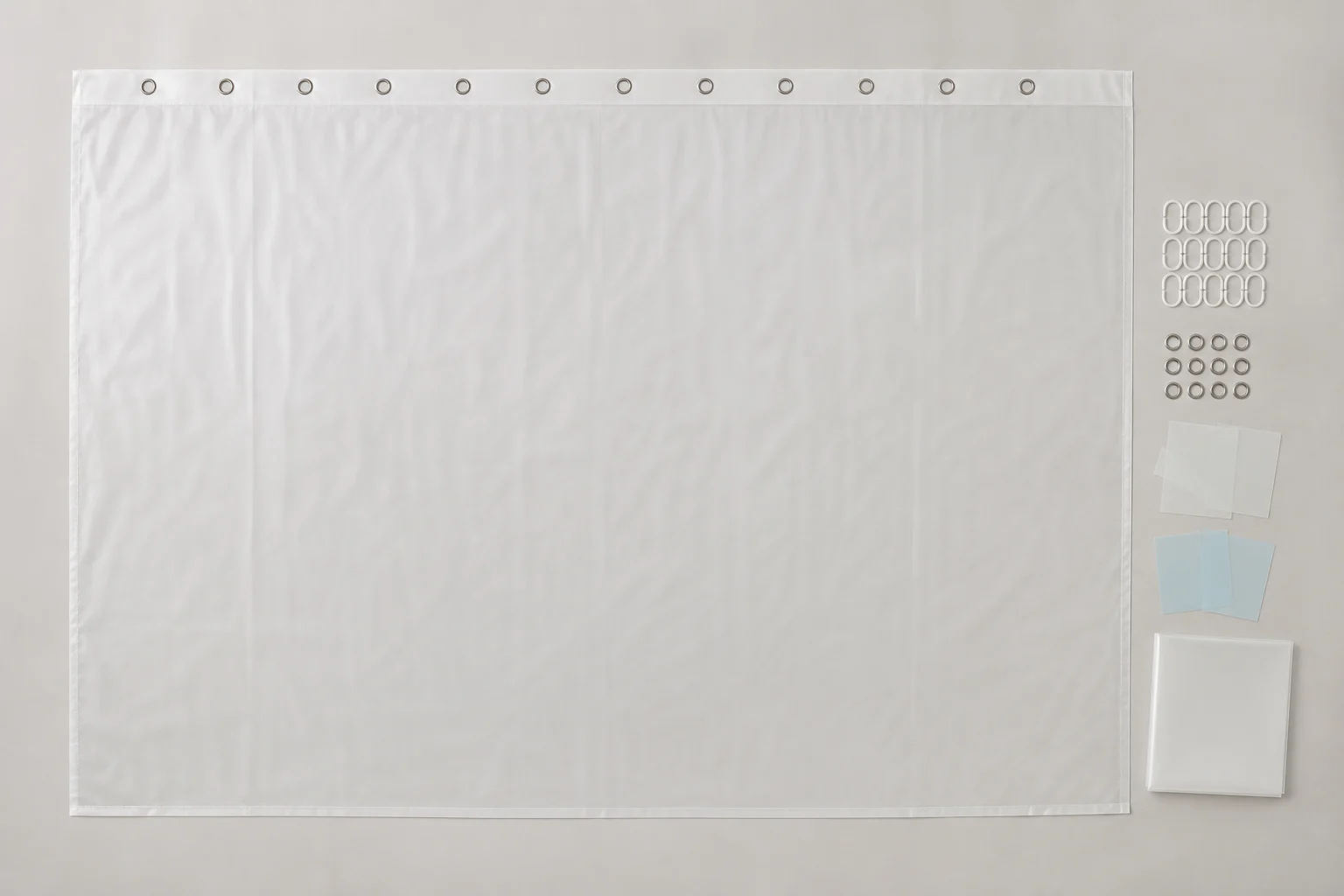
Issue count, center spacing, first-hole offset, opening size and permitted variation. State that grommets belong in the top header only unless another design is deliberately released. Total width alone cannot assure hook alignment.
04
Hardware fit trial
Insert the exact proposed hook or ring through every opening and hang the complete curtain. Record binding, distortion and movement with the hardware code; a successful trial with one component does not automatically approve another.
RFQ checkpoint 06
Choose lower-edge control for the actual bathroom
Weights, magnets, tabs and plain hems change handling and use behavior. They are options to define and test, not universal requirements.
01
Plain or weighted route
State whether the lower edge is plain, carries an integrated weighted strip, uses discrete corner weights or has another approved construction. Describe component location and attachment in the finished drawing.
02
Magnet compatibility
If magnets are proposed, identify the receiving surface and confirm the complete installation rather than assuming every tub supports magnetic retention. Record component count, location and the exact represented setup.
03
Edge-seal appearance
Approve the lower seam width, straightness, corner form and visible joining condition. Use a full-width sample so isolated close-ups do not hide waviness, uneven tension or edge-to-edge variation.
04
Wet-use observation
Observe coverage, movement and drainage in a controlled representative setup. Document the configuration and result as a project observation, not as a universal water-containment certification or lifetime promise.
RFQ checkpoint 07
Carry print and private-label approval through the whole curtain
Artwork approval has to survive scale, conversion, folding and pack presentation. A cropped digital proof closes only one step.
01
Artwork revision
Give every file a revision, dimensions, orientation, print face and ownership status. Show header and edge exclusion zones directly in the production asset. Remove superseded versions from the active packet.
02
Full-size placement
Approve motif scale, repeat, margins and relationship to openings on the complete hanging curtain. A color strike-off can close ink and film interaction but cannot prove the final composition.
03
Folded presentation
Condition the printed item in its proposed unit pack, then open it and review transfer, blocking, fold memory and visible alignment. Keep the sealed pack and the opened result connected to the same artwork revision.
04
Label and barcode control
Define label text, barcode owner, legal review status and placement. Composition, care or environmental wording remains part of the claim matrix and must not be added during packaging artwork without evidence review.
RFQ checkpoint 08
Evaluate odor and appearance after realistic packing
The buyer receives a folded, enclosed and transported article. Packed condition needs a repeatable observation protocol of its own.
01
Conditioning plan
Define the pack construction, sealing time, conditioning duration, approximate storage condition and review timing after opening. Supplier samples should follow the same protocol before their observations are placed in one comparison table.
02
Neutral odor record
Record reviewer, sample code, time and descriptive observation without diagnosing chemistry from smell. If the buyer intends an odor-related market statement, define the evidence route separately from the sensory review.
03
Opening appearance
At the same review, inspect blocking, surface transfer, fold set, edge distortion and ease of unfolding. Photograph the complete item and relevant details without presenting photos as proof of composition.
04
Controlled correction
When the pack result is unacceptable, change one variable at a time, such as film, airing, fold map or unit pack, then repeat the same protocol. Retain both versions so the accepted correction is traceable.
RFQ checkpoint 09
Map care instructions and claims to the exact SKU
Supplier websites commonly use broad care and material language. The released page and package need wording supported by the represented product.
Build the claim file from traceable relationships
For a shower-curtain statement, bind the wording to the accepted film, finished curtain, header and grommet construction, care method, recorded result and destination decision.
Do not hide an applicability gap inside a document folder
Records for other formulations or finished forms may guide review while the current SKU remains unresolved.
01
Care owner
Decide who drafts and approves cleaning, drying and replacement wording for the destination. Verify the proposed instructions on the coded film, decoration and components instead of copying directions from another material family.
02
Composition wording
Treat PVC-free, chloride-free, recycled-content and related terms as claims with defined meaning and evidence. Confirm the represented specimen and destination review before publishing them; a supplier headline is not the buyer's approval file.
03
Functional wording
Waterproof, mildew-resistant, antimicrobial and durability phrases may imply different evidence needs. List intended wording exactly, then record the method, specimen, date, result and limitation used for the decision.
04
Change and expiry
Assign a review trigger for changed source, formulation, gauge, color, print, component, care method, destination or claim. Keep expired or mismatched documents visible as gaps rather than silently broadening their scope.
RFQ checkpoint 10
Inspect conversion on complete finished curtains
Film approval does not close cutting, sealing, openings, print, assembly or packing risks. Inspect the article the buyer will receive.
01
Identity and pack count
Verify SKU, declared film code, color or artwork revision, accessory count and label identity before measurement. Mixed variants can create misleading results and should be isolated before the inspection continues.
02
Geometry and openings
Measure finished width and drop at released datum points, then check header width, hole count, spacing and edge offsets. Record actual values beside the accepted limits rather than keeping only a pass label.
03
Full-face review
Hang or lay out the entire curtain under the agreed condition and review surface, print, seams, edges and corners. Use defect references so severity and location are judged consistently across lots.
04
Assembly confirmation
Fit the represented hooks and any lower-edge components, then hang selected pieces. Record the setup, sample selection and observed interference or distortion; retain photographs as inspection records, not material proof.
RFQ checkpoint 11
Release the fold, unit pack and carton configuration
Packaging affects first impression, storage, freight volume and pack-related surface change. It belongs in the approved product file.
01
Fold map
Issue a fold sequence or retain a marked approved sample. Specify the face direction and insert position so repeat production does not move creases through artwork or place hardware against an exposed surface.
02
Unit pack
Define bag or box material, closure, unprinted or printed status, label position, barcode and pack quantity. Treat any material or care wording on the pack as controlled copy.
03
Carton plan
Record units per carton, orientation, divider needs, carton marks and gross-weight reporting. Review handling and warehouse requirements before choosing the smallest possible case or an unsupported stacking claim.
04
Sealed reference
Retain one accepted packed unit and the carton specification with the revision history. Repeat orders can then compare fold, presentation, count and marks against a controlled physical and documentary baseline.
RFQ checkpoint 12
Normalize quotations and preserve the repeat-order baseline
Unit prices become comparable only when each supplier exposes included work, alternatives and unresolved fields against the same brief.
01
One RFQ revision
Issue the same dated requirement matrix, drawings, claim list, quantity scenarios and pack route to every bidder. Ask for a field-by-field response instead of a substitute catalog specification.
02
Commercial scope
Separate development samples, artwork, tooling, testing, hardware, unit packaging, cartons and logistics assumptions from the unit-price line. This reveals scope differences without inventing universal MOQ or lead-time promises.
03
Departure log
Require every proposed deviation to cite the affected field, reason and impact. A quoted alternative remains proposed until the buyer accepts it and updates the released baseline.
04
Repeat-order control
Carry the accepted film, complete curtain, artwork, packed unit, inspection plan and change log into replenishment. Reopen only affected gates while preserving the learning and evidence already confirmed.
Evidence boundary for this page
This page does not promise a universal formulation, thickness, recycled content, treatment, service life, certification, minimum order, lead time or destination compliance. Released facts and claims must remain attached to the exact accepted EVA/PEVA curtain SKU and current evidence.
Importer FAQ
Questions to close before product release
What belongs in an EVA or PEVA shower-curtain RFQ?
Include the finished article role, supplier-declared film route, controlling thickness or weight method, finished dimensions, header and opening drawing, hooks, lower-edge control, appearance, packing, quantity, destination, claims and open evidence tasks.
Is EVA always different from PEVA in supplier catalogs?
Commercial usage varies. Ask each supplier for the declaration that represents the exact film and finished SKU, then approve the wording required for the destination instead of relying on the label alone.
Can a film swatch approve the order?
No. A swatch may close selected appearance and material fields, while finished dimensions, hanging interface, full-size drape, artwork, lower edge and packed condition require represented complete samples.
How should odor be compared?
Use the same pack, conditioning duration, storage condition and observation timing for coded samples. Record neutral observations separately from any composition or performance evidence.
When should a repeat order be reapproved?
Review changes to film source or formulation, thickness, color, emboss, print, reinforcement, eyelets, hooks, lower-edge components, pack, claims or destination, then reopen the gates affected by the change.
Controlled next step
Bring a measurable EVA/PEVA curtain brief to supplier review
Send the use setting, declared material route, finished size, appearance, top interface, lower-edge control, packing plan, quantity, destination and intended claims. Nothing is released until the represented samples and records are accepted, revision-linked and available to the people controlling repeat production.