

BUYING GUIDE · MATERIAL AND SUPPLIER COMPARISON
EVA vs PEVA Shower Curtain Buying Guide: Compare the Declared Finished System
Published by EverBen
Do not choose from a material label alone. Compare the declaration, complete hanging sample, pack condition and evidence attached to the exact SKU.
This guide gives importers a practical sequence for separating terminology from measurable differences, observing hand feel and odor fairly, testing the top interface and carrying the accepted record into repeat orders.
Buyer method 01
Frame use, channel and replacement consequence
The same film can serve a retail liner, hospitality replacement unit or decorative program. Start with the buyer's situation.

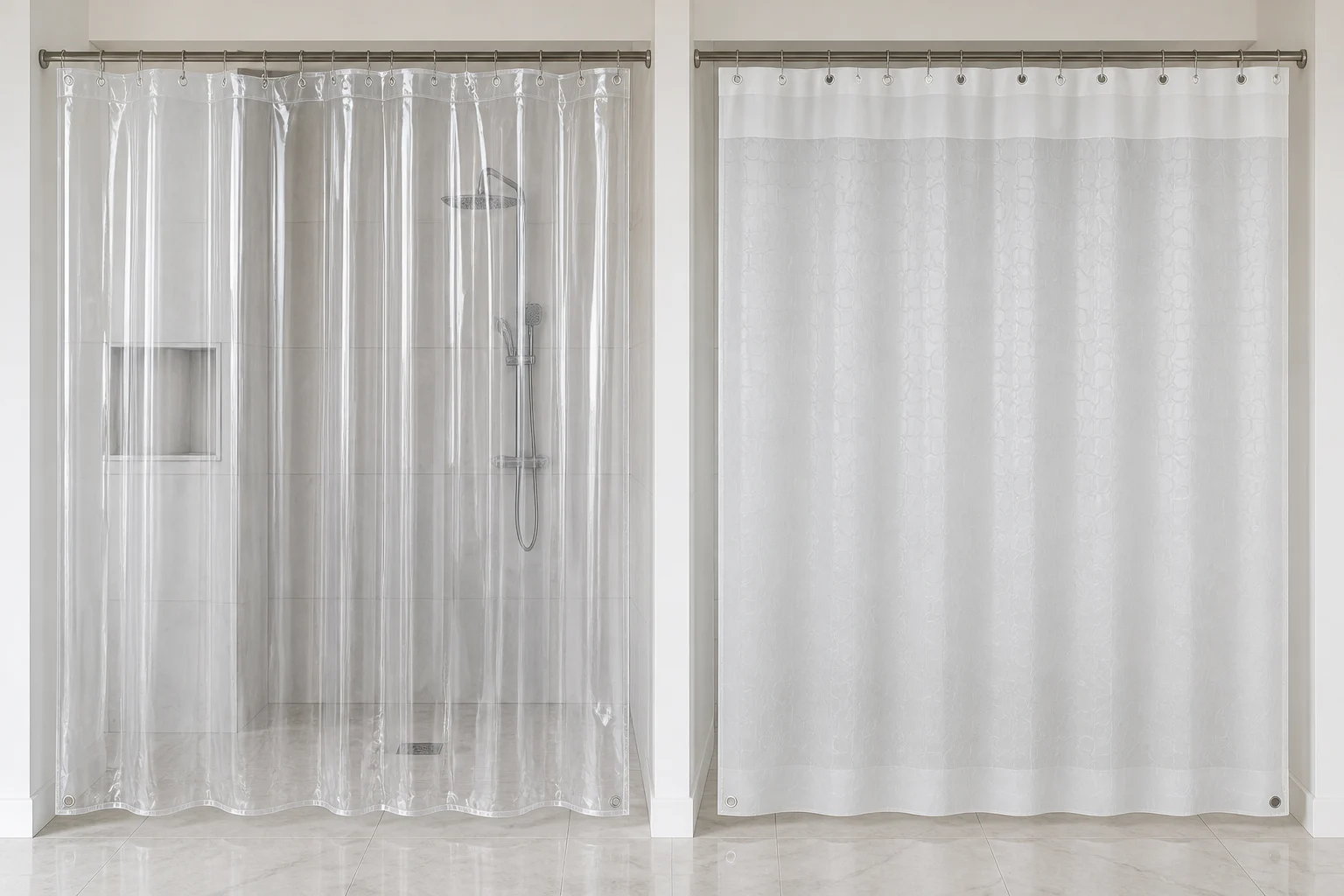
01
Describe the hanging task
Record rod span, finished drop, tub or tray relationship, planned hooks and whether the item is a liner, outer curtain or coordinated set. This prevents material comparison from ignoring the geometry that makes the product usable.
02
Name the commercial route
Retail, hospitality and project supply create different folding, labeling, pack-count and replacement needs. State the sale unit, warehouse route and approval owner so each supplier prices the same work.
03
Rank the failure consequence
Identify the costly outcomes: poor coverage, top-edge distortion, objectionable packed condition, print error, slow replacement or unsupported package wording. Use consequence to prioritize sample gates rather than treating every field as equal.
Buyer method 02
Decode EVA and PEVA names without assuming a winner
Supplier terminology varies. A comparison should preserve each declaration and connect it to coded material and finished samples.
| Comparison field | Ask each supplier | Buyer decision |
|---|---|---|
| Material wording | Exact declaration and represented film code | Applicable / gap / alternative |
| Thickness or mass | Unit, value, method, location and condition | Normalize before ranking |
| Hand feel and drape | Full hanging sample under common setup | Record observation, not a universal claim |
| Packed condition | Same fold, pack and observation clock | Compare complete opening result |
| Commercial scope | Samples, artwork, evidence, hardware and pack | Compare total included work |
01
Ask for the represented declaration
Request the exact commercial and technical material wording, issuer and represented film code. Keep color, gauge, emboss, print and recycled-content route as separate fields so one label does not stand in for the whole construction.
02
Separate statement from evidence
A supplier may propose PVC-free, recycled-content or other wording. Treat it as requested copy until the specimen, method, scope, date and destination review are matched to the SKU.
03
Record proposed alternatives
When suppliers use different terms, do not force false equivalence. Map each offer against the buyer's required fields, note open gaps and approve the terminology only when its meaning and evidence are clear.
Buyer method 03
Compare thickness, hand feel and drape under one method
A catalog gauge cannot predict the entire hanging experience. Normalize the measurement and observe complete curtains side by side.
01
Normalize units and locations
Choose the controlling unit, measurement condition and positions on plain film. Ask suppliers to declare how their values were obtained, and avoid direct gauge-to-GSM conversion unless the construction basis supports it.
02
Use full-size coded samples
Hang complete curtains on the same representative hardware. Review opening force, surface feel, translucency, fold recovery and lower-edge movement, recording the reviewer, timing and sample code.
03
Document the trade-off
A heavier-feeling option may also change pack volume, header load, fold memory and cost. Rank buyer priorities and ask each supplier to disclose the impact of any alternative rather than selecting the largest number.
Buyer method 04
Compare packed odor and opening condition fairly
Fresh film and a sealed retail unit have different histories. Every supplier sample needs the same conditioning and observation clock.
01
Set the protocol
Define unit pack, sealing or receipt date, conditioning duration, approximate storage condition and the times at which reviewers observe the article after opening. Inconsistent timing makes rankings unreliable.
02
Use neutral observations
Note the coded sample, reviewer, timing and perceived character without inferring a chemical cause. Keep composition and regulatory questions in a separate evidence workflow with a defined specimen and method.
03
Inspect the complete opening result
At the same time, review blocking, transfer, fold set, surface marks and ease of unfolding. The combined record helps distinguish a packing issue from an unsupported conclusion about the material name.
Buyer method 05
Audit the header, grommets and hooks as one interface
Top-edge problems can come from reinforcement, hole geometry, spacing, hardware or installation. Avoid blaming the film before mapping the interface.
01
Map every component
Record header construction, opening count, center spacing, edge offset, eyelet material, hole size and actual hook code. Confirm that openings occur only where the released drawing places them.
02
Reproduce the setup
Insert the planned hooks through every opening and hang the complete coded sample on representative hardware. Observe binding, local distortion and movement, retaining the setup details so the trial can be repeated.
03
Change one variable
If the interface fails, compare one controlled change such as opening size, reinforcement route or hook design. Update the drawing only after the buyer accepts the isolated improvement and records its impact.
Buyer method 06
Approve appearance from swatch to packed curtain
Clear, frosted, embossed, colored and printed routes create different approval objects at each production stage.
01
Control the physical reference
Approve opacity, color and emboss using a coded swatch under a named viewing condition. Record face orientation and boundaries; phone-screen images help communication but are not repeat-production standards.
02
Review the complete curtain
Check pattern scale, print placement, margins, header relationship and full-face surface condition while the curtain hangs. A cropped proof cannot show whether conversion changed the intended composition.
03
Open the proposed pack
Condition the approved design in its actual fold and unit pack, then review transfer, blocking, crease placement and first presentation. Connect the sealed reference to the artwork and product revisions.
Buyer method 07
Scope evidence to exact wording, specimen and destination
A folder of reports is not an approval decision. Start with what the buyer intends to say and sell.
Start evidence review from the intended market wording
Then follow the chain to the specific specimen, method, outcome, date and responsible decision owner.
Classify each record before relying on it
Informative material can support questions without being treated as proof for the offered curtain.
01
Inventory intended wording
Copy composition, care, restricted-substance and performance statements from the specification, listing and package. Identify the destination and business owner for each phrase before requesting documents.
02
Audit applicability
For each declaration or report, record issuer, date, specimen, method, result and limitation. Compare formulation, color, thickness, print and finished form with the order under review.
03
Make the gap visible
Classify records as applicable, informative, mismatched, expired or pending. Assign an owner and deadline for gaps rather than expanding a document beyond its published scope.
Buyer method 08
Normalize supplier offers and release a repeatable baseline
The comparison ends with an accepted object, not a winning spreadsheet row. Preserve the samples, records and departures that define it.
01
Issue one requirement matrix
Give all suppliers the same dated fields, drawings, quantity scenarios, pack route and claim list. Require included, proposed, excluded or open status for each field and a precise description of every alternative.
02
Compare total scope
Separate samples, artwork, tooling, evidence, hardware, unit pack, cartons and logistics assumptions from the unit price. Do not copy MOQ or lead-time numbers from other suppliers or unrelated public pages.
03
Release and control change
Create one revision that identifies the approved swatch, hanging sample, artwork file, sealed pack, inspection method and evidence decisions. On repeat orders, review declared changes and reopen only affected approval gates.
Evidence boundary for this page
This educational comparison does not certify a supplier or product and does not declare EVA or PEVA universally superior. The importer must decide from the exact declaration, specimen, method, market, intended wording and accepted commercial file.
Importer FAQ
Practical EVA/PEVA supplier-comparison questions
Is PEVA automatically better than EVA for every shower curtain?
No universal ranking follows from the label alone. Compare the represented declaration, finished construction, use setting, pack condition, evidence and buyer priorities.
How can suppliers with different gauge or GSM claims be compared?
Select one controlling measurement, define positions and condition, and ask for each supplier's method. Use full-size hanging samples for hand feel and drape instead of converting unlike values blindly.
Does an odor observation prove material composition?
No. Sensory observations can be recorded under a controlled protocol, while composition or claim decisions require their own applicable evidence and destination review.
What should be checked at the top edge?
Review header construction, hole count and spacing, edge offsets, grommet or opening detail, hook code and the complete hanging trial as one interface.
What should be frozen after supplier approval?
Freeze the requirement revision, declared material reference, complete sample, artwork, packed unit, inspection plan, accepted departures and evidence map by their exact identifiers.
Controlled next step
Convert the comparison into a versioned EVA/PEVA curtain brief
Return to the corresponding Product page for the complete specification architecture, or share material, geometry, hardware, packing and open approval decisions for a structured comparison.