
Independent B2B event-rainwear operations guide
How to Buy PE Disposable Rain Ponchos for Events without Creating an Issue-Day Failure
Published by EverBen
A bulk poncho program succeeds only when demand, product shape, opening, artwork, pack, carton allocation and receiving are designed as one operating system.
Step 1 · Start before the product search
Write the Event Rainwear Operating Plan Before Collecting Poncho Quotes
A disposable poncho purchase is an operations project disguised as a simple product order. The product must reach the right person, open quickly and provide the intended temporary coverage at the moment the weather changes.
Name the weather decision
State who watches the forecast, when the trigger is called and whether distribution is proactive or reactive. A festival may issue ponchos before gates open, after the first rain alert or only when guests request one. Each policy changes queue pressure, reserve consumption and the value of a compact pack.
Keep the trigger separate from the supplier’s product claim. Procurement controls the operating decision; the rainwear specification controls the item available when that decision is made.
Map every issue point
List entrances, seating zones, transport hubs, hotels, vehicles, volunteer stations or kit lines. For each point, record likely users, storage space, staffing and resupply route. A correct total quantity can still fail when cartons are concentrated in the wrong building.
Use destination codes in the pack plan and receiving record. Avoid exposing customer-sensitive names in public samples or reusable operating templates.
Define the user journey
Follow one person from receiving the pack through opening, orientation, donning, movement and disposal or storage of an unopened unit. Note clothing layers, bags, tickets, phones and accessibility needs. This journey reveals whether a cape or sleeved product is more suitable and which opening steps require attention.
Do not assume that one-size wording removes fit and access questions.
Assign named owners
Identify who approves the product, artwork, quantity, reserve, carton split, receiving check and event-day release. A decision with no owner tends to move into the final week, when changes create delay or unsupported substitutions.
The responsibility list belongs in the buyer’s internal file and should be reflected in supplier milestones.
Send the event type, issue points and owner list. We will organize the first sourcing questions.
Step 2 · Choose the product route
Select Cape Poncho, Sleeved Raincoat and Pack Format from the User Journey
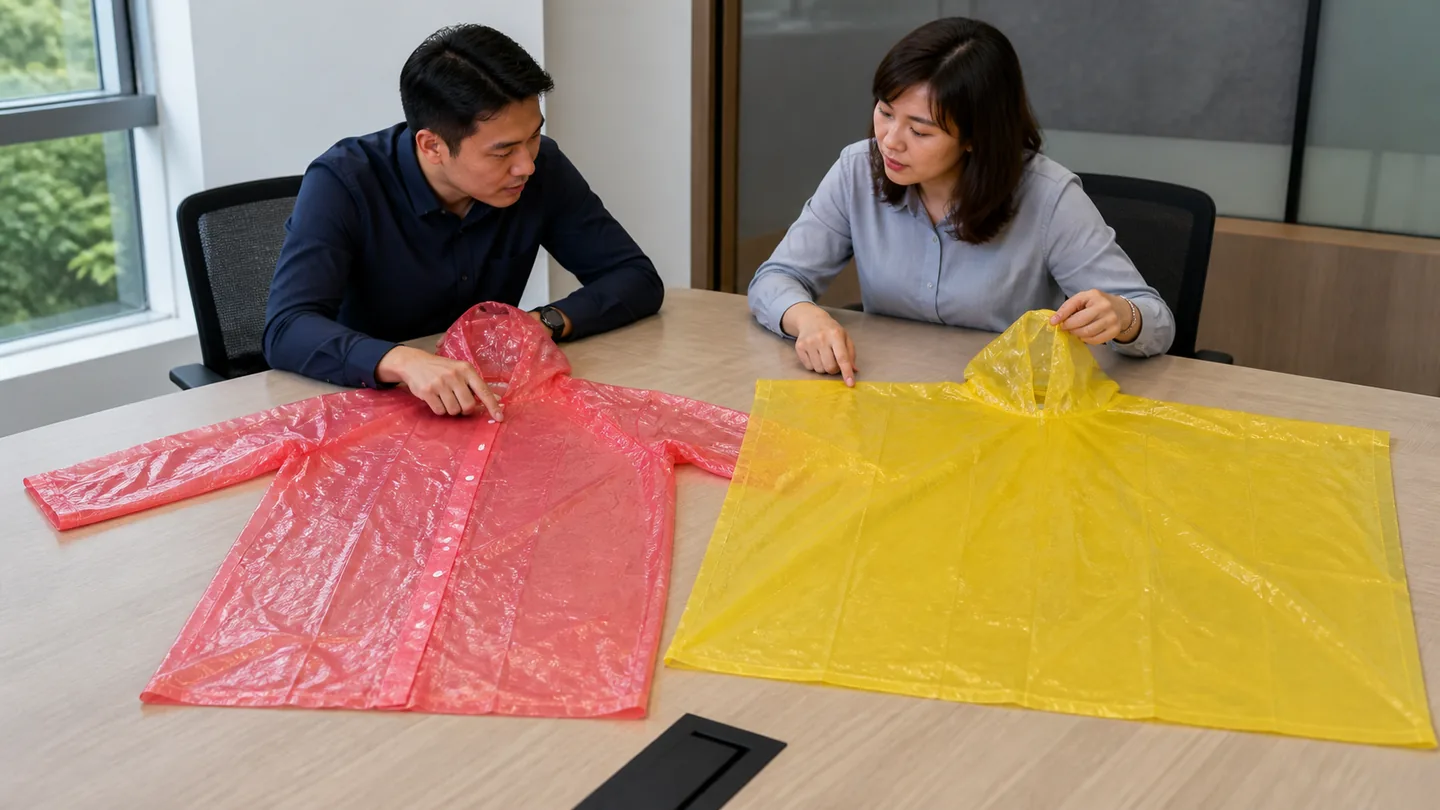
The cheapest visible unit may be the wrong product architecture. Cape and sleeved routes affect opening, movement, print area, size management and the number of construction zones that need control.
Compare cape coverage
A broad cape can support rapid issue and generous upper-body layering with fewer size choices. Check hood position, open sides, arm reach, front and back length and behavior around bags or seats. A cape that is too long or wide may obstruct hands, steps or neighboring seats.
Approve the cape while users perform the event’s real actions rather than standing still for a photograph.
Choose the Temporary PE Rainwear Architecture
| Architecture | Coverage | Opening and joining focus | Use-duration boundary | Buyer inputs | Evidence gate |
|---|---|---|---|---|---|
| Poncho | Broad body coverage with hood and open or fastened sides | Head opening, hood join, side geometry and hem | Buyer-defined issue event and disposal route | Audience, clothing layers, issue point and pack | Complete donning and packed-opening observation |
| Sleeved raincoat | Torso and arm coverage with front access | Front overlap, sleeve roots, cuffs and seams | Named temporary task | Wearer range, garment dimensions and motion | Finished garment fit and movement sample |
| Cape | Broad draped coverage | Neck/hood transition, side depth and fasteners | Defined carrying and movement route | Coverage map, wearer and task | Representative coverage trial |
| Apron | Front-only task coverage | Neck and waist attachment, edges and front dimensions | Specific contact cycle separate from rainwear | Task, wearer range and disposal plan | Complete article fit and interface inspection |
Compare sleeved control
Separate sleeves may help controlled arm coverage and front access, while adding sleeve-root joints, cuff openings and closure patches. A snap-front disposable raincoat can be easier to enter for some users but requires a clearer size and closure plan than an open cape.
Specify the architecture by drawing, measurements and approved sample. Do not allow the quote to switch routes silently.
Decide the individual pack
A flat clear bag can support compact storage and color identification. A printed pouch or insert can add instructions and brand visibility. Choose the pack according to the issue task, then test it with the actual folded product.
Avoid novelty containers or additional bags unless they solve an approved distribution problem. Extra parts change cost, cube, opening and waste.
Keep alternatives visible
If the buyer expects repeated service, longer exposure or demanding movement, compare an EVA/PEVA, PVC, PU-coated or textile rainwear route instead of forcing a thin disposable PE item into a reusable role.
Record which requirement triggered the alternative and what new evidence it needs.
Describe donning, movement, layers and service expectation. We will compare the architecture choices.
Step 3 · Forecast quantity and reserve
Calculate Demand, Weather Reserve and Destination Quantity without Copying a Generic Percentage
The correct order quantity depends on attendance, staff, issue policy, location uncertainty, replacement assumptions and the consequences of shortage or excess. A single reserve percentage cannot fit every event.
Build the population base
Separate guests, staff, contractors, speakers, transport teams and emergency reserve recipients. Remove people already covered by uniforms or another rainwear program only when that assumption is controlled. Use attendance ranges rather than one optimistic forecast if sales or registrations remain open.
Keep the data source and date beside the quantity so later changes are visible.
Model the issue policy
Calculate the effect of proactive distribution, request-only issue and location-limited issue. Proactive handout can improve readiness but consume stock in dry periods. Request-only issue may create queues. The product pack and staffing should be evaluated against the chosen policy.
Do not ask the supplier to choose the buyer’s weather-risk tolerance.
Create a controlled reserve
Reserve should answer identified uncertainty: attendance variance, carton damage, opening damage, route delay or resupply time. State who can release it and whether it is held centrally or divided by destination.
Review the reserve when the forecast, registration or logistics plan changes instead of treating it as hidden extra stock.
Use scenarios, not false precision
Prepare at least a base case and a high-demand case. Show the quantity at each issue point and what happens when one point exceeds plan. This supports carton and resupply decisions better than one precise total with no operating explanation.
Document accepted shortage or excess risk as a buyer decision.
Send attendance ranges, issue policy and destinations. We will structure a demand scenario worksheet.
Step 4 · Rehearse opening and donning
Run a Packed Poncho Opening Trial before the Product and Fold Are Frozen
Thin PE can cling to itself and tightly folded units can hide the hood or opening. The most useful sample trial begins with the production-intent pack and representative users.
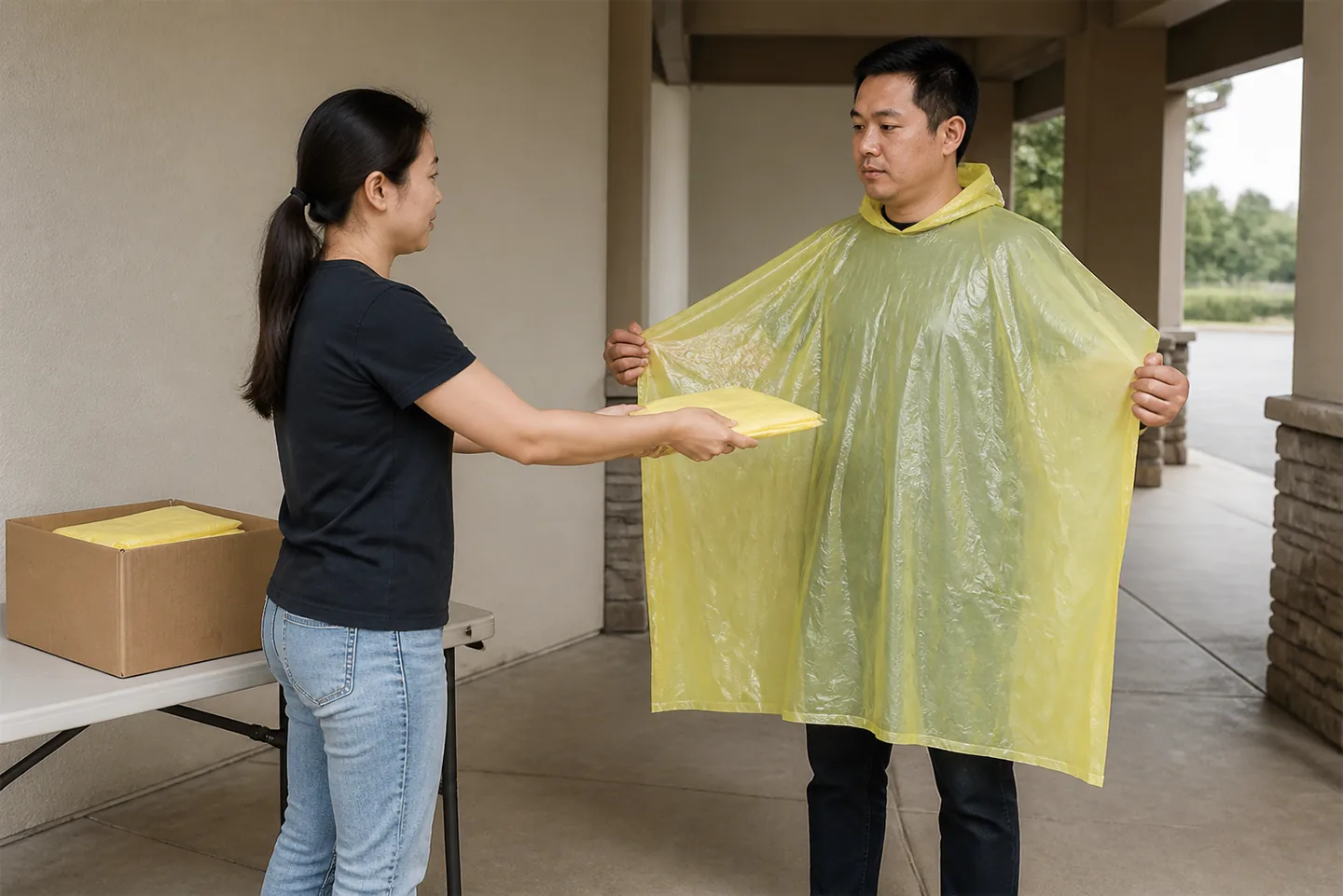
Begin with a sealed unit
Use the proposed bag, fold, insert and storage condition. Ask the user to identify the opening, remove the product and find its orientation without coaching. Record hesitation, excessive force, film damage and instruction questions.
A loose garment proves little about the final issue task.
Observe the complete sequence
Continue through hood placement, cape or sleeve access, closure operation, reach and removal. Use normal clothing and carried items. The trial should reveal whether product geometry or the pack creates the problem.
Avoid publishing a universal donning time from a small internal rehearsal.
Classify every failure
Separate bag seal, fold, film blocking, unclear orientation, narrow opening, weak edge and user-instruction causes. A corrective action should target the observed cause. Heavier film is not automatically the correct response to a poor fold or hard bag seal.
Repeat the affected portion after the change, then rerun the full sequence before approval.
Keep an approved packed reference
Retain a labeled unit that represents garment, fold, bag and instructions. Record revision, date and sample status. Bulk inspection and receiving teams then have the same physical reference instead of several unlabeled samples.
A pack revision should reopen the opening trial even if the garment itself has not changed.
Share the current sample and issue route. We will outline a repeatable opening rehearsal.
Step 5 · Approve artwork on the real object
Control Logo Position, Thin-Film Appearance and Fold Contact beyond the Digital Mockup
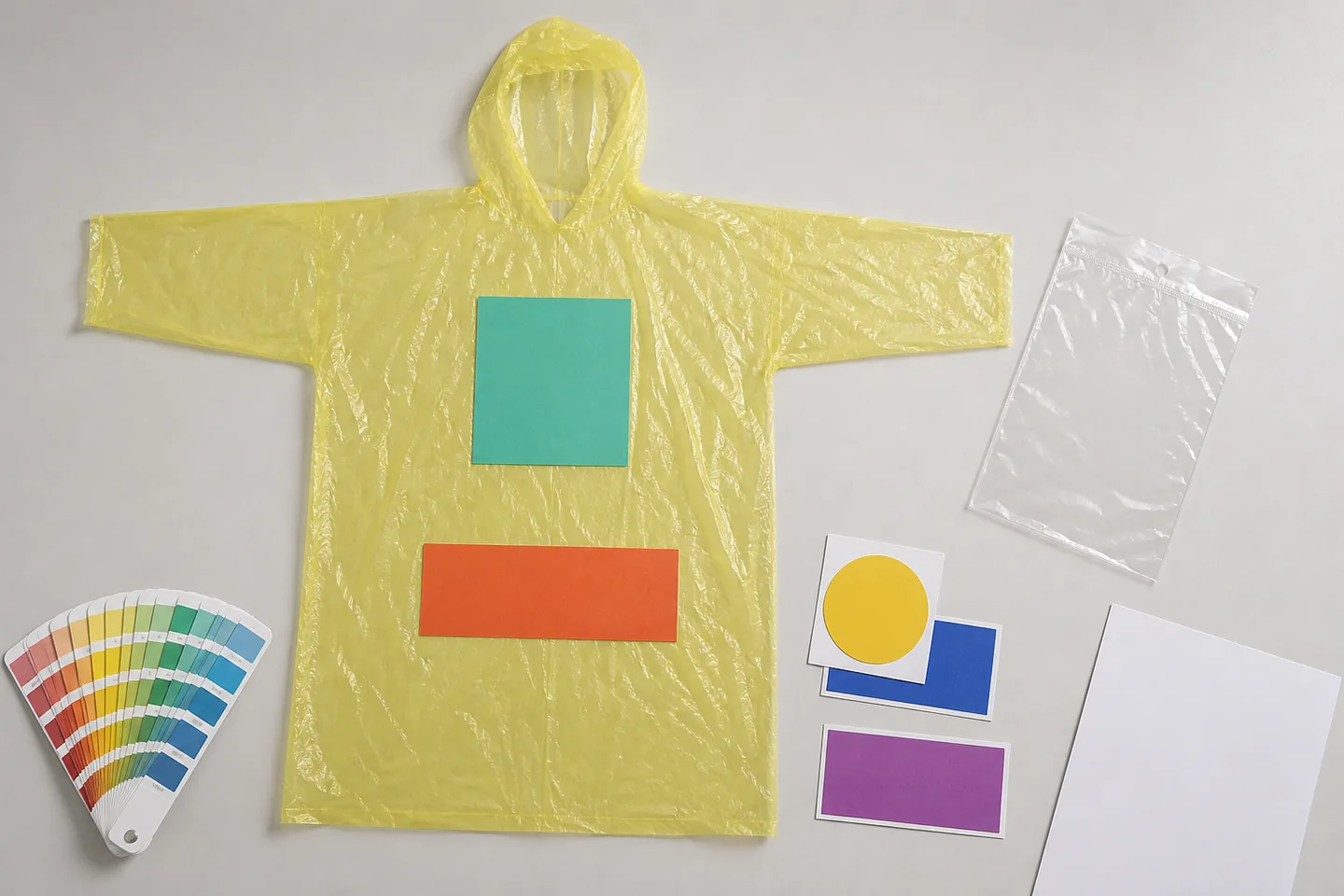
A logo can appear different on clear or translucent PE, over clothing, across wrinkles and after packed contact. Digital approval should lead to a physical print and packed-sample decision.
Choose the communication surface
Decide whether the message belongs on the garment, individual pouch, label or insert. Garment print may offer visibility while worn; the pouch can help users identify and open the unit; an insert can carry instructions. Each surface has different dimensions, material and evidence needs.
Do not reuse artwork from old customer-logo photographs. Require buyer authorization for every new file.
Freeze the artwork revision
Record vector file, color references, printed size, location from stable garment edges and approval date. Keep a proof history so the supplier does not print an earlier version after a late comment.
If a position depends on a fold or seam, connect the drawing to the final garment dimensions.
Approve the physical film result
Print on the intended film color and dimension. Review opacity, show-through, edge quality, distortion and visual balance over representative clothing or backing. The purpose is not to copy a competitor’s appearance but to confirm the buyer’s own authorized design.
State lighting and viewing condition when color or legibility matters.
Challenge fold and contact
Pack the printed sample using the production fold and observe transfer, blocking, crease and legibility after an agreed condition. Map which surfaces touch. Adjust print route, location, interleaf or fold only after the interaction is understood.
Keep claims within the tested material, color and pack combination.
Send authorized artwork, garment route and pack idea. We will map the proof sequence.
Step 6 · Make the pack understandable
Design Unit Instructions and Identification for a Rushed, Wet User
The individual pack may be the only communication object available at the issue point. It should help users recognize the item and open it without creating clutter, unsupported claims or translation errors.
Prioritize the opening action
Show where and how to open the pack only when the bag route needs instruction. Avoid placing the opening cue under a seal, fold or dark print. Test the final size with representative users rather than approving a large desktop artwork view.
Instructions should support the design, not compensate for an unnecessarily difficult package.
Control languages and symbols
List destination languages and approve every version. Use understandable, legally reviewed symbols when appropriate and avoid invented safety icons. Keep the printed revision linked to the purchase order and sample.
Do not allow auto-translation or supplier shorthand to reach production without buyer review.
Separate facts from claims
Product type, color, lot, buyer item code and basic use instruction can be controlled fields. Waterproof duration, recyclability, biodegradability, certification and safety claims require exact evidence. Remove unsupported marketing language before artwork release.
A small package does not lower the evidence standard.
Make identification useful to operations
Where required, connect unit, inner group and master carton through item, color, lot and destination fields. Receiving and issue teams should identify stock without opening every pack.
Choose only the data the program needs and protect customer-sensitive information.
Send the destination languages and identification needs. We will separate essential instructions from risky claims.
Step 7 · Allocate by destination
Build the Carton and Issue-Point Map before Packing Starts
Destination packing can save hours of emergency sorting, but only when the supplier receives a controlled map and the buyer verifies it at receiving.
Choose the packing owner
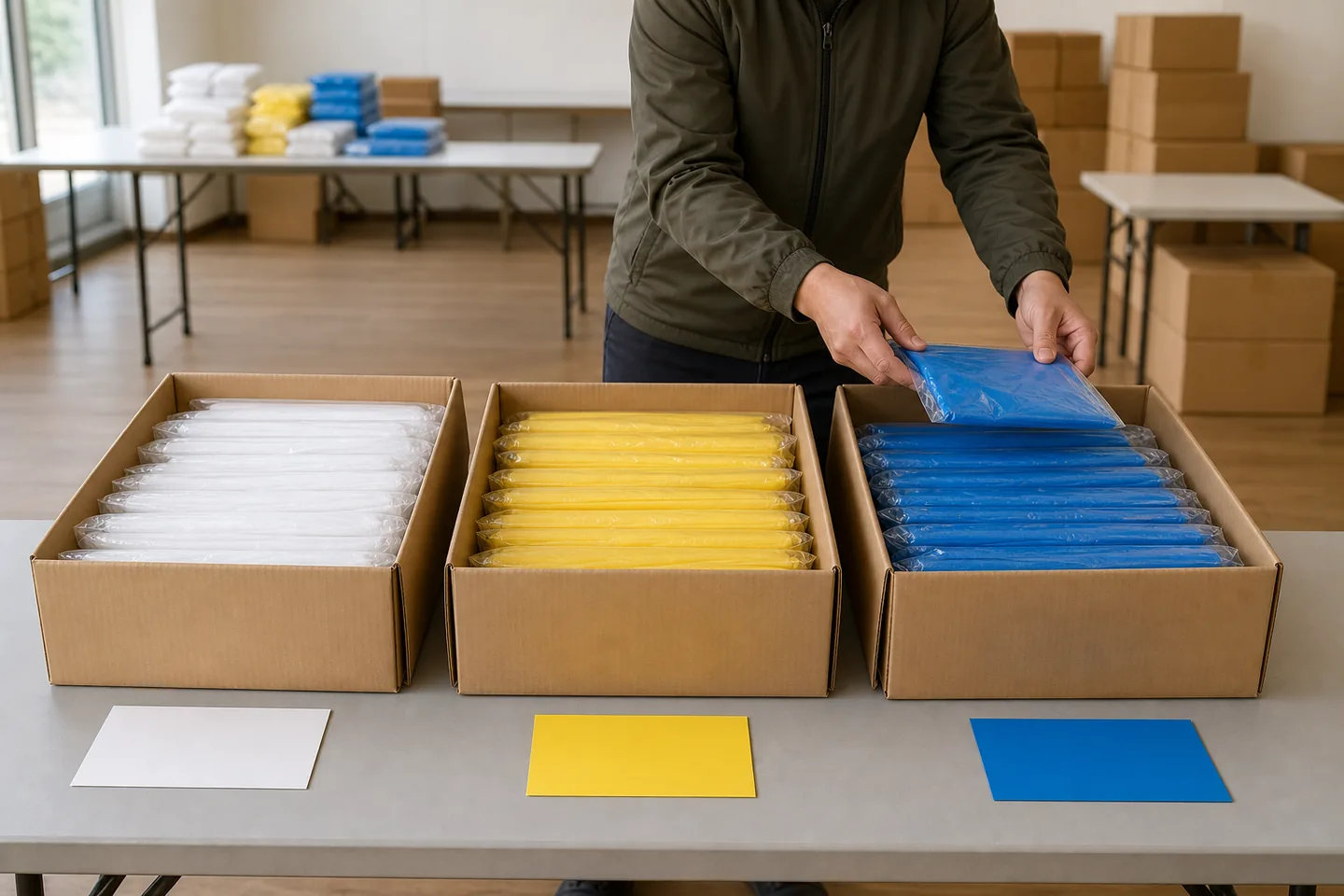
Decide whether destination sorting happens at the supplier, importer, central warehouse or event site. Supplier sorting can reduce later handling but increases label and carton complexity. Local sorting can remain flexible but requires time, space and staff.
Quote the selected service explicitly so suppliers do not assume different work.
Create a destination matrix
List each location, product color or route, quantity, carton count and reserve relationship. Use stable codes and revision control. When the attendance plan changes, update both the matrix and purchase-order packing instruction.
A spreadsheet total should reconcile with ordered quantity and reserve.
Design carton marks for action
Carton marks should help receiving identify item, lot, count and destination without exposing unnecessary customer information. Define label position, print size and any color coding. Test scanning or readability if those functions matter.
Do not rely on handwritten interpretation at the last minute.
Plan resupply between points
State which location holds central reserve, who requests resupply, how cartons move and what threshold triggers action. Event geography and access restrictions can make a nearby reserve operationally distant.
A brief rehearsal can reveal missing carts, keys, staff or weather protection before guests arrive.
Send locations, quantities and reserve ownership. We will structure a carton-allocation matrix.
Step 8 · Receive and rehearse
Inspect Shipment Identity and Run One Issue-Point Drill before the Weather Trigger
The buyer needs time to detect count, label, damage or opening problems. A receiving gate and short operational drill close the gap between factory release and public distribution.
Verify shipment identity
Compare carton count, marks, lot and destination matrix with shipping documents. Photograph damage before opening and isolate affected cartons. Record received time and responsible person.
A clean outer carton does not prove the unit pack, so continue with representative opening checks.
Sample the final unit
Open cartons from relevant destinations and colors. Compare garment, fold, bag, print and instructions with the retained approved reference. Perform the opening sequence and record any change after transit.
Escalate mismatches while replacement or reallocation is still possible.
Rehearse an issue point
Set up the table, carton, staff position and handoff path. Practice opening a pack and resupplying the point. Observe queue obstruction, wet-surface exposure, storage access and waste-bin location without needing a live crowd.
Keep the drill focused on the planned product and operation.
Close exceptions in writing
Assign owner, containment, corrective action and release authority for count, damage, label or function exceptions. Do not allow verbal acceptance to become the only record for a disputed shipment.
Update the event plan if stock is reallocated or reserve is consumed.
Share the delivery and event calendar. We will map receiving checks and a short issue-point drill.
Step 9 · Learn from actual use
Record Issued, Unopened, Damaged and Misallocated Units after the Event
A post-event review turns one weather response into better demand, product and pack decisions for the next order. It should distinguish stock outcomes without assuming opened products can be reissued.
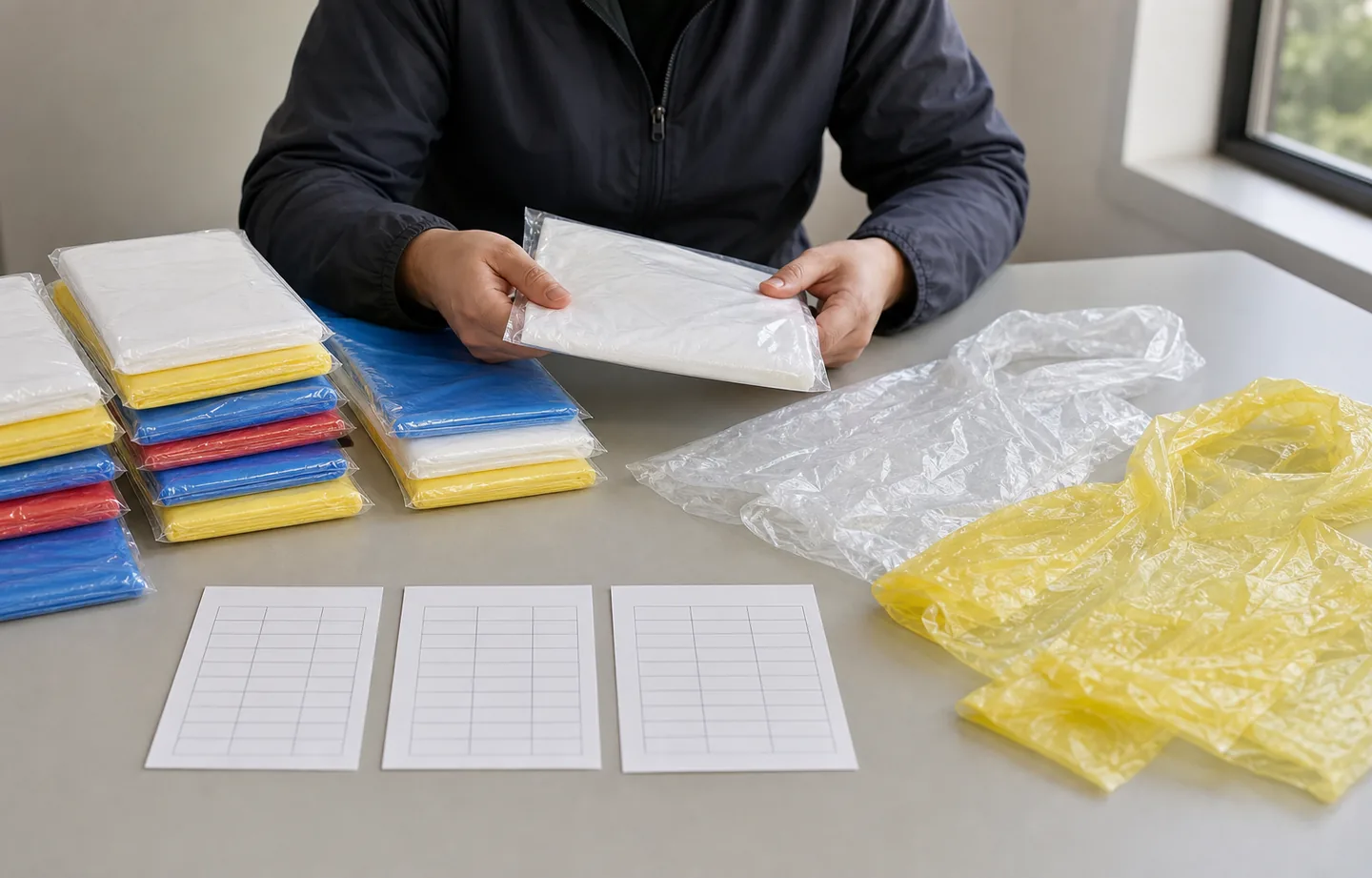
Reconcile each destination
Record received, transferred, issued, unopened, damaged and unexplained balance by issue point. Compare the pattern with attendance, weather trigger and staffing. A location with high leftover stock may have received too much or may have been difficult for users to find.
Preserve the assumptions used in the original forecast so the variance can be explained.
Classify product feedback
Separate opening, orientation, fit, hood, movement, film damage, print and pack comments. Ask for examples or retained units when possible. Avoid converting one anecdote into a universal defect without checking lot and condition.
Prioritize repeated observations that affect the program’s operating job.
Review unopened stock
Check storage condition, pack damage, lot identity and future program relevance. The buyer should decide whether unopened units remain controlled stock, require periodic checks or cannot be carried forward.
Do not reissue opened or contaminated items without an approved hygiene and product policy.
Update the next-order ledger
Record which quantity assumptions, architecture, pack, instruction, carton map or evidence tasks change next time. Classify whether the next order is unchanged, uses an approved option, or becomes a revised program.
This prevents “same as last year” from hiding operational changes.
Send issue and balance data by location. We will organize a post-event learning ledger.
Step 10 · Submit one controlled brief
Build the Event-Ready PE Disposable Poncho RFQ and Approval Calendar
The final sourcing file should make every supplier quote the same program and make every internal owner see the same deadline. List unresolved choices explicitly instead of allowing silent supplier assumptions to complete them.
Product and user fields
State event or kit job, target users, cape or sleeved route, garment dimensions, hood and opening construction, PE film reference or proposal fields, color and sample movements.
If the buyer requests alternatives, require each route to use the same comparison columns and show its trade-offs.
Artwork and pack fields
Attach authorized files and list print surface, color, size, position, proof, individual bag, instructions, inner grouping, carton count, marks and destination matrix.
Connect the packed-opening trial to the final fold and bag revision.
Quantity and delivery fields
Provide base quantity, reserve, destination split, receiving date, distribution date, event date, shipping destination and Incoterm. Ask the supplier to list timing assumptions and exclusions.
MOQ and lead time become order-specific after these fields are reviewed.
Evidence and approval fields
List material identity, sample stages, opening rehearsal, construction checks, artwork proof, packed-contact review, final inspection, retained sample and receiving gate. Assign buyer and supplier owners with dates.
No product, route or claim change should bypass the affected approval.
Submit the controlled website form so the rainwear team receives the complete decision record directly.
Buyer FAQ
Frequently Asked Questions about Event PE Disposable Poncho Programs
Use the answers as decision boundaries, not universal product promises.
Every final value belongs to the approved SKU, pack and destination plan.
How many disposable ponchos should an event order?
Build a population base, issue policy, destination plan and controlled reserve. Use base and high-demand scenarios rather than one generic percentage. The correct reserve depends on attendance uncertainty, weather trigger, resupply time and shortage consequences.
Should an event choose a cape poncho or sleeved raincoat?
Choose from the wearer journey. Capes can simplify fit and rapid issue; sleeved raincoats add arm control and front-access options but also add joints, cuffs, closures and size decisions. Test the final packed product with representative users.
What should be tested before approving a PE poncho?
Start with film and construction identity, then open and don the unit from the final pack. Review hood, openings, movement, film damage, print, fold contact, instructions and carton identity under declared conditions.
How should artwork rights be controlled for a new poncho program?
Use only buyer-authorized artwork and record the approved file, colors, size, position and revision. Customer logos and protected designs from another program must not be copied. Create and approve a new controlled proof for every buyer program.
When should carton allocation be finalized?
Create the destination matrix before packing instructions are released, then verify it at receiving. Any attendance or location change must update quantities, reserve and carton marks together.
What does EverBen need for an accurate quote?
Send the use case, architecture, wearer range, film request or reference, dimensions, color, artwork, individual pack, carton map, quantity, destinations, evidence needs, Incoterm and receiving date.
Send the event, user, quantity, product route, artwork, pack and destinations through the secure form.
Use the form or return to the PE Disposable Rainwear product page.