EverBen · Coated-textile program control for overseas B2B teams
Manufacturer-Led Coated Polyester Programs for Controlled Bulk Sourcing
Build the specification from the coated textile outward: assign each jacket, poncho or suit its own layer stack, interface map, movement trial, appearance approval and shipment-release record.
For importers, brands, distributors and program owners who need production decisions documented before sample approval and commercial release.
Substrate, barrier and interfaces approved together
Appearance and allocation tied to the released revision
B2B product decision system
Specify the Finished Polyester Rainwear Object before Comparing Price
A woven polyester face can support very different garments once coating, lamination, lining, seams and trims are added. This page keeps those entities attached to individual SKUs and turns the approved combination into a quotation and release basis.
Use one linked product-and-evidence file.
Each declared value must point to a named material, component or finished sample and show whether it is requested, proposed or verified. Unclosed items stay visible in the decision log.
Evidence boundary for this page
The visuals support design and inspection questions only. Order-specific composition, performance, compliance, volume and schedule require current documentary confirmation.
Define the Wearer, Exposure and Service Model before Selecting Polyester Rainwear
Polyester describes a fiber family, not the finished protection system. A useful brief starts with the wearer and operating condition, then connects those facts to architecture, material, evidence and release decisions.
Exposure
Describe the rain event as an operating window
Record whether the garment is reserved for short showers, worn through repeated outdoor shifts, used while riding, or issued during an event. Add wind direction, temperature, exposure time, shelter and the consequence of water entry. This gives the supplier a real design problem without inventing an unsupported laboratory target.
Separate normal use from exceptional conditions. If one program covers mild commuting and prolonged industrial exposure, create distinct SKU routes or evidence plans instead of assuming one lightweight construction can honestly serve both jobs.
Wearer task
Map movement, carried equipment and clothing layers
List walking, cycling, bending, reaching, kneeling and seated tasks. Identify helmets, backpacks, gloves, boots, harnesses and insulated layers. These relationships affect hood volume, sleeve reach, shoulder ease, garment length, trouser overlap and opening access, and they belong in the sample trial rather than a vague request for comfortable fit.
Use representative wearers or approved forms and document the layer set. A static photograph cannot establish mobility, and a larger size can create wind lift, snag risk or poor hood control while solving only one tight area.
Service model
Set reuse, care, storage and replacement assumptions
State whether garments are disposable, occasionally reused, seasonally retailed or repeatedly issued to workers. Add cleaning, drying, folding, vehicle storage, humid warehousing and replacement practice. Coating, tape, printing and pack decisions should respond to that service model rather than to a generic durability claim.
Where long life, laundering, abrasion or regulated protection matters, define a project-specific validation route. Polyester content alone cannot prove how the coated material, seams and trims will behave after the intended cycle.
Claim boundary
Separate product needs from market and legal claim ownership
Record who owns destination requirements, label language and any performance or environmental statement. The supplier can propose a construction and evidence route, but the buyer must confirm which claims are necessary and which market rules apply.
Keep undecided claims out of public or packaging language until the exact SKU, method and evidence scope are approved.
Decision 02 · Product architecture
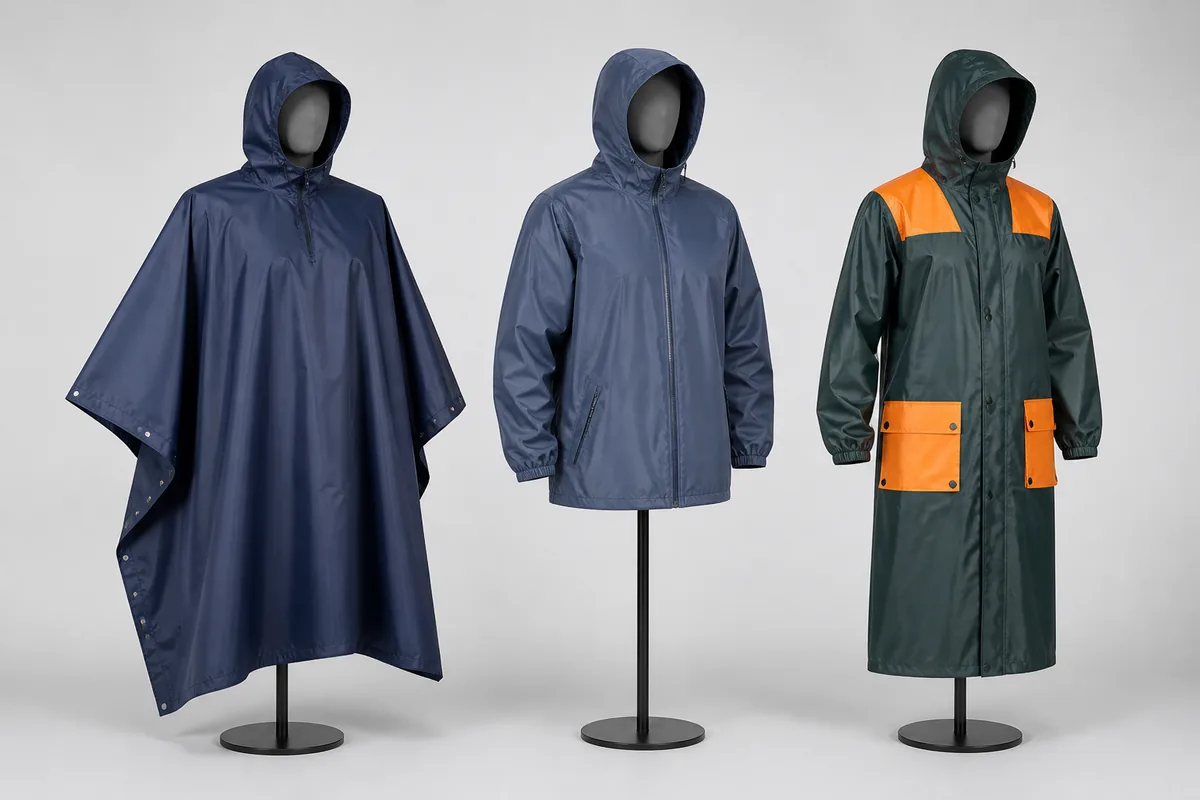
Choose a Jacket, Suit, Poncho or Cape by Coverage and Interface Risk
Different polyester rainwear forms create different openings, fit burdens, component counts and packing volumes. Freeze the product object before price comparison.
Jacket
Use a jacket when controlled sleeves and access lead
A jacket supports defined sleeve mobility, pockets and layered sizing, but creates decisions at the front zipper, storm flap, hood, cuffs, hem, vents and pocket openings. Specify length, lining, closure operation and whether trousers form part of the same issued set.
A fashion shell, promotional jacket and wet-duty work jacket can all use polyester while requiring different reinforcement and evidence. Keep the intended use attached to the SKU.
Poncho
Use a poncho or cape when rapid broad coverage matters
A poncho can reduce sleeve sizing and cover clothing or a small pack, yet open sides, wind lift, hood rotation, hem clearance and hand access require deliberate geometry. Define body width and length, side closure, head opening and the movement poses used for approval.
Do not treat every cape as equivalent. Event issue, cycling and work-zone coverage create different front length, fastening and equipment-clearance decisions.
Suit
Use a two-piece or one-piece suit only after mapping overlap
A jacket-and-trouser set adds waist overlap, lower-leg opening, size pairing and pack allocation. An overall reduces one gap while increasing torso-length and entry complexity. Record how boots, gloves and work layers pass through openings and how pieces stay assigned together.
If reflective or occupational language is requested, separate appearance from regulated performance. The silhouette or trim alone cannot establish compliance.
Program logic
Decide which program elements may genuinely be shared
Jackets, ponchos and suits may share a color family, logo file or carton language while keeping different patterns, seam maps and size controls. Mark shared and item-specific decisions explicitly in the line plan.
This prevents one sample from being treated as permission for related products it did not represent.
Decision 03 · Textile identity
Specify the Polyester Substrate beyond a Fiber Name or Marketing Number
Yarn, weave, construction, mass, finish and controlled reference affect hand, strength, noise, drape and coating behavior. Record them as linked attributes rather than treating denier or thread count as a quality grade.
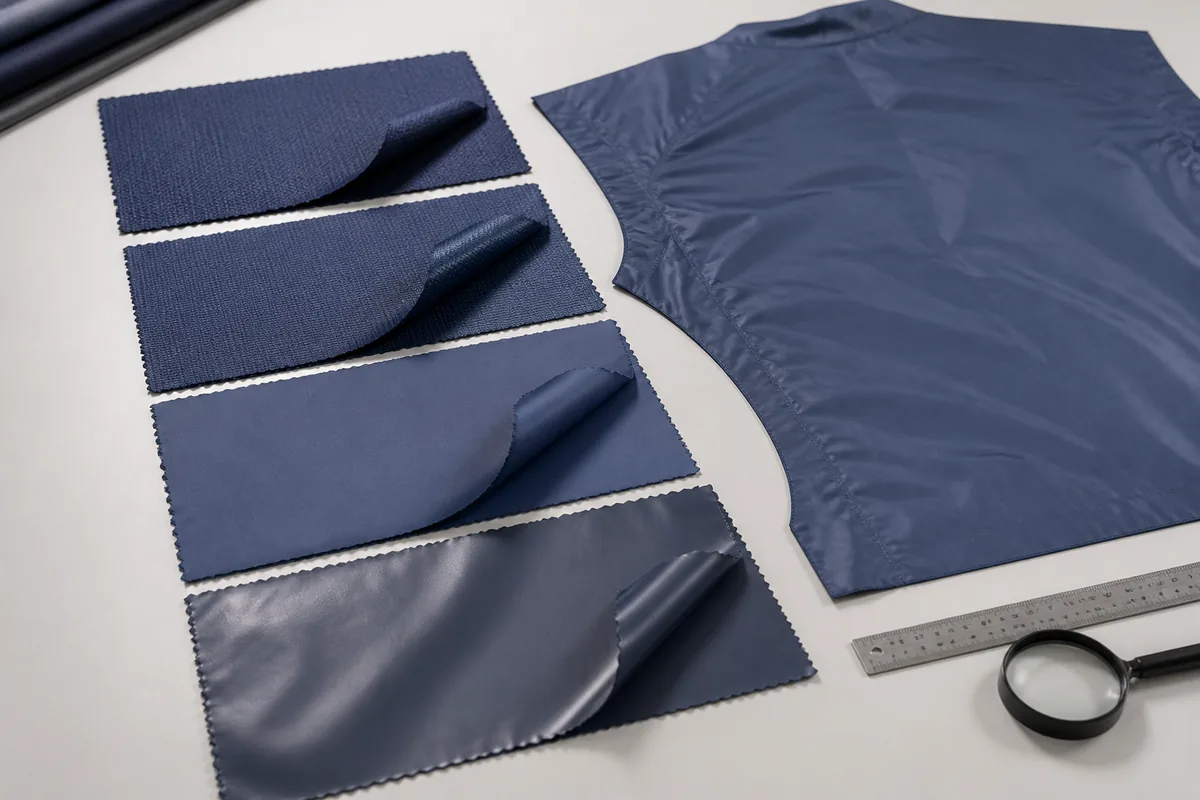
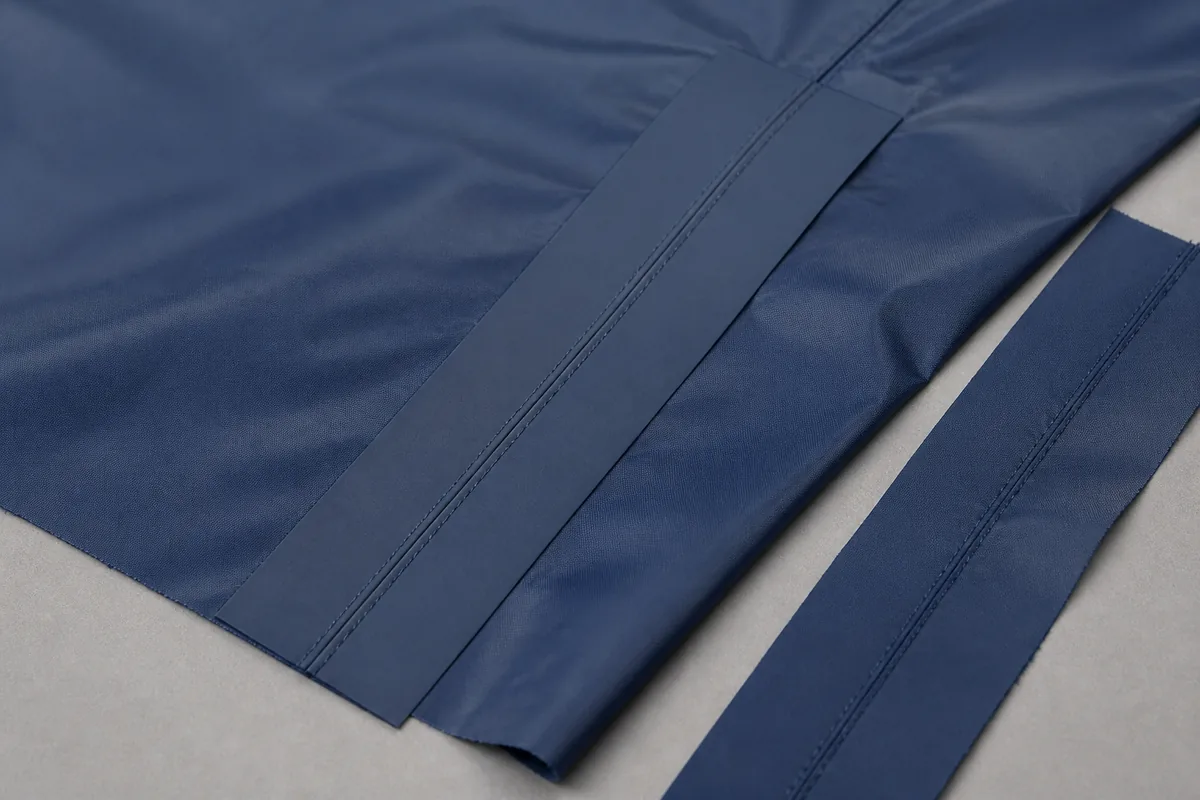
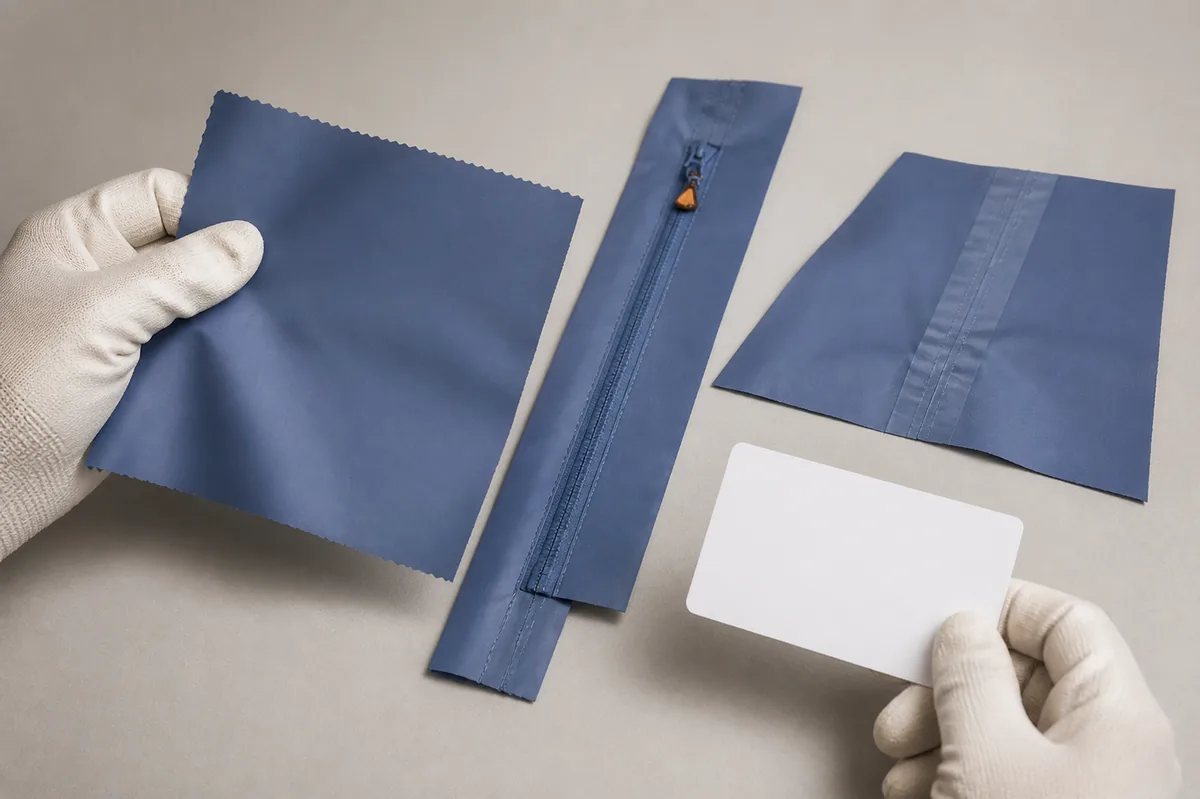
The swatch set displays coated face, reverse, weave, color and hand for one material approval.Curved seams, overlaps and bulky junctions identify the tape routes that need finished-construction review.
Yarn
Use denier and yarn data as identity fields, not rankings
Denier describes linear density under a stated convention; it does not independently predict waterproofness, tear behavior, softness or durability. Record yarn or supplier construction data when it is material to the project, together with the weave, finished mass and controlled swatch.
Avoid comparing isolated numbers from unrelated fabrics. A finer yarn in a dense construction can behave differently from a heavier yarn in another weave, especially after coating and finishing.
Construction
Record weave, surface texture and visible finish
Plain, ripstop, pongee, taffeta and Oxford descriptions can signal different structures, but trade names vary. Approve the actual face texture, luster, drape, wrinkle behavior and reverse appearance under agreed lighting. Link the reference to a supplier code or sealed sample.
Confirm garment category and silhouette on the approved sample, then verify fiber content, weight and coating chemistry in the specification and evidence file.
Process fit
Connect substrate selection to cutting, sewing and end use
The substrate must tolerate the selected needle, seam allowance, tape, heat, print and repeated folding route. Ask for construction coupons before a full garment when compatibility is uncertain. Map high-load zones such as crotch, shoulder, pocket and closure reinforcement.
A material can look suitable in a flat swatch yet distort, pucker or lose hand after assembly. Approve the finished interface as well as the roll.
Lot control
Plan shade lots and material allocation before cutting
Custom color, coating finish and weave appearance can vary between lots. Define the approved viewing condition, allocation rule and what may be mixed within one garment, carton or destination.
Retain practical references and require notification before a later lot or alternative source enters production.
Coated-polyester rainwear entity and approval matrix
Controlled object
Fields to freeze
Commercial effect
Closing record
Textile substrate
Fiber statement, weave, yarn data when relevant, finished mass, face, reverse and color lot
Hand, cutting, coating behavior and lot allocation
Approved swatch, supplier code and specification revision
Barrier assembly
Coating or laminate route, wearer side, lining and compatible join
Interface development, evidence and pack behavior
Layer declaration plus approved construction coupon
Garment SKU
Architecture, measurements, openings, components and wearer task
Pattern, trim count, size ratio and inspection burden
Pre-production garment and controlled measurement chart
Appearance system
Color reference, artwork, trim match and permitted variation
Custom lots, process trials and replenishment continuity
Actual-material approval and production artwork
Release package
Evidence scope, defect rules, unit pack and destination cartons
Testing, inspection, allocation and shipment timing
Evidence register, inspection result and carton matrix
Decision 04 · Barrier system
Distinguish Direct Coating, Lamination, Surface Finish and Lining
A polyester face may carry a coating, bonded film, surface treatment and optional lining. Each layer answers a different question and must remain connected to the approved specimen.
Layer stack
Name the coating or laminate route and wearer side
Ask the supplier to describe the construction from outside to inside: face textile, surface finish, coating or laminated layer, backing and lining. Record which side is exposed, which receives seam tape and whether the structure is continuous across the garment.
Words such as PU-coated, PVC-coated or laminated are starting points. They do not establish chemistry, thickness, hand, breathability or a finished-garment result without project evidence.
Surface
Separate DWR or surface wet-out from the main barrier
A repellent finish can influence beading and wet-out while the primary barrier may be a coating or film. Define the intended claim and evidence scope so a surface observation is not confused with water entry through the complete garment.
Care, abrasion and contamination can change surface behavior. Any retention statement needs a named method, condition and accepted sample rather than a general promise.
Wearer side
Treat lining and inner contact as a separate design system
Mesh, tricot, jersey or no lining changes feel, airflow, drying, print access and pack volume. Define coverage, attachment, color and behavior at hood, cuff, hem and pocket interfaces. Confirm whether an inner print or transfer can contact the coating during folding.
Lining can hide tape and seam workmanship during routine inspection. Build access and inspection records into the sample plan.
Conditioning
Ask how heat, humidity and care affect the selected layer stack
Where the service model creates risk, define conditioning or aging challenges relevant to the chosen coating, laminate, adhesive, lining and print. Record the sample, duration, environment and acceptance observation.
Do not copy universal hydrolysis, wash or cold-flex claims from unrelated products; the project evidence must represent the actual construction.
Decision 05 · Water-entry map
Audit Seam Tape, Stitching, Zippers, Hoods and Pockets as One System
A fabric result cannot close every path in the finished garment. Build an interface map from hood crown to hem and assign a construction and challenge to each critical path.
Seam tape
Qualify tape against the exact coated reverse
Record tape identity, width, application route and the machine parameters controlled by production. Review adhesion, edge lift, channeling, puckering and overlap on straight, curved and bulky seams. Connect the approved coupon to the exact fabric code and color route.
Changing coating, backing, tape or settings can invalidate the earlier compatibility result. Define the notification and retest trigger before bulk production.
Closure
Design the front closure as more than a zipper
Specify zipper construction, flap direction and overlap, top garage, chin area, lower termination and secondary fasteners. Test operation with expected gloves and layers. Inspect the entire assembly in the worn shape rather than relying on a component label.
Water-resistant component language does not prove the complete opening. The surrounding seams, flap, user behavior and garment posture remain part of the system.
Secondary openings
Map hood, pockets, vents, cuffs and hem paths
Define hood attachment and adjustment, brim or peak, pocket entry, vent cover, cuff closure and hem drawcord or finish. Decide which openings must remain functional in rain and which can be simplified. Include drainage and snag concerns where relevant.
Every added opening should answer a buyer task and enter the sample challenge. Avoid decorative complexity that creates uncontrolled entry paths.
Service feedback
Include repair, damage and field feedback in the interface plan
Decide whether damaged garments are replaced, repaired or returned for analysis. Give users a simple way to report location, weather, motion and product identity so complaints can be traced to a seam, opening, material or operation.
Field feedback becomes useful when it connects to the production revision and lot rather than to a generic product name.
Decision 06 · Fit and movement
Approve Layered Fit, Hood Rotation and Reach across the Size Range
Finished measurements become useful only when connected to a wearer population, clothing layers and movement tasks. Approve the base size and then challenge grade behavior at both ends of the range.
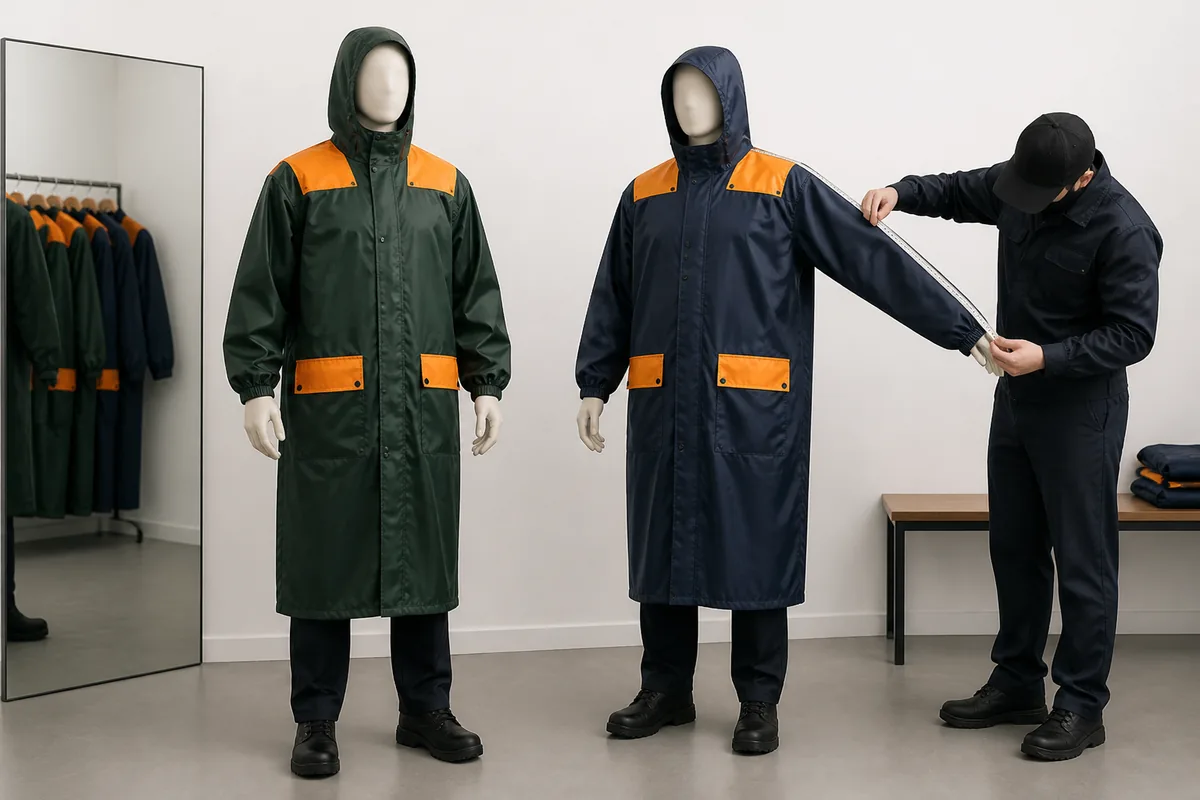
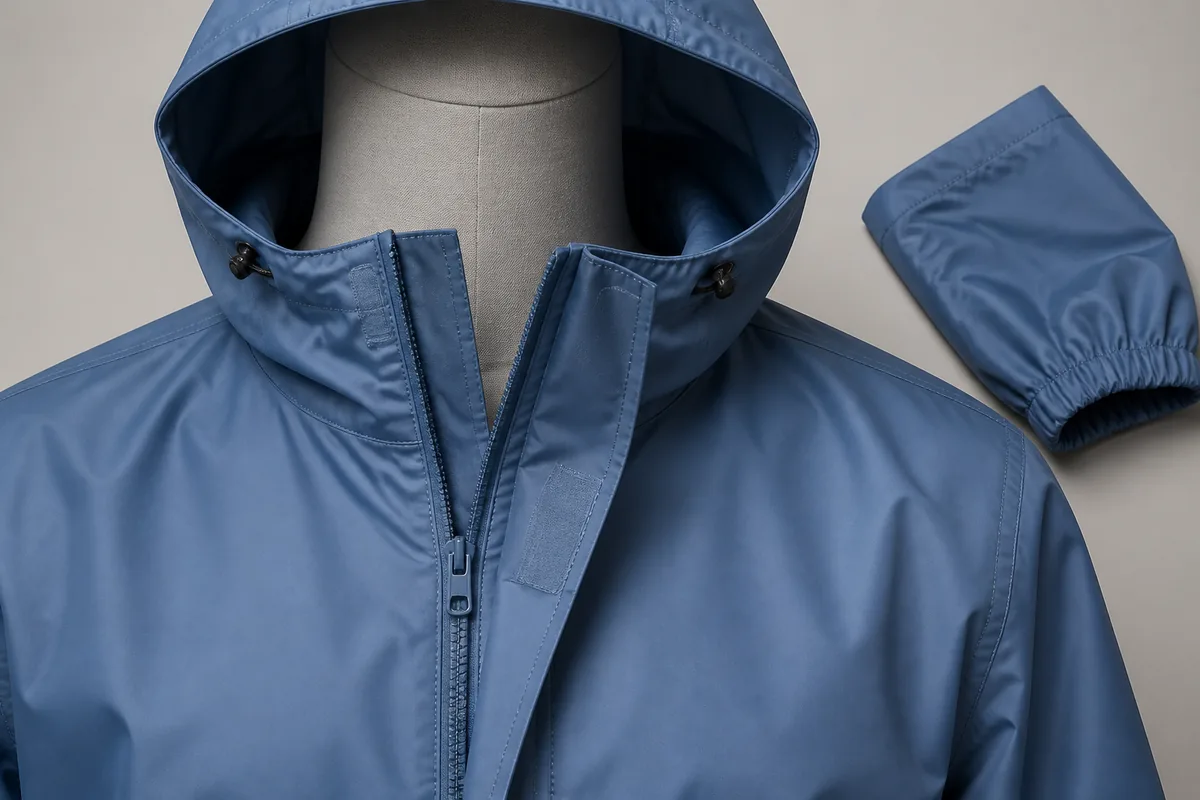
Movement poses connect the measurement chart to sleeve reach, overlap, hood control and lower-body clearance.Hood, collar, storm flap, cuff and zipper interfaces are arranged for visibility, adjustment, glove-use and rain-path review.
Measurement
Write a measurement chart with defined points and tolerances
Identify chest, waist, hip, body length, sleeve, inseam, rise, hood and relevant opening measurements using clear diagrams. State whether values are garment or body measurements and which layer allowance is included. Set tolerances by functional risk rather than copying one value everywhere.
Measure the same conditioned sample state used for approval. Garment posture and lining can change apparent dimensions if the method is not controlled.
Movement
Challenge reach, bend, sit, step and head-turn tasks
Observe sleeve pull, hem lift, waist gap, crotch restriction, knee clearance, hood rotation and visibility during representative motion. Record size, wearer or form, layer set and any equipment. A pass should refer to these conditions rather than to a universal comfort claim.
Correct the pattern or architecture when the problem is local. Simply increasing every dimension can create excess fabric and wind or snag issues.
Size set
Review smallest and largest sizes before freezing the grade
The base sample can hide grade problems at sleeve, hood, torso and rise. Review representative end sizes with the production material and components, especially where pocket, reflective or artwork positions must move or remain fixed.
For mixed-size event or work programs, connect the approved grade to the allocation plan so packaging does not recreate a fit problem through the wrong size ratio.
Grade interaction
Link grade changes to pockets, artwork and reflective layouts
As sizes change, fixed placements can move relative to seams, wearer visibility and equipment. Define which dimensions scale, which stay fixed and when the smallest and largest sizes need separate visual approval.
This avoids a base-size approval that produces crowded artwork or misplaced components at the range ends.
Decision 07 · Usability interface
Coordinate Hood, Collar, Front Closure, Cuffs and Equipment Access
Usability failures often appear where the wearer must see, grip, turn, reach or pass equipment through the garment. Review these interfaces together, not as isolated trim options.
Hood
Fit the hood to the expected headwear and sightline
State whether the hood is fixed, detachable, stowable or helmet-compatible. Review crown depth, face opening, peak, drawcord position, collar connection and rear adjustment while the wearer turns and looks up and down.
Do not add cords or small components without reviewing age group, snag and destination requirements. Any safety statement needs applicable evidence.
Operation
Make front and cuff controls operable in the real task
Test zipper pull, snaps, hook-and-loop and cuff tabs with expected gloves, wet hands and layers. Check that closures do not expose sharp edges, catch adjacent fabric or create a pressure point after folding.
A component that performs well alone can become difficult when the flap, lining or seam allowance interferes. Approve the assembled location.
Equipment
Preserve access to pockets, radios, packs and trousers
Map where the wearer needs to reach through or around the shell. Pocket positions, side access and hem length should not conflict with harnesses, backpack belts or work surfaces. For suits, confirm jacket-to-trouser overlap during access.
Keep project-specific equipment in the trial record. One successful use case should not be presented as evidence for every occupation.
Trim register
Control component identity, color and substitution
Record zipper, snap, cord, adjuster, thread, binding and label references with color and intended location. Identify critical performance or appearance attributes and the notification needed before substitution.
A visually similar trim can change operation, corrosion risk, color match, sewing behavior or evidence scope.
Decision 08 · Appearance system
Qualify Color, Artwork, Reflective Details and Components on the Actual Surface
Color and branding decisions interact with coating, heat, flex, seam tape, laundering and folding. Approve them as a system on the intended material and garment location.
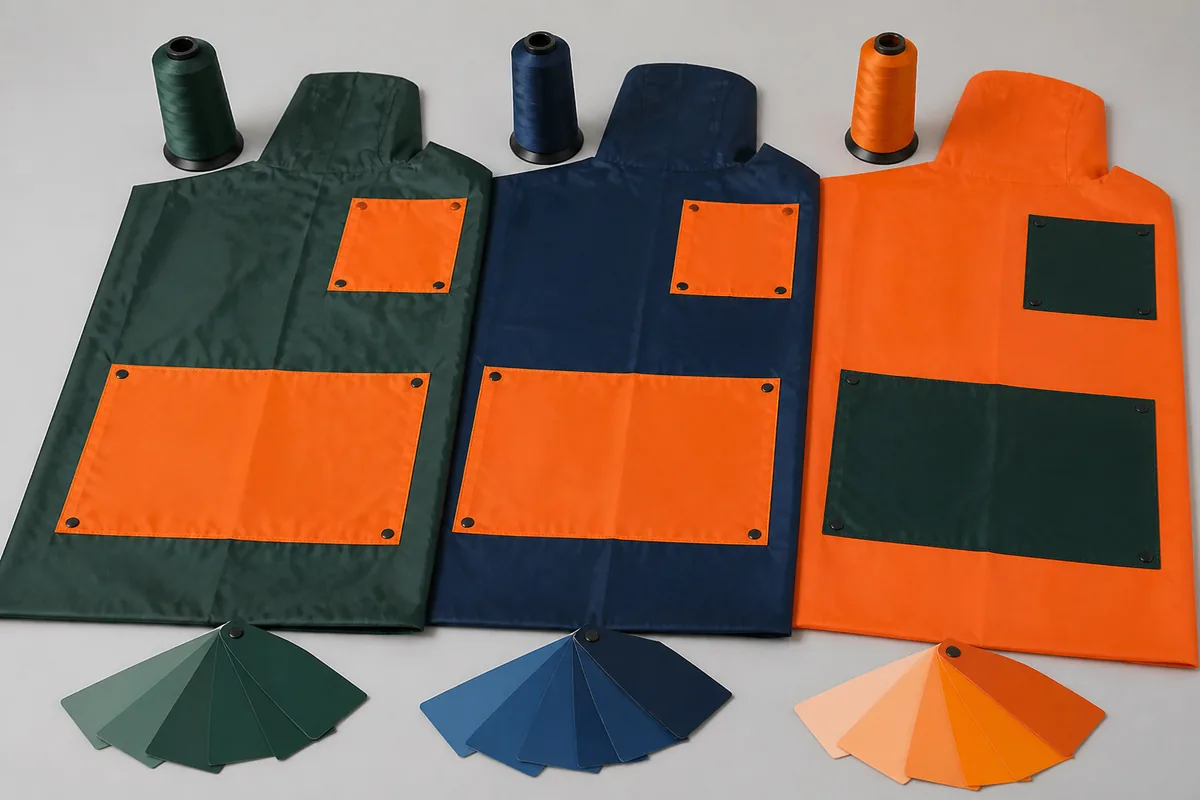
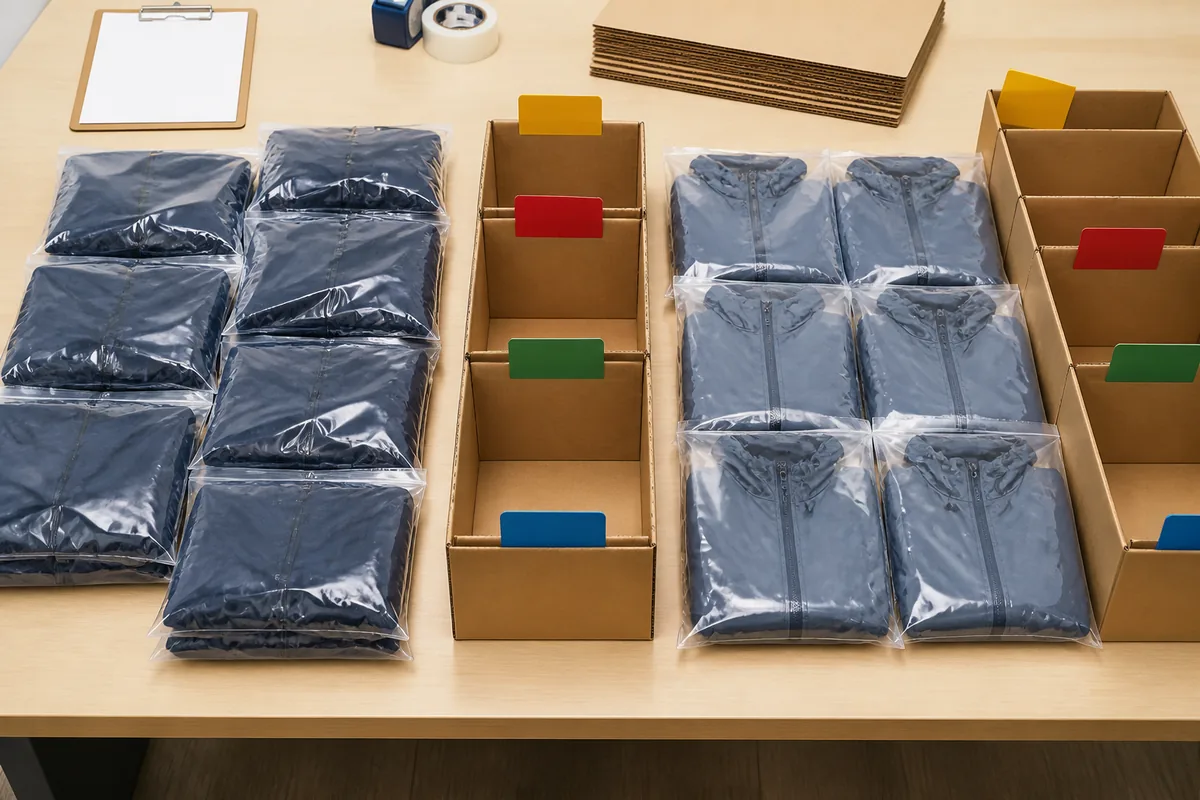
Actual-material trials compare color, decoration placement and reflective trim on the proposed coated polyester surface.The release bench combines material, measurement, workmanship and document checks for finished-product review.The allocation layout connects garment identity, folding, labels and destination cartons for packing approval.
Color
Approve color under controlled light and with adjacent trims
Define a master reference, viewing condition, surface side and allowable lot variation. Compare shell, zipper tape, binding, thread and printed areas together because coating gloss and texture can change perceived color.
Record whether color is stock, custom or print-derived. The choice can divide material lots and affect timing, but the public page makes no fixed MOQ promise.
Artwork
Trial decoration on the production material and location
Use buyer-authorized files with dimensions, placement and color callouts. Evaluate adhesion, cure, opacity, stretch, hand, puckering, needle holes and transfer after realistic folding or care. Approve a finished location when seams or curves affect the result.
A flat artwork proof confirms layout, not compatibility. Keep digital approval, material coupon and finished sample as distinct records.
Components
Separate visible reflective trim from a regulated claim
Define trim identity, width, layout, attachment and intended statement. Request current product-specific evidence when the buyer needs a regulated high-visibility or photometric claim. Do not infer compliance from silver appearance in a photograph.
Apply the same scope discipline to zippers, snaps and adjusters: component documents answer component questions, while the garment assembly needs its own review.
Approval ownership
Assign comment authority and close every open sample decision
Name who can approve fit, color, artwork, evidence, packing and commercial deviations. Use dated comments with accepted, rejected, revised or open status and attach them to the corresponding sample revision.
Silence, shipment of a sample or a chat message should not be treated as unqualified approval.
Decision 09 · Sample governance
Use Separate Material, Construction, Fit, Pack and Pre-Production Gates
One attractive sample cannot close every decision. Give each sample a purpose, pass criteria, comment owner and revision so approval can be traced into bulk production.
Material gate
Start with swatches and coupons when compatibility is open
Approve face, reverse, color, hand and declared construction on controlled swatches. Build seam tape, print, reinforcement and fold coupons for the risky interfaces. This is faster than discovering incompatible layers after a complete size set is made.
Record sample identity and what remains unresolved. A coupon approval applies only to the represented material, settings and task.
Garment gate
Use development and size-set samples for architecture and movement
Review coverage, opening layout, component access, lining, finished measurements and movement on the intended route. Convert every comment into a measurable action or controlled visual reference with an owner and due date.
Avoid ambiguous instructions such as improve quality or make it bigger. Identify the exact location, observed issue and acceptance condition.
Release gate
Seal pre-production and packed references before bulk release
The approved pre-production garment should connect to the current bill of materials, measurement chart, artwork, component references, evidence plan and packing instruction. A packed reference confirms fold, labels, included parts and carton presentation.
If a later substitution changes an approved object, reopen the affected checks instead of relabeling the earlier sample as proof.
Defect language
Create a defect taxonomy tied to business consequence
Define examples for critical, major and minor issues where the buyer uses those categories, and connect them to function, appearance, labeling and allocation. Include photographs or controlled references when wording may be interpreted differently.
Acceptance levels and sampling remain project decisions; the useful control is a shared understanding of what each named defect means.
Decision 10 · Quality release
Connect Incoming Material, In-Process Checks and Finished-Garment Evidence
Inspection should follow the risk map established during development. Material identity, workmanship, dimensions, interfaces, claims and packing are related stages, not interchangeable checklists.
Incoming
Verify incoming lots against the approved material record
Compare supplier code, color lot, width, surface, reverse, hand and required project checks before cutting. Segregate unclear or unapproved material and preserve practical lot traceability into finished production.
A visual match is not a substitute for a required composition or performance record. Use the evidence type agreed for the claim.
In process
Inspect critical construction before the whole lot repeats it
Check early output for seam and tape placement, closure alignment, hood geometry, reinforcement, artwork location and critical measurements. Define named defects, severity and disposition instead of relying on a vague workmanship label.
Frequency and sampling should reflect lot size, process risk and buyer agreement. This page does not publish one universal inspection plan.
Final
Release the finished lot with traceable results and deviations
Verify SKU, size, color, measurements, appearance, critical interfaces, labels, packing and required documents against the current revision. Identify the inspected lot, sample basis, result, open deviation and approver.
When evidence is outside the acceptance boundary, isolate the affected production and record correction, new sampling or an authorized waiver. Do not turn an open deviation into an unqualified public claim.
Transit condition
Review carton moisture, stacking and destination handling
Consider warehouse dwell, container climate, stacking pressure and the way cartons are opened and redistributed. Select carton, liner or desiccant decisions only when justified by the approved transit and product risk.
Logistics controls should prevent avoidable damage without creating unsupported guarantees about every route or climate.
Approved textile
Interface sample
Wear-trial garment
Destination pack
Authorized lot disposition
Decision 11 · Supply continuity
Control Folding, Carton Allocation, Transit and Repeat Orders
Coated garments can change through pressure, moisture, color contact and substitution. The pack plan and reorder file are part of product control, not logistics afterthoughts.
Unit pack
Approve the fold and individual pack on the final construction
Check that garments are clean and appropriately dry, that coated faces and printed areas do not create avoidable transfer, and that cords, zippers and trims are positioned without pressure damage. Record bag, insert, label and reopening presentation.
A hanging sample cannot prove packed behavior. Challenge realistic storage time and temperature when the risk justifies it.
Allocation
Build a carton matrix by SKU, size, color and destination
Define solid or mixed assortments, inner grouping, quantities, carton marks, destination and reserve stock. Verify product identity and count together. Correct total quantity in the wrong size ratio or location can still create a major commercial failure.
Use buyer-provided barcodes or private identifiers only in controlled order files, not public website content.
Reorder
Protect replenishment with retained references and notification
Keep the approved specification, material and component identities, measurement revision, artwork, pack matrix, evidence and inspection outcome. Before each repeat, confirm availability and changes in source, construction, regulation or destination.
Absolute duplication across production dates is not a responsible promise. Establish the acceptable comparison range and a written review route so any alternative is approved before production.
Value engineering
Model cost drivers before simplifying the specification
Separate material, color, component, labor, evidence, packing and lot-fragmentation drivers. When a target price requires change, identify which controlled attribute changes and reopen the affected sample or evidence gate.
Do not achieve a lower number by silently removing tape, lining, reinforcement or inspection work that defined the accepted product.
Decision 12 · Comparable RFQ
Issue a Polyester Rainwear RFQ That Exposes Assumptions and Exclusions
A controlled RFQ combines architecture, material, evidence, quantity and commercial rules. It lets suppliers identify open decisions instead of solving them invisibly inside the price.
Product
Complete the technical and entity block
State the wearer and use, product route, substrate, barrier and lining, seams, openings, fit, components, color, artwork, evidence, packing and approved references. Assign a stable SKU and revision to each distinct object.
Mark unknown values as decision requests with a responsible owner. Honest open fields are safer than copied numbers that have no relation to the project.
Commercial
Complete the quantity, allocation and delivery block
Map the forecast by SKU, wearer size, approved shade and receiving location; then add sample checkpoints, requested arrival window and trade term. Mark which figures are planning estimates and which authorize purchasing so every source uses the same demand basis.
MOQ and timing depend on the actual route, evidence and packing. EverBen confirms them after reviewing the complete brief rather than publishing a universal promise.
Governance
Request assumptions, deviations and release records
Ask each supplier to list included tasks, alternatives, exclusions, quotation validity, buyer inputs and changes that trigger new pricing or evidence. Define the sample, document and inspection records required before bulk and shipment release.
The result may not be the lowest headline number, but it makes technical risk and hidden work visible enough for a defensible decision.
Quote control
Freeze quotation revision and validity with the product revision
Identify the specification and artwork revision used for price, the included quantity mix, currency and trade assumptions, and the validity period. Require a new comparison when material, evidence, pack or allocation changes materially.
This keeps an old commercial offer from being attached to a product that no longer matches its original scope.
Procurement questions for coated polyester programs
Questions Buyers Use to Close a Coated-Polyester Program
What must a buyer specify beyond polyester rainwear?
Start with the wearer and rain event, then record architecture, woven base, barrier layers, lining, joined panels, openings, measurements, trim, appearance, allocation and proof requirements. A fiber declaration leaves most quotation variables unresolved.
Does coated polyester automatically make a finished raincoat waterproof?
No. The coated material is one part of the system. Seam holes, tape, hood, zipper, pockets, cuffs, hem, fit and workmanship remain possible entry paths. Match any claim to the tested specimen, method and finished construction.
How should coating and seam tape be approved together?
Screen the exact coated reverse and tape on controlled coupons, record production settings, then review curves, overlaps and bulky junctions on the finished sample. Reopen compatibility checks when the material, tape or process changes.
Can jackets, ponchos and suits share one polyester rainwear program?
They can share coordination, color intent and some materials, but each SKU needs its own architecture, size logic, interfaces, sample approval, evidence scope and packing record. A program view must not erase item responsibility.
What changes MOQ and production timing?
Material availability, custom color, coating or laminate route, lining, style count, size and color split, components, artwork, evidence, packing, sample revisions and season can divide lots or add work. EverBen confirms MOQ and timing after reviewing the complete brief.
Which controls prevent polyester replenishment from departing from the released build?
Maintain a revision-controlled specification, material and component references, measurement chart, artwork, pack matrix, evidence register and inspection outcome. Require written notification and review before any source or construction change.