
Procurement guide · nylon shell systems · sample-to-bulk decisions
Nylon Rainwear Buying Guide for B2B Procurement Teams
Use this guide to diagnose wetness, match architecture to motion, translate material language, examine openings, challenge samples and compare suppliers without confusing a fiber name with a finished product.
Written for overseas B2B purchasing, technical, product-development and brand teams preparing a custom rainwear program.
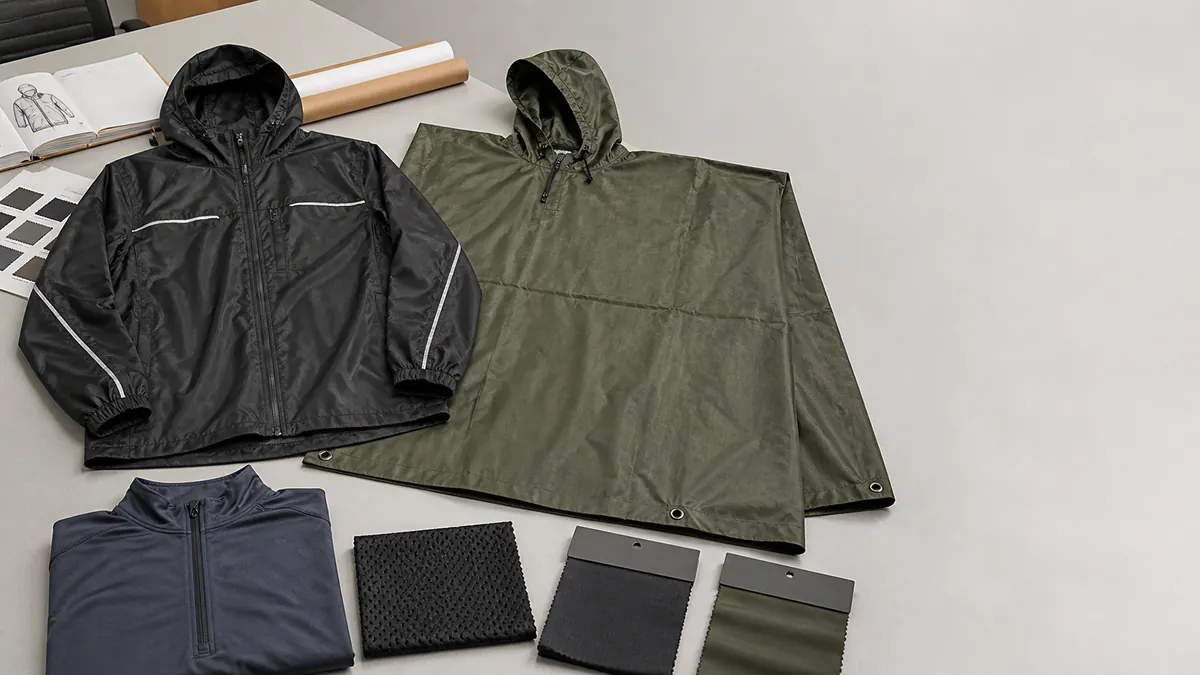
Buyer education path
Move from a Wearer Report to a Controlled Supplier Decision
Consumer guides often stop at shopping features. A B2B buyer must connect the use condition to material identity, finished construction, size set, artwork, packing, evidence and repeat-order control. The sections below turn those links into questions a purchasing team can use.
Ask what the observation can and cannot prove.
A field report, photograph, swatch test and finished-garment challenge answer different questions. Keep each result attached to the exact sample and condition.
How to use this guide
Start with the reported problem, select the relevant decision section, then carry the open fields into the Product page RFQ. No competitor claim becomes an EverBen fact.
Buying lesson 01 · Diagnose first
When Nylon Rainwear Feels Wet, Identify the Source before Changing the Fabric
A wearer report that “the jacket leaked” is important but incomplete. Procurement should separate external entry, internal moisture and wet-contact transfer before changing materials or accepting a supplier explanation.
Rain entry
Trace external water from the first likely interface
Start at the hood edge, collar, shoulder, front closure, pocket, cuff and hem rather than the center of a large panel. Ask when the sensation began, what direction the rain came from and which movement occurred. A damp area below a zipper or neckline can indicate an interface path even when the shell fabric itself remains continuous.
Photograph and mark the first observed location, then inspect the corresponding outer and inner construction. Do not turn one field report into a universal material conclusion without recreating the relevant condition on the identified sample.
Internal moisture
Separate condensation and wearer output from outside ingress
Warm humid air can collect inside a shell during walking, cycling or work. Compare activity intensity, layers, vent use and temperature. Widespread internal dampness without a clear path may require a ventilation or layering review, while a narrow repeatable wet line near a seam points to a different investigation.
This distinction protects the buyer from purchasing an unnecessarily heavy construction while leaving the real heat-management problem unchanged. It also prevents a supplier from dismissing a localized construction issue as perspiration.
Contact transfer
Check whether cuffs hems and wet outer layers transfer water inward
Water can move when a wet cuff contacts an inner sleeve, a raised hem touches clothing, or a saturated hood is folded into the collar. Observe donning, removal and storage behavior as well as exposure. The product may need a different interface, instruction or recovery routine rather than a new fiber.
Use a simple failure record: sample identity, wearer, layer set, conditions, time, first location, movement and photographs. This creates a repeatable question instead of a vague complaint.
Buying lesson 02 · Coverage logic
Match Jacket, Poncho and Suit Coverage to Weather, Motion and Issue Method
Architecture determines where the product opens, how it moves and how many sizes or components the buyer must control. Compare routes through the operating job instead of treating them as interchangeable nylon raincoats.
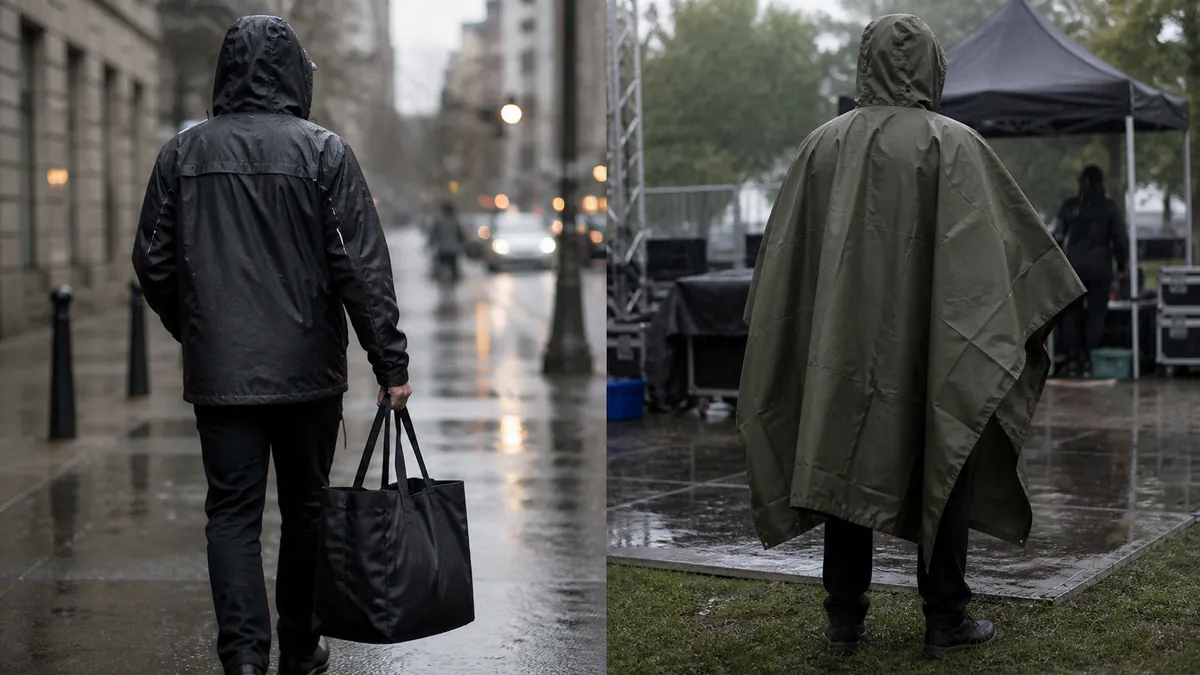
Jacket question
Choose a jacket when mobility and controlled access outweigh maximum drape
A jacket can support arm movement, pockets and layered fit, but it concentrates decisions at cuffs, front closure and hem. Ask whether the wearer reaches, cycles, carries tools or removes the garment frequently. Define the clothing underneath and whether lower-body exposure remains acceptable.
A short unlined shell, lined work jacket and longer activity coat can all be called nylon rain jackets. The buying brief must identify the route before price, weight or feature comparisons become meaningful.
Poncho question
Choose a poncho when rapid broad coverage outweighs close control
A poncho may cover varied body sizes and a small carried item with fewer sleeve decisions. Check wind lift, side openness, arm access, sitting behavior and equipment clearance. Event issue and trail reserve use can lead to different hood, length and fastening requirements.
Do not assume that broad fit equals universal fit or that a poncho designed for walking is suitable for cycling. Moving equipment and wheels create a separate safety and geometry review.
Suit question
Choose a coordinated suit when waist and lower-body exposure matter
A two-piece suit adds waist overlap and size pairing; a one-piece route adds torso-length and donning complexity. Ask how boots, gloves and protective clothing pass through openings. Determine whether jacket and trousers are packed, issued and replenished as one SKU or separate components.
If high-visibility, road, protective or motorcycle claims are required, request product-specific evidence. Color and reflective trim alone do not establish regulated performance.
Buying lesson 03 · Material translation
Translate Nylon, Ripstop, Coated and Breathable Language into Verifiable Fields
Marketing terms can point to useful product ideas, but they rarely define a comparable material. Convert each word into an entity, attribute, specimen and evidence question before supplier selection.
Base textile
Ask what the nylon word identifies and what it leaves open
Nylon may identify fiber composition while leaving yarn, denier, weave, mass, color and finish unspecified. Ripstop describes a reinforcing grid construction, not an automatic strength or waterproof result. Request the exact material code, controlled swatch and values relevant to the project.
Confirm the woven shell and garment structure on the approved physical sample, then verify composition and performance through the specification and evidence file.
Treatment route
Ask what creates water resistance in the shell system
A surface water-repellent treatment, backside coating and laminate serve different roles. Identify the treatment, side, lining, seam compatibility and finished-garment openings. If a numeric claim matters, name the test specimen, method, condition and acceptance rather than accepting a bare value.
Fabric evidence should follow the material revision used for the sample. It should not be transferred from another color, coating, supplier or product without a documented basis.
Comfort claim
Ask what breathable means in the stated activity and construction
A published vapor figure, if supported, describes a defined material test and does not predict every wearer’s comfort. Lining, vents, fit, weather, output and layers influence the internal climate. Ask how the supplier proposes to connect material evidence to the intended activity and finished garment.
For light activity, simplicity may be more valuable than added vents. For higher output, a vent or mesh route may deserve a sample challenge. The correct choice is conditional, not a slogan.
| Observed issue | First question | Inspect next | Do not assume |
|---|---|---|---|
| Localized wet line | Where and when did it begin? | Corresponding seam, flap or opening | The base nylon failed |
| Widespread inner dampness | What was the activity and layer set? | Vent use, lining and internal climate | Rain entered everywhere |
| Poor reach or hem lift | Which movement and size? | Layered fit, grade and pattern balance | A larger size fixes every issue |
| Print lift or shell puckering | Which method, surface and care challenge? | Coupon, location and fold contact | The artwork file alone proves approval |
Buying lesson 04 · Moisture balance
Plan Layers, Vents and Linings as a Moisture-Management System
Rain protection and internal comfort are related but separate. A good buying guide connects exertion, weather and recovery to the shell, midlayer, vent and lining decisions.
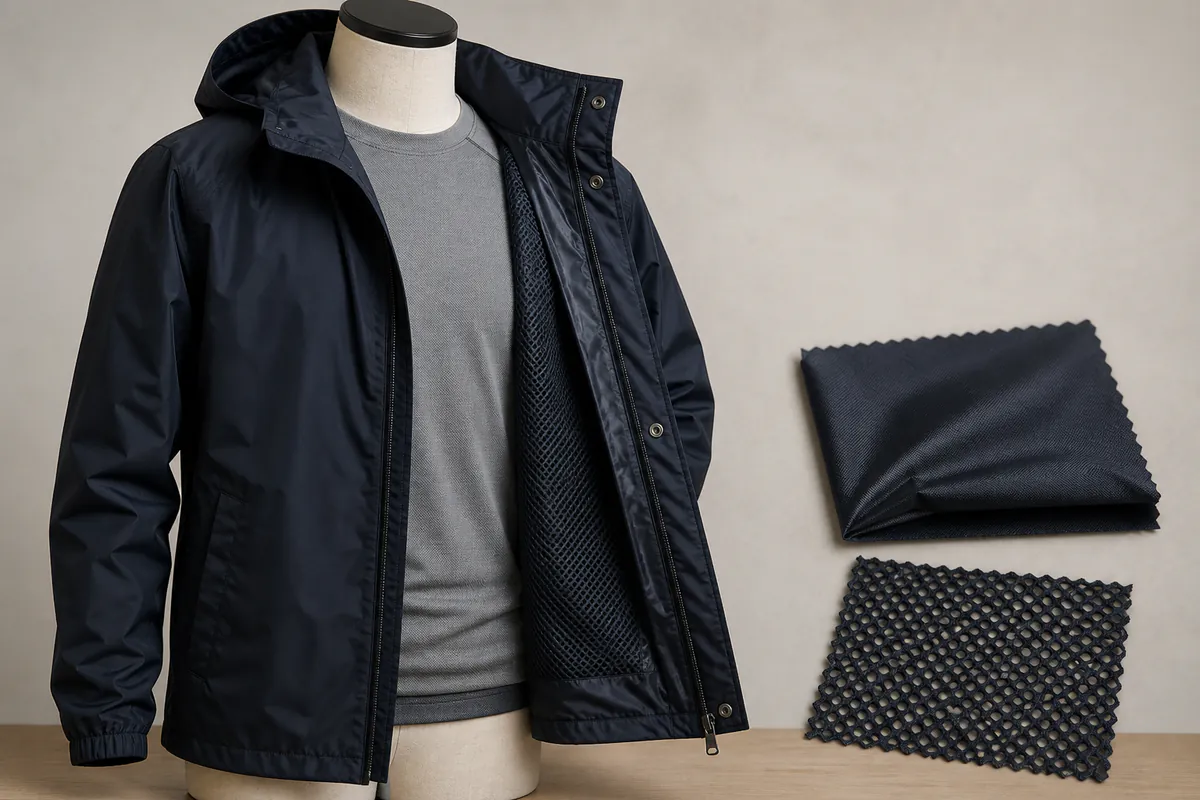
Activity pattern
Start with heat generation and the opportunity to adjust
Describe whether wearers can slow down, open a vent, remove a layer or reach shelter. A commuter, grounds crew and queue steward have different adjustment opportunities. The best architecture for one may trap heat or admit rain for another.
Build a short scenario with temperature, activity, duration, layers and wind. Use it to review the sample rather than relying on a generic breathable label.
Vent geometry
Choose vent location only after mapping rain and movement
Back yokes, underarm openings and mesh-backed zones can support airflow while creating additional seams and openings. Ask how each vent is covered, oriented and prevented from gaping during the key movements. Consider carried straps, decoration and reflective placement.
A vent that remains blocked by a backpack or becomes an entry path under driven rain may add cost without helping the operating job.
Lining decision
Treat lining as a controlled layer with its own trade-offs
Mesh can separate the shell from clothing and support some vent structures; tricot can protect a membrane; fleece can add warmth and bulk. Specify coverage and attachment. Review how the lining moves, dries, snags and affects decoration access.
Do not let suppliers substitute lining types under one generic word. A change can alter fit, pack volume, internal feel and the garment’s production process.
Buying lesson 05 · Interface audit
Inspect the Hood, Front, Pocket, Cuff and Hem as Connected Openings
Most rainwear is not a sealed bag. It contains openings for sight, hands, movement, storage and donning. The buyer should audit how those openings interact through posture and weather.
Head interface
Review hood field of view rotation and collar transition
Check the intended cap, helmet or bare-head route. Observe face opening, crown volume, brim or peak, drawcord placement and the transition into the collar. Turn the head and look down as well as forward. A hood that looks generous when flat can pull the jacket or block vision in use.
Record whether components create loose ends or small-part concerns for the target market. Do not add cords or stoppers by default.
Torso interface
Review the front closure and pocket access under rain direction
Operate the zipper or snaps with expected gloves and layers. Inspect flap overlap, top and bottom terminations, pocket orientation and drainage. A component marketed as water resistant cannot compensate for an exposed termination or an open pocket.
Decide which contents, if any, a pocket is expected to protect. If critical items require dry storage, specify that need and evidence rather than relying on the word pocket.
Edge interface
Review cuffs hems and lower-leg openings during movement
Raise the arms, bend, sit and step over the footwear expected in use. Observe sleeve retreat, hem lift, trouser overlap and the operation of zippers, hook-and-loop or elastic. Adjustability must remain usable without leaving hardware in a snag-prone location.
Create acceptance language for coverage and operation. Avoid vague terms such as good fit or tight cuff without a stated wearer, layer and task.
Buying lesson 06 · Evidence method
Run a Nylon Rainwear Sample Challenge That Can Explain a Failure
The purpose of a sample challenge is not to create a dramatic pass image. It is to identify which material, junction, movement or user interaction should be changed before bulk release.
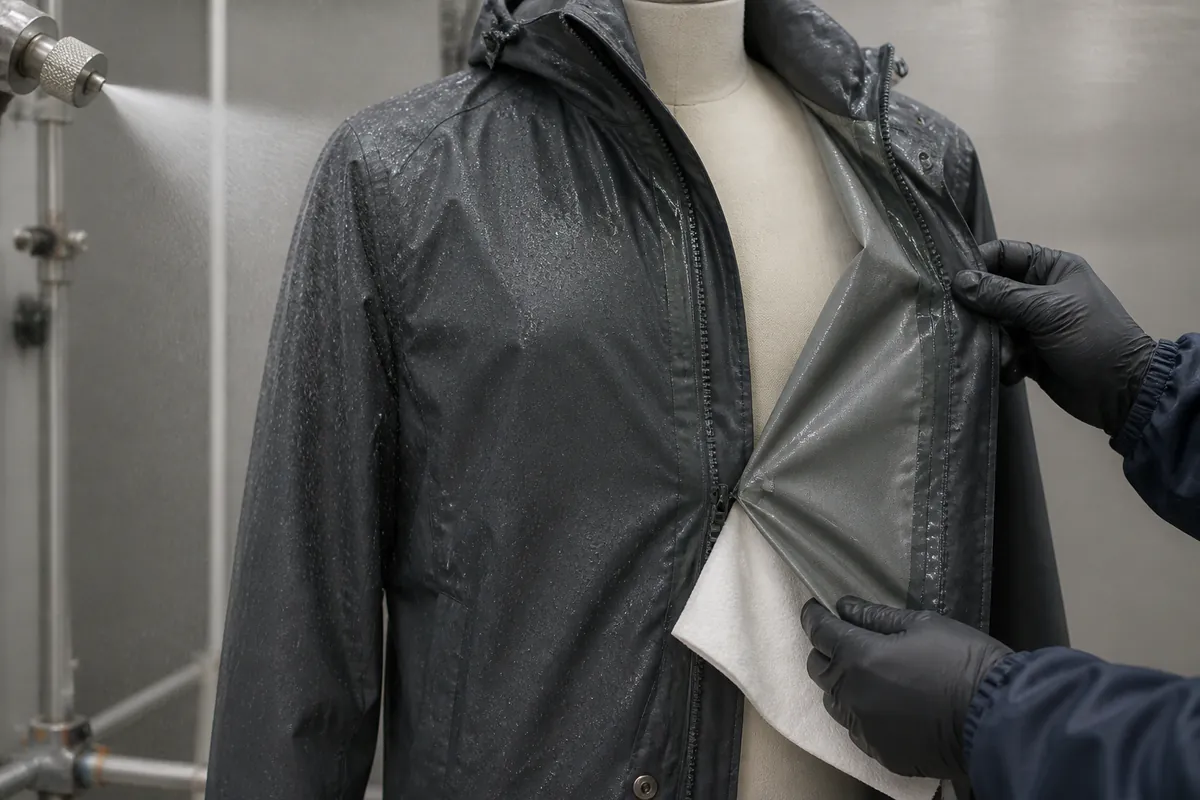
Test question
Write the condition and observation plan before applying water
Define sample identity, conditioning, layer set, wearer or form, spray direction, duration, movements and observation points. Use a method appropriate to the claim when a formal value is required. For development, a controlled challenge can reveal design issues without being presented as certification.
Decide who records the first visible change and how it is marked. Inspecting only after the whole interior is wet makes the original path difficult to determine.
Dynamic path
Observe junctions while the garment changes posture
Include head turn, reach, bend and closure operation if they belong to the use case. Watch curved seams, flap edges, pocket openings, cuffs and hem. A stationary test can miss gaps created by movement, while uncontrolled motion can make results impossible to compare.
Keep the movement sequence consistent across revisions. Note any deviation instead of forcing a simple pass or fail conclusion.
Corrective loop
Classify the result and rerun only the affected decision chain
Separate shell material, seam process, pattern geometry, component, fit and user-operation causes. Change one controlled variable where possible, then repeat the relevant challenge. A heavier material cannot repair every opening problem, and additional tape cannot correct an unsuitable pattern.
Retain unsuccessful evidence. It prevents a rejected construction from returning later during cost reduction or supplier substitution.
Buying lesson 07 · Fit evidence
Read a Nylon Rainwear Size Set through Layers, Grade and Motion
A measurement table is necessary, but it becomes useful only when the buyer understands how the values support the wearer range and task.
Measurement clarity
Check where and how every finished measurement is taken
Ask for diagrams covering finished back length, half-chest, bottom opening, arm reach, hood and relevant trouser or overall fields. Confirm whether garments are measured flat, closed and relaxed. Ambiguous points create apparent inspection differences even when production has not changed.
Prioritize dimensions with a coverage, donning or compatibility effect. Do not collect dozens of measurements without ownership or acceptance criteria.
Grade logic
Review the middle size then test grade behavior at the extremes
The center size helps establish the base pattern and movement. The smallest and largest sizes reveal whether sleeve, hood, rise, torso and opening relationships scale sensibly. A fixed grade increment can create disproportionate results at the ends.
Document the wearer and layer used for each trial. If the population or regional fit changes, consider a separate size block rather than stretching one grade.
Material interaction
Connect fit findings to the exact shell and lining build
Stiffer coating, added lining or decoration can change drape and perceived ease even when the measurement chart remains unchanged. Review the final material route in the size set. A substitute fabric should not inherit fit approval automatically.
Keep the approved size record, revision and change triggers together so a reorder does not rely on an old label alone.
Buying lesson 08 · After exposure
Evaluate Packability, Drying and Storage without Damaging the Shell System
A small packed volume is attractive, but repeated compression, wet storage and print contact can change appearance and usability. The buyer should evaluate the complete recovery cycle.
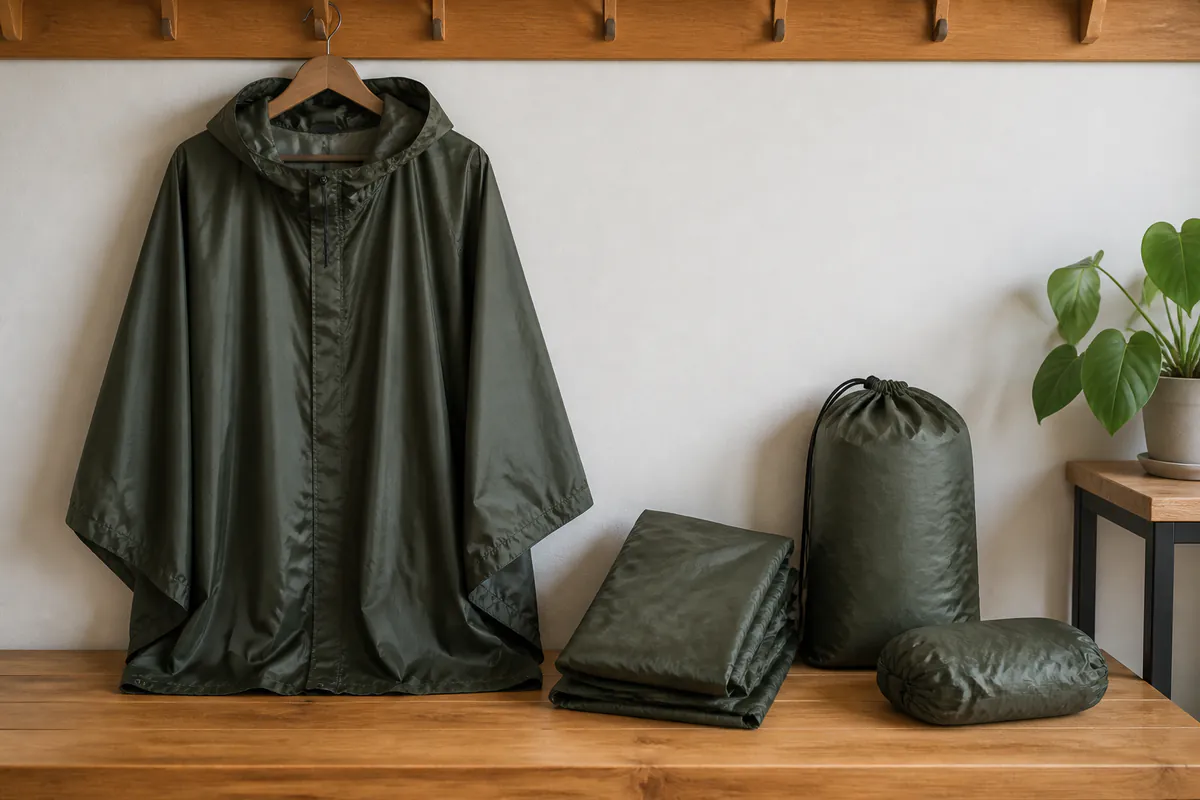
Folding route
Approve a fold that protects closures coating and decoration
Fold the final garment with its lining, cords, zipper and decoration. Check whether hard components press into the shell, coated faces block together or artwork contacts another surface. Record the fold sequence and pouch orientation when fast issue matters.
A sample made from a lighter unlined material cannot approve the packed volume of a lined or decorated production route.
Recovery route
Create a realistic drying and reissue routine
State whether used garments are hung, wiped, washed or removed from service. Separate wet items from dry reserve and avoid unverified heat or chemical instructions. The exact care recommendation should follow current evidence for the approved shell, lining and decoration.
Observe odor, sticking, color transfer and closure operation after the agreed recovery cycle, not only immediately after exposure.
Storage route
Challenge storage conditions that matter to the program
Consider carton pressure, temperature, humidity and time when products remain packed between seasons or in vehicles. Reopen representative units and inspect creasing, blocking, surface transfer and ease of deployment. Define the sample and condition instead of promising unlimited shelf stability.
Treat any packaging-material change as a possible interaction change. A new pouch or insert can affect transfer, ventilation and fold pressure.
Buying lesson 09 · Quote readiness
Compare Nylon Rainwear Suppliers by Assumptions, Evidence and Change Control
The cheapest quotation can hide a different architecture, shell, seam route or pack. A defensible comparison makes each supplier state what is included, excluded and still open.
Like-for-like object
Normalize the product object before comparing price
Create a one-page object definition: architecture, use condition, shell system, lining, seam and opening route, dimensions, components, artwork and pack. Ask each supplier to mark deviations. If one quote is for an unlined wind shell and another for a taped lined rain jacket, the price difference is not a sourcing victory.
Keep quantity and destination assumptions aligned. Size count, color count, artwork versions and carton allocation can affect setup and complexity.
Approval scope
Compare sample and evidence commitments as commercial work
Record which swatches, coupons, size samples, artwork proofs, tests, inspections and retained references are included. Ask who supplies documents and when open fields must close. Evidence work has timing and cost even when it is not a visible garment component.
Reject vague claims that every certificate is available. Match each requested document to the material, product, facility, market and validity period.
Change governance
Compare substitution notice and repeat-order continuity
Ask how material, component, process and packaging changes are communicated and approved. A supplier with a clear notification route may reduce reorder risk even if the initial price is not the lowest. Define quotation validity and events that trigger new pricing or sampling.
The final award should record technical assumptions, unresolved items and the approved route so later teams can understand why the supplier was selected.
B2B buyer FAQ
Nylon Rainwear Buying Questions Procurement Teams Ask
Is nylon itself waterproof?
Nylon is a fiber family. Water resistance depends on the textile construction, coating or laminate, finish, seams and finished-garment openings. Ask for the complete shell system and evidence for the exact specimen and claim.
Why can the inside feel wet even when rain does not enter through the fabric?
Wearer heat and moisture can condense inside a shell, and wet cuffs or layers can transfer water during movement. Diagnose location, activity, layers and timing before changing material or assuming a leak.
How should buyers compare a nylon poncho with a rain jacket?
Compare coverage, movement, wind behavior, size burden, openings, donning, carried equipment and packing. A poncho favors broad rapid coverage; a jacket offers controlled sleeves and access but adds more interfaces.
What should be checked during a sample rain challenge?
Define the sample, condition, layer set, spray direction, duration, movements and observation points. Trace the first moisture path and classify material, seam, opening, fit or user-operation causes before correcting the design.
Does reflective piping prove a nylon rain suit is road compliant?
No. Reflective appearance does not prove photometric performance, garment classification, wash durability or road approval. Request current product-specific evidence for any destination standard or regulated claim.
How should packable nylon rainwear be stored after use?
Follow verified care guidance for the exact shell, lining and decoration. Dry or separate wet garments before packing when the approved route requires it, and assess blocking, creasing, surface transfer and reopening after realistic storage.
Which records help a procurement team compare suppliers?
Use one controlled product definition, deviation list, sample and evidence scope, size and artwork records, packaging assumptions, quotation validity, substitution rules and repeat-order plan. This exposes what each price includes.