
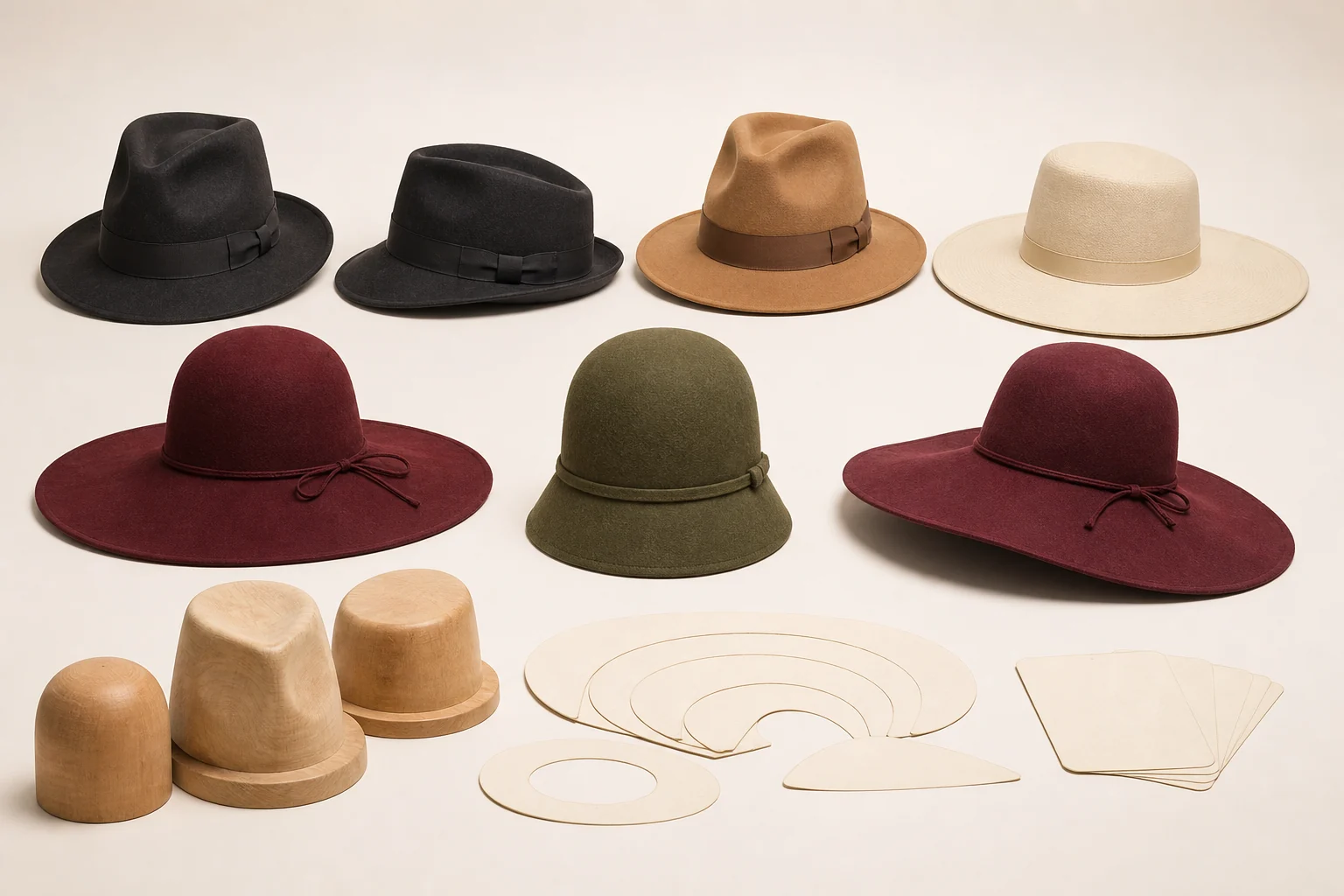
BUYING GUIDE / FEDORA CROWN, BRIM AND SHAPE-SETTING
How to Audit Fedora Crown, Brim and Shape-Setting Construction
Published by EverBen
A fashion reference does not define a production form. Buyers need complete views, a controlled crown block, measurable brim geometry, the exact material stack and a repeatable shape-setting and packing route.
This guide turns fedora, cloche and wide-brim style language into physical approval objects. It separates crown dents, brim set, material hand, trim and recovery so one attractive sample does not silently authorize a different bulk construction.
01 / style boundary
Define retail role, wearer and complete silhouette before selecting a block
A statement fedora, everyday felt hat, event piece, cloche and wide-brim fashion hat have different visual hierarchy and handling needs. Start with the intended product role and owned approval references rather than a copied mood-board image.
- 01Assign retail and wearer role
- 02Approve complete silhouette
- 03Define owned references
- 04Freeze the style boundary
01
Name the retail role
Record channel, occasion, wearer, seasonal timing, display method and handling expectations. This context guides form, trim and packing without becoming an unsupported durability claim.
02
Describe the whole silhouette
Use complete front, side, rear and top views to state crown-to-brim balance, visual scale and intentional asymmetry. A cropped image cannot control the complete edge line.
03
Set ownership boundaries
Translate inspiration into buyer-owned drawings, landmarks and physical samples. Exclude recognizable competitor decoration, undeclared substitutions and unverified claims from the factory instruction.
02 / crown block
Control crown height, taper, dent and pinch through one governing block
Teardrop, center-dent, telescope and soft crowns distribute volume differently. Identify the block and finished-form landmarks, then retain complete views that show how the material actually leaves that form.
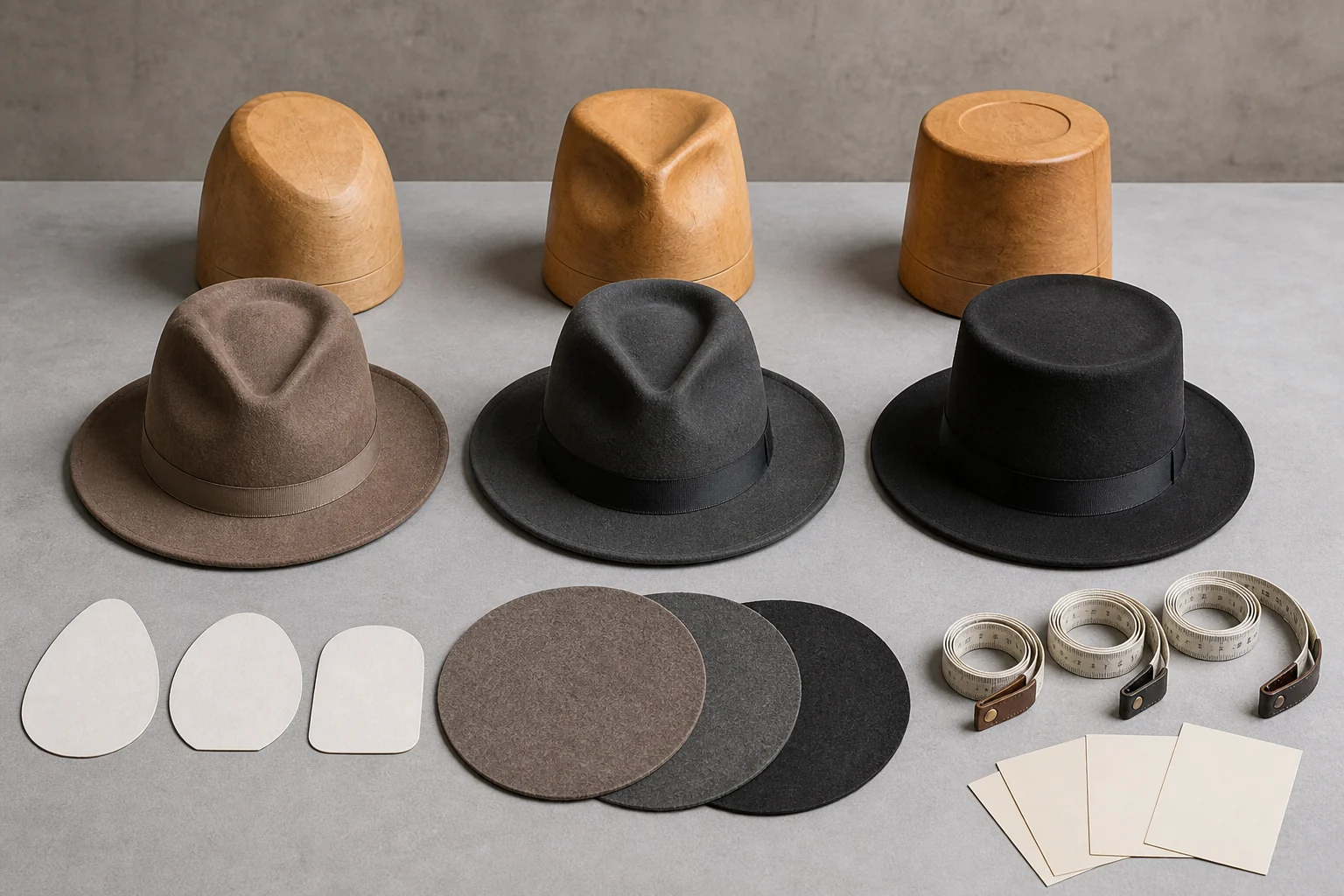
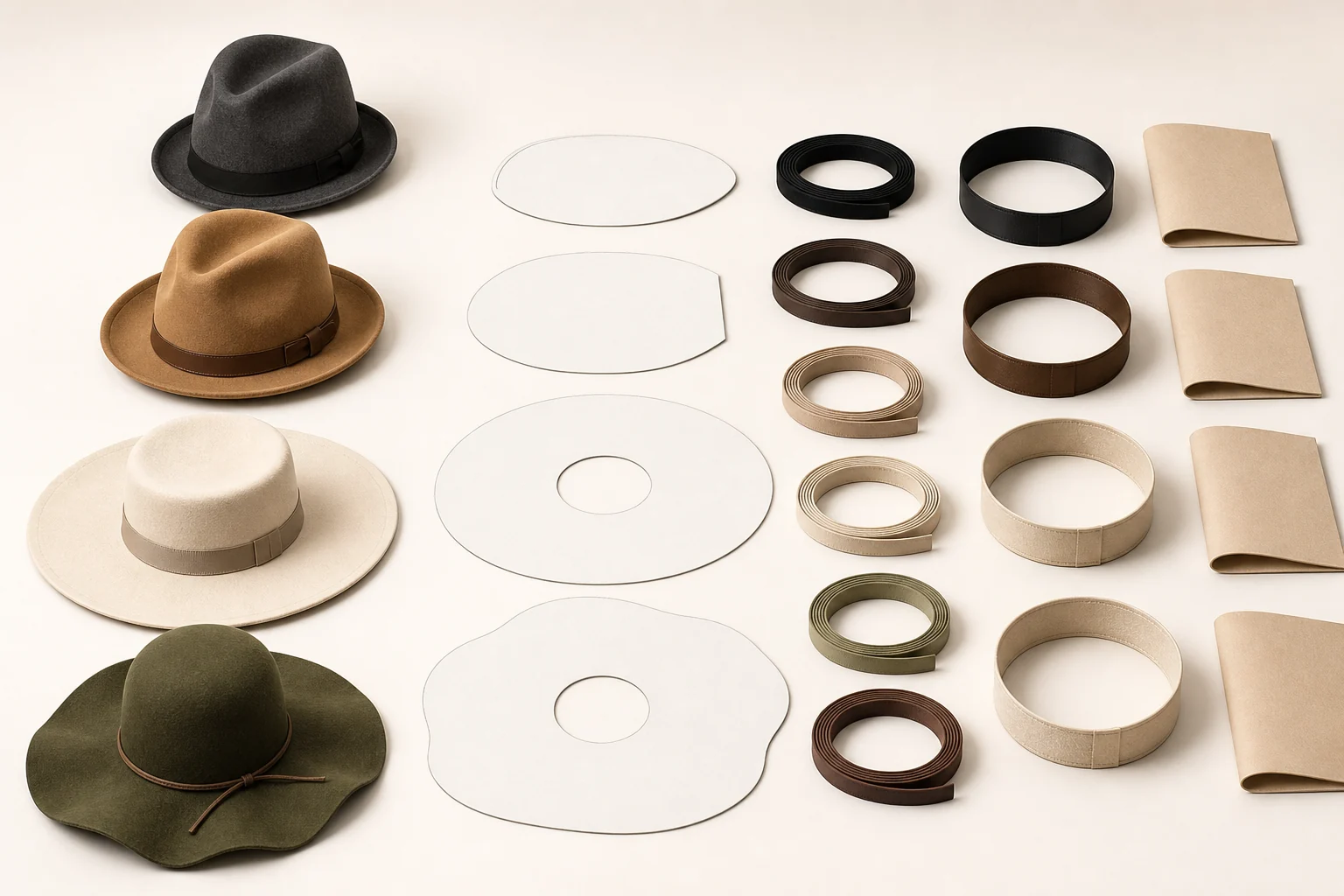
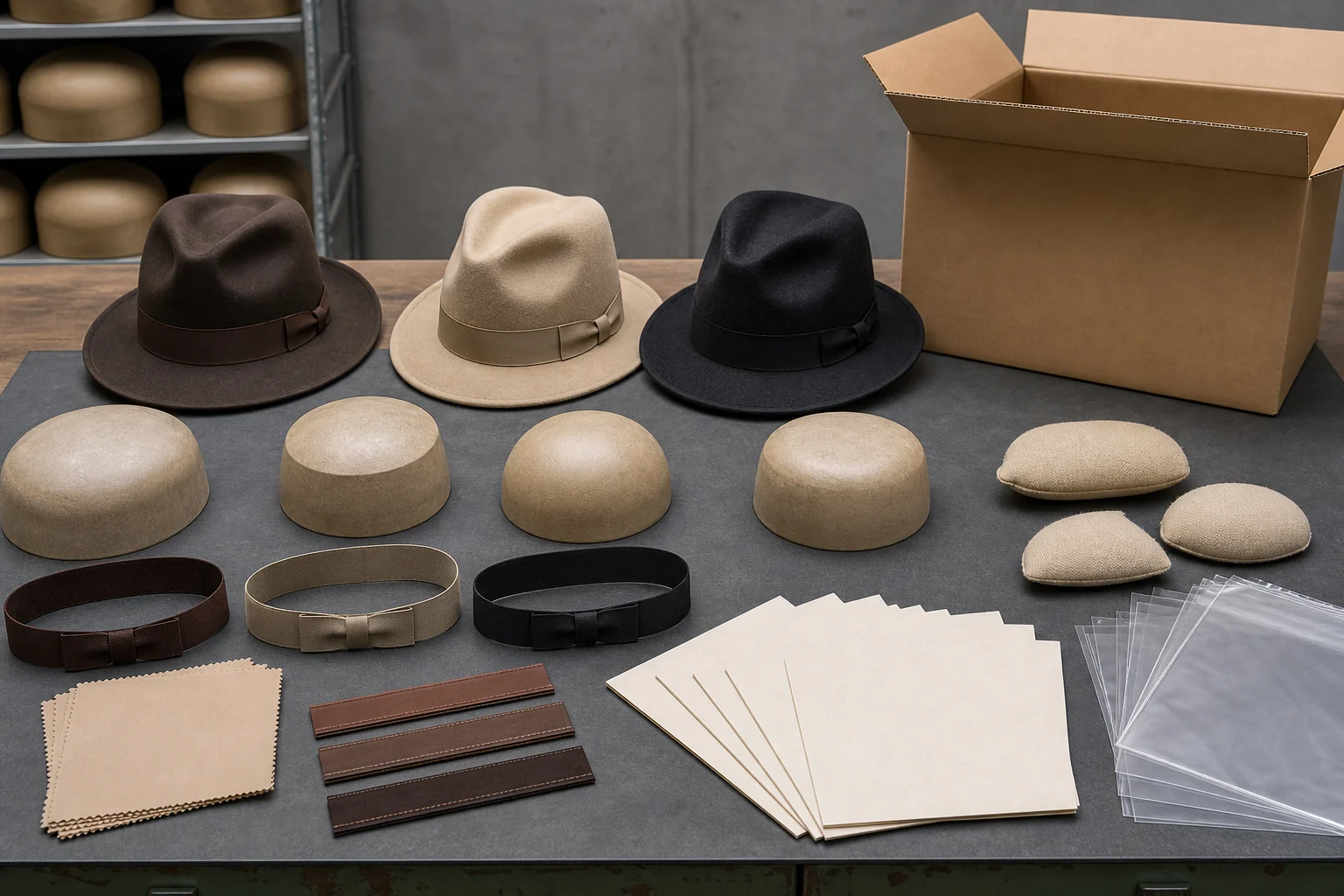
Work backward from the delivered crown and brim silhouette
Resolve the fashion phrase to channel, wearer, complete views, crown block, dent or pinch, brim template, material stack, fit, trim, packed reference and approval owner.
Keep block and finished-hat approval distinct
A block cannot prove how the selected material leaves the form, how the brim is set, how trim changes the crown or how the complete hat recovers after packing.
01
Identify the block
Assign a revision code to the physical or digital block, its size and orientation. Keep blank block views beside the authorized finished hat so the governing form is traceable.
02
Measure stable landmarks
Define crown height, front pinch, top dent, side taper and rear profile from named points. Record the hat condition and support because hand shaping changes readings.
03
Approve complete crown views
Compare front, both sides, rear and top without forcing the hat. Record lean, uneven dents, surface marking and intentional asymmetry as observable states rather than vague better-shape comments.
03 / brim geometry
Engineer brim outline, width, edge and set as one visible component
A brim can be narrow, wide, flat, snapped, rolled or softly waved, but those labels do not define production geometry. Approve the full outline and its relationship to the crown from multiple views.
- 01Freeze brim outline template
- 02Approve support and edge route
- 03Set complete crown-brim form
- 04Verify recovery after handling
01
Dimension the complete outline
Record front, side and rear projection from fixed crown-junction landmarks, plus intended oval, asymmetric or circular outline. Retain the full-size template where applicable.
02
Define edge construction
Identify raw, bound, welted, stitched or other edge routes with materials, width and join placement. The edge can change stiffness, wave and visual thickness.
03
Control delivered set
Specify up, down, snapped, flat or waved regions through complete side and front references. State the rest condition and whether repositioning is intended or excluded.
04 / material system
Approve face material, hidden support and hand on the finished form
Fiber or material names do not predict crown sharpness, brim fall or recovery. Record face construction, thickness or weight convention, support, finishing and color reference, then judge them on the complete hat.
| Decision row | Required relationship | Gap indicator |
|---|---|---|
| Face material | Construction, composition, lot, surface and color resolve to the approved hat | Material family name only |
| Hidden support | Stiffener, reinforcement, sweatband and lining are separately identified | Exterior view used as complete specification |
| Hand and form | Firmness, drape, nap and recovery are judged on the finished route | Loose swatch used as shape proof |
| Handling | Packing, dwell, opening and recovery condition are recorded | Hand-reshaped presentation only |
| Continuity | Material, support, process and tooling changes trigger review | Silent substitution or process change |
01
Declare the material route
Identify felt, woven, braided or other construction, composition, supplier reference, lot and surface direction where relevant. Keep physical standards with the approved form.
02
Separate support layers
Map internal support, stiffener, edge reinforcement, sweatband and lining as distinct components. Similar exterior materials can behave differently when hidden layers change.
03
Review hand and surface
Compare firmness, drape, nap or sheen, color and surface marks under agreed conditions. Screen images can guide discussion but cannot replace physical approval.
05 / forming process
Control blocking, moisture, heat, dwell and cooling as a shape-setting route
Shape is the result of material, tooling and process together. Record the real factory sequence and its control points without publishing unverified universal temperature, steam or dwell values.
- 01Prepare identified material
- 02Form on approved tooling
- 03Cool or dry in controlled state
- 04Release complete shape reference
01
Map the sequence
Document preparation, blocking, moisture or steam where used, pressing, dwell, cooling or drying, removal and finishing. Assign the responsible station and represented material route.
02
Define observable controls
Use block identity, surface condition, dimensions, dent position, brim set and recovery references. Mark proposed process values separately from buyer-approved outcomes.
03
Set change triggers
Reapprove affected lanes when equipment, block, material, support, stiffener, process order, condition or finishing changes. A similar appearance at one moment does not prove continuity.
06 / fit and trim
Verify internal fit, sweatband, hatband and ornament on the exact form
Internal opening and exterior trim can alter the finished silhouette. Approve fit and decoration after the crown and brim route is fixed, using named landmarks and complete views.
01
Measure the internal route
Define internal opening, crown depth, sweatband construction and size labels with the hat in a stated condition. Keep target wearer or fit-reference context in the record.
02
Scale and place the hatband
Record band width, overlap or bow, centreline, distance from brim junction and attachment. Check whether tension dents the crown or shifts during handling.
03
Review ornament attachment
Approve bows, badges, feathers or other trims on the exact material stack. Inspect reverse-side contact, pull distortion, marking and pack interference before bulk release.
07 / release evidence
Protect crown, brim and trim through packing, storage and recovery evidence
Formed hats can change under nesting pressure, edge contact, humidity or long storage. Treat the complete pack as part of product approval and keep immediate and timed recovery views.
| Entity | Required attributes | Decision value | Review state |
|---|---|---|---|
| Program | Channel, wearer, complete silhouette and claim boundary | Defines the represented fashion-hat route | Clear / open |
| Crown | Block revision, height, taper, dent, pinch and complete views | Defines the controlled upper form | Matched / unmatched |
| Brim | Outline, projection, edge, support, set and recovery | Defines the controlled lower form | Approved / conditional |
| Finished hat | Material, fit, trim, shape-setting, labels and pack | Bounds the delivered-product approval | Approved / conditional |
| Continuity | Tooling, material, process, revision and reapproval controls | Preserves the accepted relationship | Active / reapproval due |
01
Design physical support
Specify crown forms, brim rings, tissue, sleeves, nesting orientation and contact surfaces. Photograph exact placement before closing the representative carton.
02
Run the pack trial
Declare cap count, carton, orientation, dwell, storage condition and opening method. Capture the untouched hat immediately and after the named rest interval without hand reshaping.
03
Release production evidence
Link block, materials, dimensions, trim, lot inspection and packed reference to one SKU revision. A component pass cannot replace the complete-form decision.
08 / commercial continuity
Carry form, process and packing controls into RFQ and reorder
A useful quotation exposes technical alternatives and open decisions. Preserve the authorized block, material, shaping and pack route so a later hat with the same style label is not assumed equivalent.
- 01Issue controlled fashion-hat RFQ
- 02Review complete form and evidence
- 03Freeze one production revision
- 04Reapprove affected changes
01
Issue a form matrix
List retail role, block, crown landmarks, brim geometry, material stack, fit, trim, color, process, packing, quantity and destination. Require each field to be answered or marked open.
02
Price alternatives separately
Separate material, support, edge, trim, tooling, shaping and packing options. Evaluate savings together with sample and reapproval consequences.
03
Control every change
Require written notice for block, material, component, process, site or pack changes. Reorders stay on the approved route only while every governed relationship remains current.
Limits of fashion-hat style shorthand
Fedora, cloche and wide-brim names can organize style discussion, but they do not qualify an EverBen hat or publish universal material, steam, temperature or dwell settings. A purchasing conclusion depends on the exact wearer, crown block, dent or pinch, brim geometry, material stack, fit, trim, factory shaping route, finished sample, packing, destination, acceptance owner and buyer-approved wording.
Route-specific FAQ
Checks before fedora crown, brim and shape-setting approval
Does the word fedora define one crown and brim?
No. Fedora is a style family. Define crown height, block, dent or pinch, brim outline, width, edge, set, material, internal fit and trim on the exact approved hat.
What is a crown block approval?
Identify the physical or digital form, size, profile, landmarks and revision, then connect it to complete front, side, rear and top views of the finished hat.
How should brim width be measured?
Name the crown-to-brim junction and outer-edge landmarks, direction, hat condition and support. Record front, side and rear dimensions when the outline is not circular.
Is felt composition enough to predict shape retention?
No. Fiber and construction labels do not establish stiffness, thickness, support, finishing, moisture response or packed recovery. Approve the exact material and finished form.
What is shape setting?
It is the controlled relationship among blocking, moisture or steam where used, pressure, temperature, dwell, cooling or drying and finishing. Record the actual factory route without inventing universal settings.
Can trim be approved separately from the hat?
A trim sample can identify material and color, but scale, placement, attachment, crown marking and pack interaction require approval on the exact finished form.
Which changes reopen approval?
Block, material, support, stiffener, brim pattern, edge, shape-setting, sweatband, trim, attachment, pressing, packing or storage changes can reopen affected decisions.
What belongs in a fedora RFQ?
Include retail role, complete views, crown and brim geometry, material, support, fit, trim, color, shaping route, labels, packing, quantity, destination and release evidence.
Construction decision
Convert a fashion-hat reference into a controlled form and recovery brief
Send the retail role, complete silhouette views, crown-block route, dent or pinch, brim dimensions and set, material and support layers, internal fit, trim, shape-setting process, pack, quantity and destination. EverBen can organize these inputs into measurable samples and release records.