
Independent B2B material decision guide
How to Specify PVC Rainwear Thickness Without Guessing Its Softness or Cold Flexibility
Published by EverBen
Thickness is only one field in a PVC rainwear decision. Construction, plasticization, backing, finish, conditioning, deformation, joints, garment geometry and packing determine what the number can—and cannot—tell a procurement team.
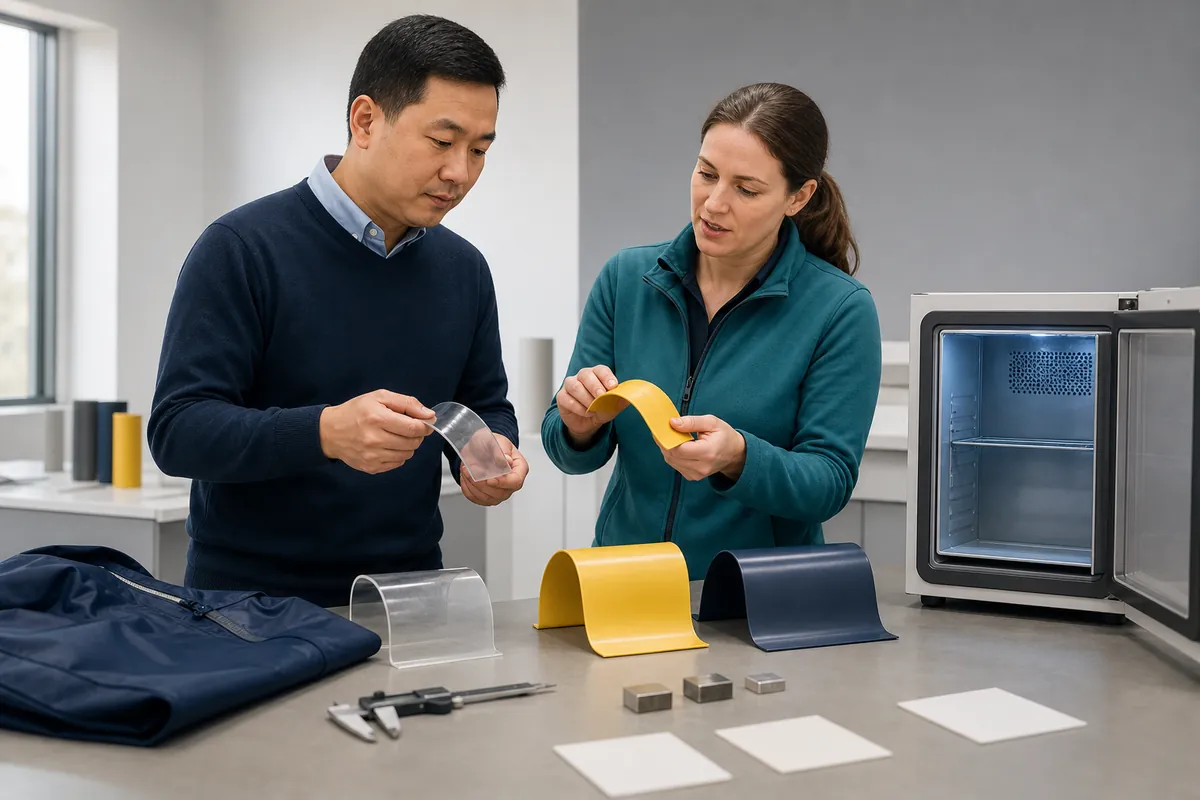
Step 1 — Identify the measured object
Why Thickness Alone Cannot Select PVC Rainwear
The question “What thickness is best?” sounds precise, yet it can compare film thickness, coating build, total composite mass or even finished garment weight. Before accepting a number, identify the construction and the business problem the number is expected to solve.
Separate film thickness from composite mass
An unsupported PVC film can be described by a dimensional thickness. A PVC-coated textile is a layered object whose total mass, support fabric, coating distribution and surface finish also matter. Grams per square meter and millimeters answer different questions, so a quotation must name the measured specimen and unit.
If one supplier quotes film thickness and another quotes finished fabric mass, the two lines are not comparable. Put construction family, measured object, nominal value, tolerance and sample identity in separate columns before judging price.
Choose the construction family before choosing the number
Transparent unsupported film, PVC-coated woven material and layered PVC composites transfer load differently. The support textile, coating arrangement and joint method influence drape, tear propagation, weld response and movement. A thickness that looks substantial in film may solve a different job than the same numerical dimension in a supported material.
Start with the wearer, exposure, movement, reuse and packing conditions. Then request a construction proposal and the fields needed to identify it. The number follows the product decision; it should not lead it.
Challenge the belief that heavier automatically means better
More material may improve one puncture or handling condition while increasing weight, stiffness, heat burden, fold pressure or difficulty at a joint. A heavier composite can also contain a different reinforcement or filler balance. The buyer needs the property and failure mode, not a ranking by mass.
Ask what the proposed increase is intended to change and how the supplier will demonstrate that change on the actual construction. A responsible alternative states the trade-off rather than promising that “heavy duty” improves every outcome.
Translate product use into comparison fields
Describe rain direction, duration, splash, wind, body posture, repeated movements, underlayers, tools, contact surfaces, cleaning, storage and service route. These details show whether the buyer should prioritize compact issue, supported durability, broad movement, cold handling or a particular garment interface.
Turn each priority into a review object: labeled material, joint coupon, construction prototype, conditioned comparison, packed sample or finished garment. That process gives thickness a proper role without allowing it to stand in for the whole product.
Send one material line or quotation. We will separate film dimension, composite mass, support and open decisions.
Step 2 — Understand the material system
How Flexible PVC Gets Its Hand and Movement Behavior
PVC resin is not the finished flexible rainwear material. Formulation, plasticization, support textile, coating, surface and processing work together. Buyers do not need a confidential chemical recipe, but they do need observable and traceable outcomes.
Treat PVC resin and flexible PVC as different entities
PVC can be formulated across a broad range from rigid to flexible. Flexible products use additives and processing choices that change chain mobility, hand and service behavior. Therefore “PVC” identifies a polymer family, not a guaranteed softness, cold limit or garment feel.
The supplier should identify a controlled material style or formulation reference without publishing proprietary recipe details. The buyer then approves observable fields and evidence for that specific style.
Understand why plasticizer type and level are not a simple dial
Technical sources explain that plasticizer type, concentration, compatibility and molecular structure can change efficiency and lower-temperature behavior. Adding more is not a universal solution because formulation also affects migration, surface contact, welding, aging, odor, regulatory obligations and other properties.
Do not prescribe a chemistry copied from a web article. State the destination and applicable substance requirements, then ask the material specialist to propose a compliant route and support it with project-relevant evidence.
Include backing, coating and finish in the flexibility discussion
A textile backing carries and redistributes load while the PVC layers create a barrier and surface. Yarn, weave or knit, coating penetration, layer balance, embossing and top finish can change bending and stress concentration. Two samples with similar mass can feel and flex differently.
Write the layer order from outside to inside, identify each face and specify which direction or orientation is tested. Approve the actual production color and finish because those choices can represent a controlled material change.
Expect color, contact and aging to affect observations
Pigment, surface treatment, heat history, UV exposure, cleaning, plasticizer migration and prolonged contact can change hand, blocking, color or cracking risk over time. A fresh room-temperature swatch cannot answer every service-life question.
Select the aging or contact conditions that matter to the real program and keep conclusions within that scope. Do not turn a short comparison into a lifetime, odor-free or non-migration guarantee.
Define the hand, movement, contact and market requirements. We will show which fields belong in the buyer brief and which remain under supplier formulation control.
Step 3 — Normalize supplier data
Read a PVC Material Line Without Mixing Units or Hiding Tolerances
A complete comparison line names the construction, specimen, direction, unit, nominal target, tolerance and evidence object. It prevents a neat table from concealing different materials behind similar marketing names.
Use millimeters or microns only with a named film specimen
When an unsupported film is measured dimensionally, record the unit, nominal thickness, tolerance, measurement method or agreed reference and lot identity. Clarify whether embossing or surface texture affects the reading and how samples are selected.
Avoid copying popular online thickness bands as universal product grades. The useful value is the one connected to the selected construction, garment geometry and buyer-approved comparison.
Use GSM only with the complete composite identity
Mass per unit area can describe a coated textile or layered composite, but it cannot reveal how mass is divided among support, PVC, filler and finish. Pair GSM with backing fiber and structure, coating arrangement, usable width, surface and material code.
If a quote provides only GSM, ask what changed when an alternative is lighter or heavier. A material can gain mass without gaining the property the buyer expects.
Name the support textile and every functional layer
Record the outside and inside faces, support fiber, woven or knitted route, coating or film layers, lining if present and any surface treatment. Make clear whether a published fiber percentage refers to the support or the total composite.
Use a bill-of-materials code and retained swatch. Photographs alone cannot reveal layer identity, and a swatch without a code cannot reliably control a later lot.
Write nominal values, tolerances and lot references separately
A nominal target is not an acceptance rule. Agree the tolerance, sampling or measurement approach and how results are rounded. Connect the approved sample to its material style, supplier lot and date so bulk and repeat comparisons use the same reference.
When the buyer does not yet have a justified tolerance, mark it open and request a supplier proposal. A fabricated number creates false precision rather than control.
| Quoted field | Correct object | Companion fields | Common comparison error |
|---|---|---|---|
| Thickness | Named unsupported film or defined layer | Unit, tolerance, texture and lot | Treating it as total composite identity |
| GSM | Complete coated-textile mass | Backing, layer arrangement and finish | Assuming more mass means more flexibility |
| Hand | Conditioned reference sample | Temperature, fold history and observation | Using “soft” without a comparison |
| Cold value | Named method and specimen | Edition, condition, deformation and scope | Calling it a garment service limit |
Paste the current material description into the secure form. We will mark mixed units, unnamed objects and missing tolerance fields.
Step 4 — Observe change before failure
Recognize What Cold Changes Before a Visible Crack Appears
The first useful cold-weather observation may be higher bending force, slower recovery or a new stress path—not a dramatic fracture. Procurement should define the conditioned action and record subtle change without diagnosing it beyond the evidence.
Observe bend force and recovery, not only breakage
A sample that drapes at room temperature can bridge a curve or resist unfolding after conditioning. That stiffness shift may transfer load into welds, snaps, reinforcement and garment openings before any visible damage appears.
Record how the sample is held, bent, released and allowed to recover. Compare equivalent specimens and avoid using hand feel from two different constructions as a numerical test.
Treat crease memory and whitening as observations
A pale line, surface change or retained crease can have several causes. Record face, location, fold radius, whether the mark changes after recovery and whether barrier or joint behavior also changes. Do not label every mark a crack or every unmarked specimen a pass.
Use agreed visual references and magnification if the project calls for it. Escalate the observation into an appropriate method or supplier investigation instead of inventing a mechanism.
Separate fast impact from slow bending
Polymers can respond differently when movement rate changes. A material may tolerate a slow broad bend yet react poorly to a rapid snap or impact, or pass an impact condition while remaining too stiff for practical donning. Bend, impact and bending force are distinct questions.
Choose the action that resembles the buyer’s use and state the limitation. If several actions matter, use several evidence objects rather than stretching one result.
Include moisture, storage and temperature cycling
Moisture trapped in folds can freeze, hold surfaces together or hide abrasive particles. Repeated transitions between warm and cold can combine stiffness changes with condensation and contact pressure. Storage beside uncontrolled heat can create a different problem.
Describe the full sequence: pack, store, condition, open, move, recover and inspect. This makes the comparison relevant to garments that travel through warehouses, vehicles and outdoor use.
Tell us whether the garment must fold, unfold, bend, move, take impact or remain static. We will map the observation and evidence sequence.
Step 5 — Scope the evidence method
Understand What Bend, Impact and Bending-Force Methods Really Prove
A named standard improves clarity only when the method, edition, specimen, conditioning and application are relevant. ISO and ASTM summaries explicitly limit how low-temperature bend data can be translated into service performance.
Read ISO 4675 as a defined coated-fabric bend question
The official ISO summary describes exposure at specified low temperatures followed by bending and examination. It also states that no general relationship between the test and service performance can be implied across different applications.
For procurement, that means the report must identify the submitted material and condition. The result is evidence for a defined bend specimen, not automatic proof of a complete raincoat at the same temperature.
Read ASTM D2136 as a prescribed deformation, not a universal limit
ASTM describes a pass/fail low-temperature bend procedure for coated fabrics and explains that prediction is relevant only when application deformation is similar. Its summary also warns that the result does not necessarily indicate the lowest temperature at which the material may be used.
Confirm the customer-requested edition and applicability. Never add the standard number to marketing copy before current project evidence and claim wording are reviewed.
Keep bend, impact and bending force as separate evidence objects
A bend method asks whether a conditioned specimen tolerates a prescribed deformation. An impact method adds a different rate and loading event. A bending-force method quantifies resistance to bending. The same material can tell a different story under each.
Select methods from the use map, not from the most impressive-looking report. Add finished-joint and garment movement evidence when those are critical.
Build a six-field method record
At minimum record method and edition, specimen identity and direction, conditioning time and temperature, deformation or fixture, observation or threshold, and the product or decision scope. Add laboratory, report and lot information when required by the buyer.
This record keeps a result from being detached from its specimen. It also shows when a design, material or supplier change requires retesting or comparison.
The evidence ladder for a responsible cold-flex decision
Material identity → conditioned method → garment-zone confirmation → packed reference
Each rung answers a different question. Material identity tells the team what was tested; the method defines the conditioned action; the garment-zone check shows whether geometry and joints introduce new risk; and the packed reference represents how the buyer actually receives and opens the product.
Send the requested standard, market and use condition. We will separate the material answer from the finished-garment decisions still open.
Step 6 — Move from swatch to garment
Explain Why a Material Result Is Not a Finished Raincoat Result
A flat specimen removes many features that create garment risk: direction, curved joints, multiple layers, openings, components, tension and wearer movement. The buyer must translate material evidence into named garment zones.
Check machine and cross directions where the construction requires it
Supported coated textiles can behave differently by direction because yarn structure and coating interact. Pattern orientation also changes which direction crosses a sleeve, knee, crotch or fold. Identify direction on specimens and pattern pieces.
Do not average unlike directions into one vague result. Use the orientation relevant to the actual panel and joint, then record how bulk cutting preserves it.
Connect weld or seam evidence to thickness and geometry
Research on welded PVC-coated textile structures shows that thickness, process, seam margin, temperature and failure mode interact. Those quantified results belong to the study specimen, not a ready-made raincoat recipe.
For the project, approve representative coupons and critical finished intersections using the actual material and production method. Curves, corners, component stacks and multiple layers deserve separate attention.
Challenge hood, closure, cuff, crotch and knee zones
These areas combine water paths, motion and changes in layer count. Cold stiffness can pull a hood, open a cuff, concentrate strain at a crotch or make a knee panel resist squatting even when the flat material shows no crack.
Mark the zones on the garment risk map and use repeatable movements with the intended size and underlayers. Record both function and visible change.
Use a wearer trial to connect hand feel with product function
Let a suitable adult fit model or form perform the relevant reach, squat, seated or donning sequence under declared conditions. Observe restriction, edge pressure, noise, overlap, closure operation and recovery after movement.
This is a comparison tool, not medical or safety certification. Keep wearer comments alongside measurable garment points and construction revision.
Identify the wearer movements and critical zones. We will connect material, joint and finished-product checks without overstating the test.
Step 7 — Compare without exposing recipes
Compare PVC Samples Without Demanding Confidential Formulation Details
Procurement can control identity, observable outcomes and evidence while the material supplier protects proprietary chemistry. The bridge is a labeled sample set and a repeatable comparison protocol.
Create a labeled construction sample set
Include unsupported film, coated textile or composite options only when they address the same use case. Label material code, layer identity, color, face, direction, lot, date and intended garment route. Keep rejected and provisional options visibly separated.
A drawer of anonymous swatches creates false confidence. The label is what lets the team connect the feel in hand to the quote, report and later bulk lot.
Compare room and conditioned references side by side
Retain an unconditioned reference and expose matched specimens using the agreed method. Compare bending, recovery, whitening, surface, joint and other relevant observations in a controlled sequence. Record when specimens return to room conditions.
Do not warm one sample by repeated handling before comparing it with another. Consistent handling protects the validity of a simple internal evaluation.
Use reference bends, folds and hand observations carefully
Broad-radius forms and defined fold geometry can make subjective hand discussions more consistent. Add a short descriptive scale only if the team defines each term and trains reviewers against physical references.
Hand observation cannot replace a required standard method. It helps the buyer compare appearance and usability questions that a pass/fail test may not capture.
Divide supplier-controlled and buyer-controlled fields
The supplier controls formulation, processing and internal traceability; the buyer controls intended use, destination, restricted-substance requirements, observable acceptance, sample approval and claim wording. Shared fields include material style, evidence and controlled change.
Write this division into the decision ledger. It prevents the buyer from specifying unqualified chemistry and prevents the supplier from replacing an approved outcome with “same PVC.”
We will structure labels, reference conditions, observations and approval status without asking suppliers to publish proprietary formulas.
Step 8 — Protect the packed surface
Control How Packing Changes Softness, Contact and Surface Appearance
A PVC garment can remain folded under pressure for weeks before the buyer opens it. That packed condition can reveal blocking, transfer, crease, odor or component contact that a hanging sample never experiences.
Approve fold radius and pressure-sensitive zones
Map fold lines across welds, prints, clear panels, reflective details, stiff closures and reinforced intersections. Avoid unnecessarily sharp or repeated creases and define how the garment is placed in the bag and carton.
Use a packed-sample review after an agreed condition. A fold should protect product presentation without creating a new stress concentration or interfering with warehouse allocation.
Treat blocking, color transfer and odor as conditional observations
Surface sticking, color movement and enclosed-pack odor depend on material, color, print, interleaf, pressure, time and temperature. Record the exact contact stack and condition before drawing a conclusion.
Do not publish “non-blocking” or “odor-free” from one fresh sample. Approve the pack combination and state the limits of the observation.
Open a conditioned pack using a repeatable sequence
Record pack date, condition, stacking, opening time and recovery period. Inspect both contacting faces, folds, artwork, clear areas, components and any transferred mark. Note whether change recovers and whether function is affected.
Photograph representative findings with the sample identity visible but keep confidential buyer marks out of public evidence. Link disposition to the packing revision.
Write storage and opening guidance for the real channel
Event kits, vehicle emergency packs, retail cartons and industrial stores have different storage periods and temperatures. Provide handling and care guidance consistent with the approved material and pack; do not invent instructions after complaints.
Where cold storage matters, explain whether gradual temperature equalization or broad-radius unfolding is required by the approved process. Keep guidance within project evidence.
Send the fold, bag, carton and storage plan. We will identify contact pairs and a packed-sample approval sequence.
Step 9 — Keep the approved identity
Control Bulk and Repeat Orders With Material, Joint and Pack Records
Repeatability comes from linked records, not from a phrase such as “same as last order.” Material style, lot, joint, garment, artwork and packing must point to one approved revision and a controlled response when something changes.
Keep material style, lot and direction traceable
Record the approved supplier style, construction, color, lot and relevant direction at incoming inspection. Compare bulk inputs with retained references and project fields before cutting. Quarantine unclear material rather than solving identity after garments are assembled.
Traceability should reach the finished lot without exposing confidential supplier recipes. A stable code and receiving record are more useful than a public chemical claim.
Link joint and finished-garment evidence to the same revision
Coupon records, prototype comments, measurement charts and finished garment checks should identify the material and construction revision they represent. If a joint process changes, reopen the affected evidence rather than leaving the old report attached.
This linkage prevents a valid test on one specimen from being reused after the product object has changed.
Freeze the packed reference and release record
Retain an approved garment and pack—or a controlled equivalent record—with artwork, fold, interleaf, bag, carton and allocation. The release file should state lot, sample basis, exceptions and authority.
When a complaint appears, the team can compare the received unit with the same evidence object used for production release.
Use change control before calling a reorder identical
Review source and component availability, formulation/style code, finish, color, artwork, pack, evidence validity and destination rules. Compare any proposed alternative against the original use and risk map, then record approval or rejection.
Classify the order honestly as a true repeat, controlled alternative or new version. This protects both the buyer and the supplier from an unsupported “same” promise.
We will connect material, joint, sealed garment, pack and release records into a repeat-order identity map.
Step 10 — Send a quote-ready decision brief
Build the PVC Rainwear Thickness and Cold-Flex RFQ
The final brief should identify the use, construction and open decisions without pretending that one thickness or test proves the complete product.
Describe environment and action before requesting a temperature
State exposure temperature or storage sequence, conditioning time, folding, bending, impact, movement, contact and recovery that matter to the real user. Add garment route, wearing layers and critical zones.
If the project has no justified number, describe the operating problem and ask for a proposed method rather than copying a competitor specification.
List construction, units, tolerance and reference objects
Name unsupported film, PVC-coated textile or composite; identify backing and faces; and separate thickness from total mass. Add color or clarity, surface, nominal values, tolerances and required labeled references.
Allow supplier alternatives only when each one is described with the same fields and its trade-offs are visible.
Connect methods to joints, garment checks and packing
Record requested standard and edition, specimen direction, conditioning and result scope. Add coupons, critical intersections, wearer movement, packed contact and bulk-lot checks that the material result cannot answer.
Assign an acceptance owner to every checkpoint and define the reapproval path for any material, process or component revision.
Submit commercial inputs without hiding technical unknowns
Provide company, contact, product, estimated quantity, destination, size/color split, artwork, sample status, evidence needs and requested date. Mark uncertain fields as open and assign an owner.
MOQ and timing are confirmed after material route, customization, evidence, sample revisions and lot splits are known.
Is thicker PVC rainwear always more durable?
No. Thickness is one variable. Construction family, backing, formulation, joint design, garment geometry, contact exposure, temperature, movement and packing can change the result. Define the failure risk and compare the actual construction instead of ranking samples only by thickness.
Does a low-temperature bend pass equal the raincoat service temperature?
No. Official ISO and ASTM summaries limit the relationship between a prescribed specimen test and service performance. The method, edition, specimen, conditioning and deformation must be recorded, then relevant joints and finished-garment zones need their own review.
What is the difference between film thickness and GSM?
Film thickness is a dimensional measurement of a named film or layer. GSM is mass per unit area, often for a complete coated textile or composite. They are not interchangeable and should be accompanied by construction, backing, tolerance and lot identity.
Can a buyer specify softness without knowing the PVC formula?
Yes. The supplier can keep proprietary formulation details while the buyer defines use, destination rules, conditioned sample identity, comparison method, hand or bend observations, packed contact and evidence scope. Both parties share change-control responsibility.
Which garment areas need cold-flex attention?
The answer depends on use, but common risk zones include hood and neck transitions, front closures, cuffs, pocket corners, crotch, seat, knees, hems, welded curves, reinforcements and component patches. Map them to wearer movement and water-entry paths.
What should be sent with a PVC rainwear RFQ?
Send wearer and use, exposure and temperature sequence, construction family, thickness or mass fields, size and garment route, joint and component plan, branding, quantity, destination, required methods, sample stages, packing and requested date. Mark undecided fields openly.
The secure page form routes rainwear questions server-side to the dedicated rainwear inbox without opening a desktop email program.
Send the supplier line, use condition, construction, garment route and evidence question.